
An Interview With ‘The Ballad Of Little Jo’ Director Maggie Greenwald
by Rachel Bellwoar
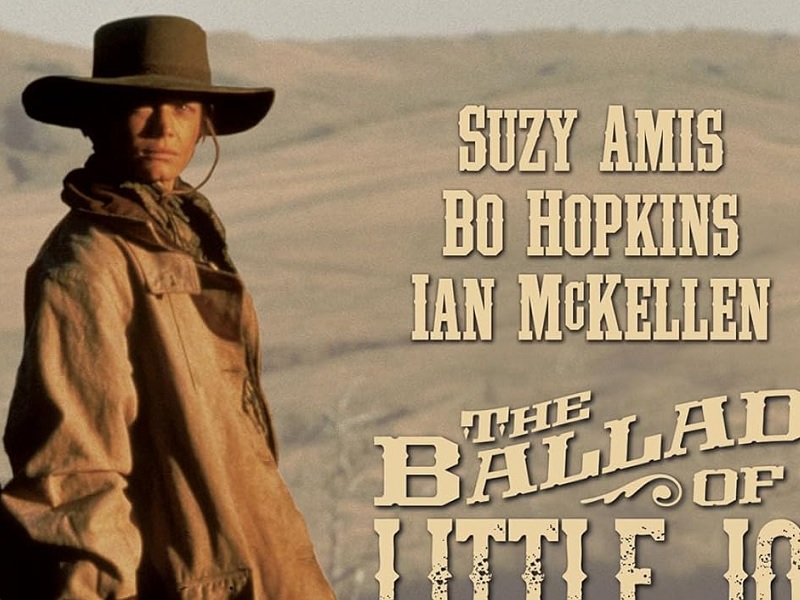
Forced to leave her child with her sister and try to fend for herself, Josephine Monaghan (Suzy Amis) didn’t initially plan on dressing like a man (which in the 19th century meant wearing pants and cutting your hair short). It’s a choice she makes after her early experiences on the road show how unsafe it can be for a woman traveling alone. Loosely inspired by the story of “Little Joe” Monahan, The Ballad of Little Jo was Maggie Greenwald‘s third feature film as both director and screenwriter. Recently released on Blu-ray for the first time by Kino Lorber, find out what it was like casting the film and working on the screenplay in this interview with Greenwald below:

Rachel Bellwoar: Last year marked the 30th anniversary of The Ballad of Little Jo‘s premiere. Had you approached Kino Lorber about doing a new 4K scan or did they approach you?
Maggie Greenwald: Kino Lorber was releasing my friend Beth B’s films and she suggested I contact them about restoring and re-releasing The Ballad of Little Jo. So, I did and luckily, they responded immediately that they were interested.
Bellwoar: Before this Blu-ray release had you ever recorded a commentary for one of your films before, and what was that experience like?
Greenwald: I recorded a commentary on the DVD of my film Songcatcher, along with composer David Mansfield.
Bellwoar: Looking back at the film today, is there anything you’d do differently, or is that a dangerous route to go down?
Greenwald: While I’m making a film I love it totally. Then with some distance, I begin to see what I would do differently. I learn so much with each film I make that it’s inevitable that I will see flaws and things I’d like to change.
Bellwoar: After having your first two films be set in New Jersey, what was it like filming in Montana for The Ballad of Little Jo?
Greenwald: Filming in Montana was glorious. It’s one of the most beautiful places I’ve ever been.
Bellwoar: How did you first hear about the real “Little Joe” Monahan and was there much information available?
Greenwald: I was looking for a new film to make. I wanted to make a Western. I stumbled upon a newspaper article about “Little Jo Monaghan,” a poor ranch hand who lived and died somewhere out West. Upon their death, it was discovered that Jo was a woman and among their remains were a few letters from their sister that indicated she’d had a son out of wedlock many years before. I felt this was the premise I had been searching for. I wanted to create a legend – you know, like Jesse James or Wyatt Earp, but about a woman. The film is NOT a biopic. I made up the entire story!
Bellwoar: Growing up were you a fan of Westerns and what are some of your favorites today?
Greenwald: My father was a huge fan of Westerns and I grew up watching them with him. I’ve always loved them. My favorites today are the same favorites that formed my love of Westerns and cinema – The Wild Bunch, Once Upon a Time in the West, McCabe and Mrs. Miller. I used to love The Searchers, but the racism is pretty tough to take, now. She Wore A Yellow Ribbon…
Bellwoar: An early betrayal gears viewers for the kind of Western The Ballad of Little Jo is going to be. Were there any films that helped inspire the film’s harsher tone?
Greenwald: My films often tell stories that are “harsh” or dark. That seems to be the side of life I’m compelled to explore with my work.
Bellwoar: Did you always plan on including time jumps to cover Little Jo’s entire life?
Greenwald: The film was conceived as a ballad — with an episodic structure, like the verses of a ballad. So yes, it was always intended to cover her entire life. I knew I wanted to end with the before, debutante photo beside the after, ranch hand, death photo. The story I was interested in telling was the story of why a woman would choose or need to disguise herself as a man, then why she would choose to continue to live as a man for the rest of her life.
Bellwoar: Late into the film Jo meets Tien Ma (David Chung) and they become close. Did that storyline help inform how you approached writing and directing Sophie and the Rising Sun (which is also a period piece about an interracial romance)?
Greenwald: Sophie and the Rising Sun is based on a novel that was brought to me to adapt and direct by Executive Producer Nancy Dickenson. When I read the book, I felt the story contained a convergence of many characters from my other films, in new incarnations, in this small Southern town. I hope Sophie stands as its own film, though it contains issues I’m always interested in – sexism, racism… the tragedy of hate.
Bellwoar: Going into the casting process, did you have any particular actors in mind for any of the roles or did it really come down to auditions?
Greenwald: Actually, I didn’t have any particular actors in mind. The audition process was an amazing. So many actors responded to the script and brought so much to the characters. As a NY Independent filmmaker, using stage and character actors was something I love to do. Also casting beloved actors from other Westerns, like Bo Hopkins who’d been in The Wild Bunch and Rene Auberjonois from McCabe and Mrs. Miller. Many actresses came in dressed in Western gear, but Suzy Amis walked in wearing a big bow in her waist length hair, capri pants and sexy mules, but behind all that, I could see her androgyny and that she was physically powerful. I knew she was my Jo.
Bellwoar: From neo-noir (The Kill-Off) to children’s television (The Mystery Files of Shelby Woo), your career encompasses so many different genres and audiences. Have you always wanted to keep trying your hand at new things?
Greenwald: Aside from writing and directing my own films, I love directing television because allows me to work as a craftsman in many genres and develop my skill. I was hired to direct some children’s television after directing The Ballad of Little Jo because, at the time, that was almost the only TV shooting in NY, where I lived. And because I’m a woman. But i’m really grateful. I loved doing those shows. Back in those days, the cops shows shooting in NY didn’t hire women.
Bellwoar: If you could oversee a restoration of another one of your films, which one would you choose?
Greenwald: I would love to have The Kill-Off restored and re-released. I’ve approached the company that currently owns it and I’m hoping they will. Kino Lorber was initially interested but the rights are not available.
Bellwoar: Are there any projects you’re working on now that you’d like to plug? I saw you were attending a screening of Little Jo soon in Philadelphia.
Greenwald: Before the pandemic I was directing episodic television. Recently I’ve been writing a screenplay for another director, which has been another great experience and opportunity to grow. I’m in the exploratory stages of looking for my own next project.
Bellwoar: Thanks for agreeing to this interview, Maggie, and best of luck on those pursuits!
The Ballad of Little Jo is available on Blu-ray now from Kino Lorber. Any readers in the Philadelphia-area can see Greenwald and editor Keith Reamer give a post-screening Q&A for The Ballad of Little Jo on March 6th at the Lightbox Film Center.

