
High-Octane Redneck Massacre — Lonnie Nadler And Matthew Erman Discuss ‘Golgotha Motor Mountain’
by Brendan M. Allen
I recently had the opportunity to sit down (virtually) with Lonnie Nadler and Matthew Erman, co-writers of IDW Publishing’s upcoming Southern Gothic Golgotha Motor Mountain. Here’s how that went.

Brendan Allen: As an obvious starting point, please tell us about Golgotha Motor Mountain. What’s this story about?
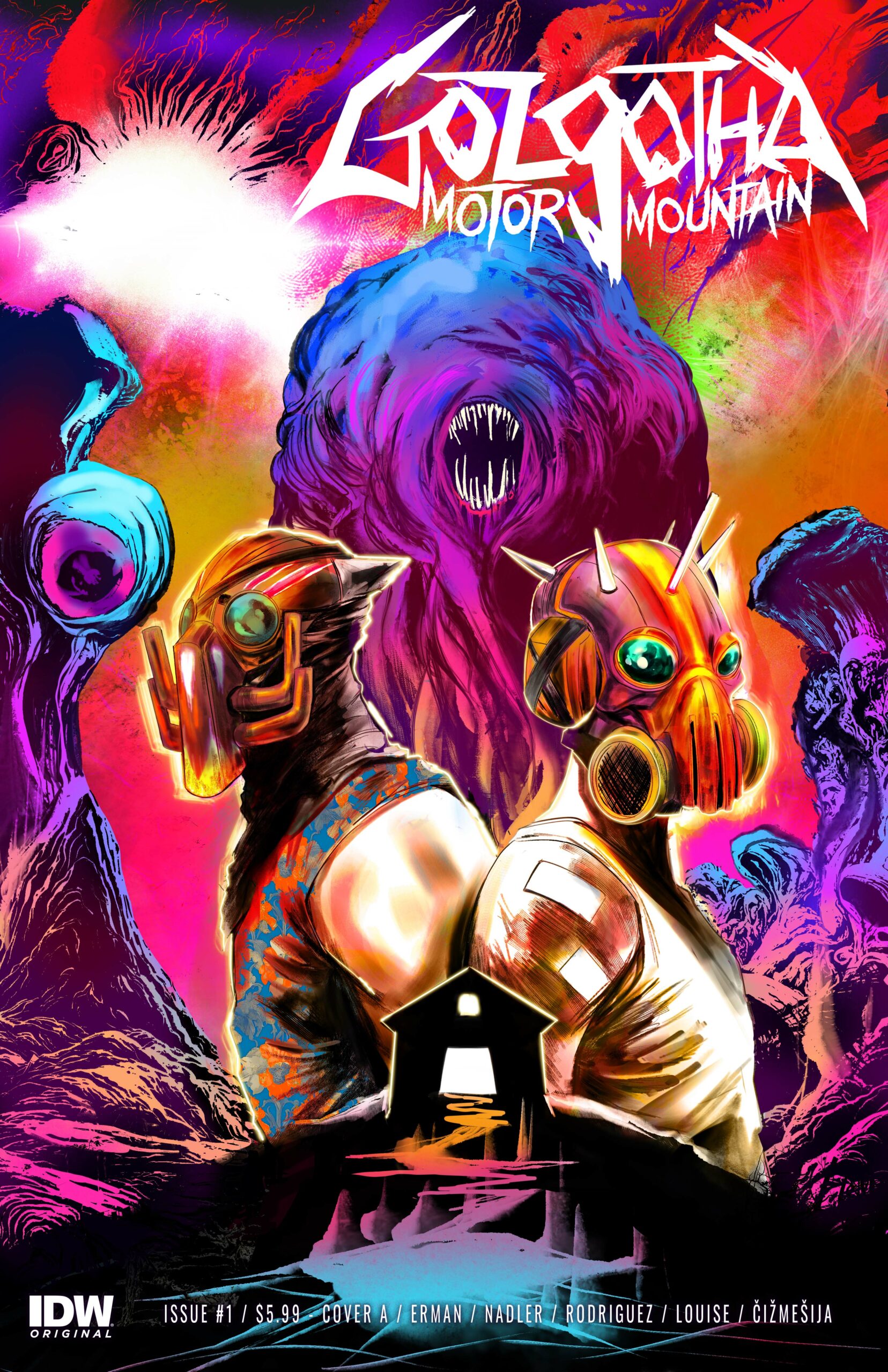
Lonnie Nadler: It’s about two brothers who have been living a pitiful excuse for a life for far too long. When the cosmos intervenes by sending a huge meteorite down on their meth lab barn, they take the wrong message and make the dumbest decision possible. The result is a Southern Gothic road trip infused with body horror and action as they try to make their way from the top to the bottom of the titular mountain before all hell breaks loose.
Matthew Erman: It’s about a place called Golgotha, Kentucky — specifically two meth cook brothers who live there and the events that transpire after a meteor ruins their latest batch and they hatch a plan to disguise the meteor as their product and sell it in hopes of leaving Golgotha. It’s a story about two brothers trying to find a better life, in spite of the one they have.

Allen: Let’s talk a little about the title. I know that ‘Golgotha’ roughly translates from Hebrew to the ‘place of the skull,’ and Motor Mountain sounds like some backwoods demolition derby. What’s the significance of the name?
Erman: The title of the comic came to me in a daydream or a moment where multiple pieces of art synchronized into a single thought or frame or idea. Golgotha Motor Mountain is the three word puzzle that spawned the guts of the story.
It was the first thing I had when I asked Lonnie to come on board to write whatever this comic would be with me – you know I love collaboration and working with people so when magic things present themselves and weird thoughts and moments align, Golgotha Motor Mountain happens.
Nadler: I honestly don’t really know where the title came from or why we chose it, which isn’t a very good or intelligent answer. I think Matthew just typed it into the document one day, we liked the way it sounded, and that’s what stuck.
It’s almost like a band name more than anything, where it’s the feeling that matters more than the explicit meaning. Of course, it has since taken on meaning in the way Robbi has depicted the meteor, in the themes of the book which have revealed themselves to us, and I’m sure that meaning is different for both Matthew and myself. I could explain it, but I think part of the magic of a title like this is that we allow readers to bring their own interpretation, to decide what it means to them, to take part in the story.

Allen: The Damnage brothers have an interesting and relatable relationship. There’s an obvious big sibling/younger sibling dynamic, and they clearly don’t make very good life choices. Where did the inspiration for these knuckleheads come from?
Nadler: I think it comes from a few places. Firstly, both Matthew and myself have brothers. I’m the younger brother in my family, while Matthew is the older brother in his. My brother and I are so different in many ways, yet so similar in others. We used to do all kinds of stupid, fun things growing up, and the book is, in part, an exploration of what happens when two brothers maintain the same relationship and same dynamic and never grow out of who they were as kids.
They are chained to their past, and, for better or worse, it takes a horrific cosmic event to force them to change, to force them to confront their inner selves, and in turn, to confront one another. Additionally, they are inspired by the fact that we have an affinity for non-traditional protagonists. We wanted to make a book about two people who would normally be seen in the background of a movie or something. Those people on the fringes of society, people who are not 100% likable, and people who are stuck in their own worlds.
Erman: I pull inspiration from many places. I have a younger brother, so writing that dynamic is fun and easy for me and then having Lonnie on top of that makes the whole scripting and ideation part of this comic somewhat meta and fun — we get to play the parts of the brothers in real time as we create the story. As far as making good life choices, who does?

Allen: Golgotha Motor Mountain dips into a few different genres. The solicit calls it a ‘high-octane redneck motor massacre.’ There are loads of Southern Gothic themes, a few body horror tropes, ‘big brother mentor’ thrown in, dark comedy, a little bit of a Breaking Bad vibe, a possible nod to Creepshow… In what camp do you place GMM, and what do you think the other tropes and genres you lean into add to the story?
Nadler: At its core, Golgotha is a Southern Gothic story above all else. When Matthew and I first started talking about the concept, it was an attempt to push the Southern Gothic genre to a really wild place. Historically, the genre is quite serious and grounded, though light supernatural elements leak in here and there, which is more about Southern piety and superstition than it is horror. We thought it would be interesting to push up those supernatural elements to the absolute max, and to bring in a bit of sci fi, a bit of cosmic horror, and a lot of body horror.
It was an experiment more than anything, a test of our skills. Is it possible to mix together the likes of William Faulkner and David Cronenberg? Can we mix the stream of consciousness narration technique and the notion of the grotesque from Southern Gothic with the existential visceral visuals and headiness of body horror? Can those two seemingly disparate modes of storytelling be brought together in something cohesive and true without any sense of irony. I think at the very least we’ve made a book that is unlike anything else, and there’s value in that alone.
I assume the nod to Creepshow you’re talking about is The Lonesome Death of Jordy Verrill, which is actually a complete ripoff of Lovecraft’s The Color Out Of Space (in the best possible way). I’m a big Lovecraft fan, and so I’d say Golgotha is more inspired by the latter, but even then, it was not entirely intentional. The idea of a meteor crashing into Earth and completely messing up the environment isn’t exactly novel, but hopefully our execution of it is.
Erman: Yeah I don’t know — I think we can get into the weeds in trying to identify every aspect of this story that may be anachronistic or slightly off-kilter. To me, you know, we have to market this I suppose, so throwing as many words at the wall in trying to convince people it’s a book they’ll like is maybe a weird strategy.
Anyway yeah this comes up a lot, like what we borrow or whoever borrows to create what they make and I’m starting to feel it diminishes the magic of creativity. Part of the joy of reading a thing or experiencing a thing is finding those moments that remind you of other things, it’s a fun puzzle and sometimes I wonder if I’m spoiling those moments. Anyway, to me, when I really think about the biggest visual and writing inspiration on this I’d say for me it is Shinya Tsukamoto who did Tetsuo: The Iron Man.

Allen: What can you tell us about creative process in the writing stages? Generally, the more people involved in a thing, the more opportunity for communication to break down. What does the division of labor look like?
Nadler: There’s never really been communication breakdown, to be honest. It’s no different from communicating between writer and artist. The job of a writer is, really, to communicate, be that with the artist, with the editor, with the audience, or with a co-writer. Of course we come to the book with our own unique ways of telling stories and our own ideas of where we want to go, but the fact that Matthew and I are such different storytellers is part of why the book feels like it does. It’s controlled chaos.
The book literally could not exist as it does if only one of us had written it. There’s something appealing about the creative process in that sense. Of course, there are moments where we disagree, but that’s not a bad thing. It means we both care, and then we have a discussion like adults, and we try to come to a compromise that makes all parties happy. I’ve co-written many books at this point in my life and I have one simple rule: as long as both parties fully understand that all we are trying to do is tell the best story possible, everything should work out.
That means creating a safe space for feedback, for iteration, for editing, etc. You cannot be precious or demanding or egotistical. You simply have to make your case for why you care strongly one way or another about a certain element, and what wins out isn’t whoever swung their dick the longest, it’s the idea that is best for the book.
Erman: Lonnie and I can transform into one single human mech when cornered or threatened.

Allen: Robbie Rodriguez and Marissa Louise nail this thing to the wall with the art. I’m a big fan of showing instead of telling, and there are a few places where you let the artistic team take the storytelling reins. How did this team come together, and why do you think this art style works so well for your script?
Nadler: This was always the goal. We wanted a book that was both dense with narration, but also that let the art run wild. Very often when books have a lot of text, it is seen as “crowding” the art. I think that can happen, but I don’t think it always has to be the case. You can have both. It’s about knowing when to do which. It’s about providing an experience.
When you’ve got people as talented as Robbi and Marissa, you know they don’t need words to explain what’s going on, so you can have them let loose, which gives us freedom to use narration for other nonsense. Balance. It’s all about balance, even within the indulgence.
Erman: I loved that we kind of assembled something bizarre with the team that mirrors how bizarre the interior narrative ended up being. It feels that way at least that all the decisions were made with the right intention to do something unique — and I don’t know I really think we made something unique that maybe arrived before the zeitgeist was ready for it to exist.

Allen: Rounding out the team, you’ve got Hassan Otsmane-Elhaou on lettering duties. Letterers are often the unsung heroes in comics. What’s it like working with one of the best in the business?
Nadler: I’ve been working with Hassan for most of my career now. He’s pretty much the only letterer I work with on creator owned books and there’s a reason for that. Lettering for Hass is not simply a trade, it’s an art, an integral part of the book. This is a belief I share so it makes it a hell of a lot easier to collaborate when you’re both on the same page to begin with. Hass adds so much character to every book he touches, and Golgotha is no exception.
Erman: I feel very lucky and I’m happy to He’s like a wizard. One day you have a comic without letters and the next you have a comic with perfect letters. He’s also such a nice guy over emails that you just want to eat dinner with him or buy him a present.
Golgotha Motor Mountain #1 hits the spinner racks on March 6, 2024.