
Film Review — ‘Dune: Part Two’ Overwhelms And Impresses In The Best Ways Possible
by Erik Amaya

Dune: Part Two is an overwhelming experience — but don’t let that word scare you. It is an awesome experience, especially on a big IMAX screen, and a credit to the filmmakers that they could make such a powerful, impressive film about something genuinely scary: the beginning of a holy war.
The film wastes no time in getting viewers up to speed; it assumes you have access to the 2021 Dune. Instead, it sets the mood by introducing Princess Irulan Corrino (Florence Pugh), daughter of the Padisha Emperor Shaddam IV (Christopher Walken). Trained by the Bene Gesserit sisterhood, she is a scholar and writer. Her commentary, a big feature in the original Dune novel by Frank Herbert, introduces one element of fallout from the events of the first film. The other great houses are unaware of the Emperor’s involvement in the Harkonnen raid on House Atreides and the knowledge of what really transpired could cost him and his house the throne.
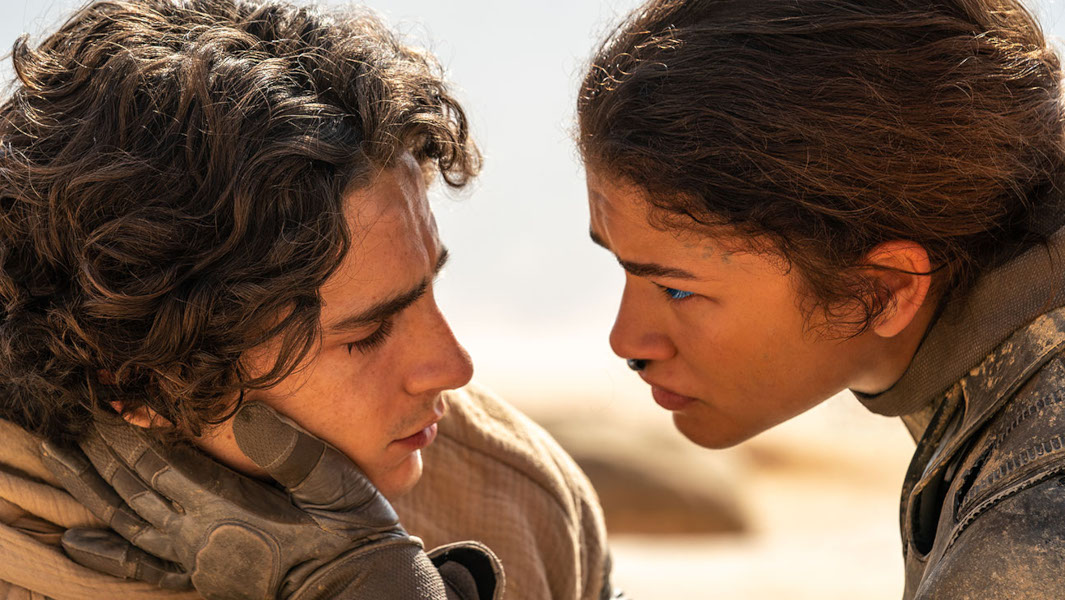
With that we return to Arrakis, also know as Dune, where Paul Atreides (Timothée Chalamet) begins his proper training in the ways of the Fremen and as one of their warriors, the Fedaykin. Almost immediately, though, conflicts emerge as some among the Fremen see him as the Lisan Al-Ghaib, a messiah promised by Bene Gesserit alterations to the local religions. Others, including Chani (Zendaya), see him as a foreigner who represents the aristocracy that has stolen their land. That tension is key as it represents the most substantial addition to the story by co-writer and director Denis Villeneuve.
In our review of the first film, we mentioned the adaptation was, largely, an act of subtraction. The contributions of characters like Thufir Hawat (Stephen McKinley Henderson) and Dr. Wellington Yueh (Chang Chen) were de-emphasized in favor of establishing Paul and his mother, Jessica (Rebecca Ferguson) and their places in the narrative.
This time, Villeneuve and co-writer Jon Spaihts allow more of their own interpretation of Herbert’s text to shine through and create a startling experience for those more fresh to the story and seasoned veterans of the Imperium, the books to come, and the expanded universe devised by Herbert’s son, Brian Hebrert. It’s fair to say both director and writer were anxious to get some of the deconstruction of the hero Herbert orchestrates in the second book, Dune Messiah, as just about every character but Jessica and Stilgar (Javier Bardem) question Paul’s role in everything and the increasing religious fervor surrounding him. Those who have read Dune Messiah will recognize this, but to see those questions raised in what is still, ostensibly, the action-adventure part of Herbert’s narrative cycle is surprising.
Leading that questioning is Chani, who is both repulsed by what Paul represents yet cannot help but fall in love with him. Zendaya delivers an amazing performance as some who cares for a man riddled in the white savior complex. She delivers tremendous stink-eye, even after they openly engage in a relationship, and never fails to be a tremendous presence in the story.
In fact, Part Two is very much a story of women even as the men appear to be the movers and shakers. The additions to Irulan’s story, essentially taking some of the epigraphs attributed to her in the novel and dramatizing them, gives her an agency she lacks in the original text. She’s highly perceptive and approaches openly questioning the designs of her order. Jessica, meanwhile, also feels a more active participant even as much of her work is accomplished off-screen as she transforms into a Bene Gesserit Reverend Mother of the Fremen tradition. It pays off on a lot of what Herbert implies in the book, but made manifest thanks to some great scenes and the nimbleness of Ferguson as a performer.
Even Jessica’s unborn daughter, Alia (voiced and played in one scene by a surprise guest), becomes an active participant in the fate of the universe thanks a substance known as the Water of Life and a clever twist on the story that pushes her birth to either the third film or a space of time in between. Frankly, we hope it’s the latter as the person Paul sees as Alia’s true form is the perfect choice in casting. She resembles someone touched by uncontrollable, spiritual forces and a member of the secret heritage Jessica and Paul learn about after they drink the Water of Life.
But we’ll leave that secret for you to discover.
Other genuinely strong women in the film include Léa Seydoux as a Bene Gesserit with a mission of her own to accomplish and Souheila Yacoub as Shishakli, a friend of Chani’s who never stops being a delight even as her belief in Paul changes.
And though the film favors Herbert’s women, the men still deliver strong performances with Chalamet upping his game substantially from the first film, Dave Bautista offering additional volume and texture to Rabban, and Bardem producing Part Two‘s handful of laughs. Austin Butler also delivers a startling performance as Na-Baron Feyd-Rautha Harkonnen, favored nephew of the Baron (Stellan Skarsgård). Presented more as a dark mirror of Paul than he is in the book, the take on the character is as agreeably unsettling as Villeneuve’s vision of the Harkonnen homeworld, Giedi Prime.
In terms of vision, Villeneuve is a master of science fiction. At no point does he allow the potential hokeyness of things to slow him down. Vistas often evoke mad, drug-fueled sci-fi art from the 1970s. Ship design makes a conscious effort not to look aerodynamic and, therefore, dreamlike and strange. Giant machinery genuinely has scale whether realized practically or as a computer-generated visual effect. For all the things he does as a member of the writing team, his greatest contribution to Dune is giving it a profoundly confident visual language with the scope, depth, and breadth readers have been finding in Herbert’s prose for generations. At no point, even in the most intimate scene, does the world feel small.
But the most extreme example of his confidence as a filmmaker is the way he shoots the climax. The tone is … surprising for what is positioned as an important action blockbuster from a major media corporation. It will not evoke the sensation audiences experienced in the final fight of Avengers: Endgame, but it is an appropriate way to frame what Paul and the Fremen do and set out to do in the near future.
Also, note how this review never once refers to Paul as “Muad’Dib.” Although he does receive that name — and his secret name among the Fremen — he never really stops being Paul. Perhaps that takeaway is the intent going into an eventual Part Three.
It all adds up, though, to a film experience that is overwhelming in the all the right ways. Dune: Part Two is a feast for the eyes, a thrill ride for the intellectual parts of the human mind, and the headiest sort of blockbuster any corporation will put out in the next few years. It openly questions its own assumptions about its themes. It addresses many of the faults critics have with Herbert’s text. It features some absolutely astonishing action while still offering a lot to think about when walking out of the theater. It even goes out of its way to explain why Bardem’s accent is different from the other Fremen. In short: it’s the exact sort of big budget moviemaking we need right now.
Dune: Part Two is in theaters now.
