
An Interview With ‘When The Lake Burns’ Creator Geneviève Bigué
by Rachel Bellwoar
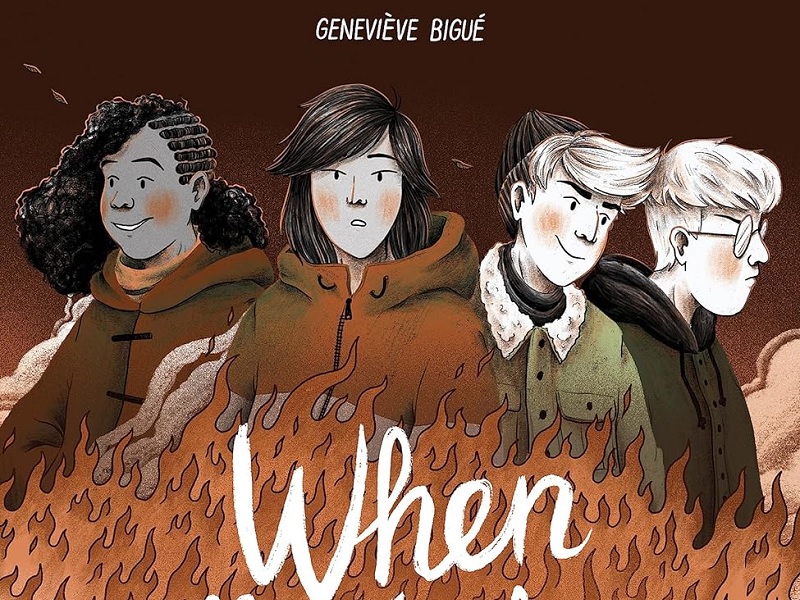
Usually water is used to put out fires. In Geneviève Bigué‘s graphic novel, When the Lake Burns, it’s water that’s on fire and Len and his friends want to see the flames for themselves. Will the lake bring them the answers they seek? Find out what Bigué had to say about their quest in the following interview:

Rachel Bellwoar: In When the Lake Burns, Len and his friends are trying to figure out the truth behind a local legend. Were you inspired by any real local legends?
Geneviève Bigué: Not by a legend, but it was inspired by a dream I had a few years ago. Back then, I had the habit of writing my dreams in a little notebook, and I remember dreaming of this strange landscape, with a lake on fire. It was inspiring. I knew I had to remember it, in case I would like to create something with it, which became this book.
Bellwoar: Despite the fact that they’re heading towards a raging fire, there’s no sense of imminent danger to their efforts. Was that key to capturing a teenage perspective?
Bigué: Teenage years are a time where you test the limits of everything. There’s a lot of things you don’t know and need to learn, and most of the time the heart speaks louder than the head. So I think for them, the promise of a legend, of gold, and possibly fame is way more important than the danger of a burning lake.
Bellwoar: Len and Theo are positioned as the risk takers of the group. What made you want to define their relationship better within their larger friend circle?
Bigué: I think it’s a pretty common dynamic in a lot of group of friends. I remember in High School, I had a circle just like that, with very close friends, but also friends that you were kind of friends with, only because another friend was friend with. To define the relationship between Len and Theo was only natural to progress in the story, to make the stakes higher, but also to make the characters more real, more complex.
Bellwoar: Is Corbeau River based on an actual place and, if not, why did you decide to name it “corbeau” (which is the French word for “crow”)?
Bigué: While Corbeau River is fictional, it’s actually based on many places. When I was still looking for visual inspiration for the book, I toured the few villages around my hometown in Abitibi-Témiscamingue and took many pictures as reference. A lot of the buildings and landscapes are directly inspired from those villages. As for the French name, it’s a nod to the name in its original version: Rivière-aux-Corbeaux.
Bellwoar: Adults in these kinds of stories can sometimes be portrayed as absent, oblivious, or unapproachable. How did you want the adults to come across in this story?
Bigué: To keep adults around in the story helped me plan how the group would go to the lake without their parents noticing, because they knew they wouldn’t be able to go otherwise. I think it’s a very teen thing to do, to sneak out to go somewhere your parents would immediately disagree with. But I think it’s important for them to be there after as well, to help them coping with the consequences of their actions.While a burning lake is fantasy, the rest of the story is really anchored on real life, so it felt important to keep the adults in the story to flesh out even more the main characters and their relationships to them.
Bellwoar: Overall the colors throughout the book are on the subdued side. Did you always want to make the kids’ coats a focal point?
Bigué: I always knew I wanted this story to take place during Fall, so when I began my research for a colour palette, I went with the ones that reminded me of this season. I also tend to work with a very limited palette, which sometimes can be hard to make elements pop out from the rest, so I worked every page to make sure that the colours I chose for my characters never blended with anything else. So yes, it was always intended that the coats remained a focal point.
Bellwoar: To me the time spent on the group walking is essential and speaks to the experience of being a kid and needing to walk to get anywhere. Was there ever any question of eliminating some of those panels or skipping ahead?
Bigué: No, this part of the story pretty much stayed the same since the beginning. It was important for me to have time for the readers to get to know the characters and their relationships. It also helps with the pacing of the story, as the kids are not aware yet of the danger that lies ahead of them. Actually, I cut a lot of the story after the scene at the lake. It helped to keep the urgency of the situation, as the pacing was a lot faster than I first planned it.
Bellwoar: It also felt very real to see what the kids prepared for (oven mitts) versus what they didn’t (getting home in time). How did you decide what each group member would pack for the trip?
Bigué: It was mostly their faith in the veracity of the legend, as well as their personality. Theo wants to prove at all cost that the legend is true, so he stuffed his backpack full of objects to throw into the fire. His priority is on proving the legend, so getting back in time is secondary. Len wants to impress Theo and the group by bringing something unexpected. Elena secretly wish the legend is true, but she is also practical, hence the marshmallows. As for Simon, he said the legend isn’t true and claims he didn’t bring anything, yet he brought a backpack. So… Who knows?
Bellwoar: Thanks for agreeing to this interview, Geneviève!
When the Lake Burns goes on sale June 11th from Conundrum Press.

