
The Math Isn’t Mathing — Reviewing ‘Strange Academy: The Deadly Field Trip’
by Scott Redmond
Overview
Tossing the Strange Academy kids into the wide Marvel Universe has some mixed results, even as they cross paths with some popular heroes in Strange Academy: The Deadly Field Trip. Fun and engaging visuals aren’t enough to prop up a story that feels like a classroom lecture at times.
Overall
7.5/10While their ongoing series might have ended, educational moments for the students of the Strange Academy are far from over.

A trip into the Marvel Universe proper goes predictably wrong in Strange Academy: The Deadly Field Trip, which collects four cameo filled one-shots featuring the magical youths. Chief to the collection is Strange Academy: Miles Morales #1, Strange Academy: Moon Knight #1, and Strange Academy: Amazing Spider-Man #1 from Carlos Hernandez, Juann Cabal, Álvaro López, Julian Shaw, Vasco Georgiev, Edgar Delgado, and Clayton Cowles.
Additionally, it sees the addition of the 2021 issue Strange Academy Presents: The Death Of Doctor Strange #1 from Skottie Young, Mike Del Mundo, Marco D’Alfonso, and Cowles.
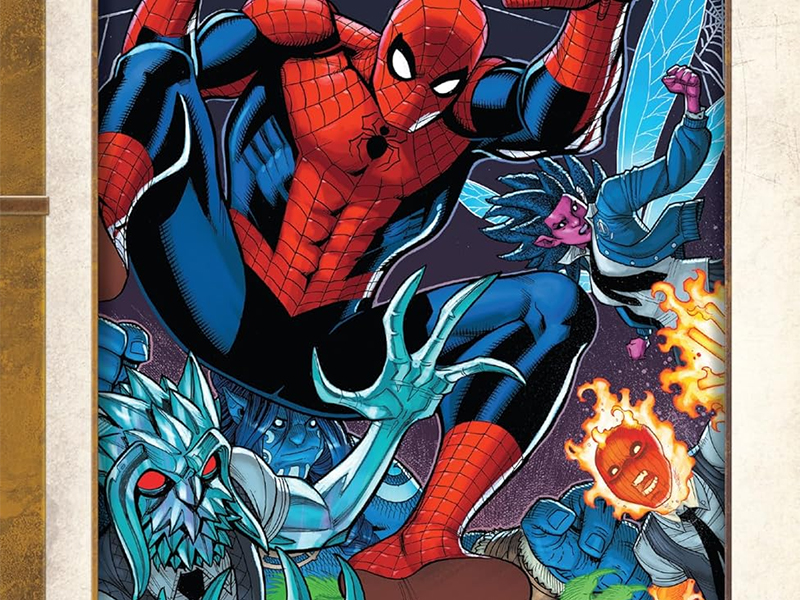
As the titles should make clear, the trio of issues at the heart of the collection feature the two Spider-Men and Moon Knight crossing the orbit of the kids. Essentially, it’s a story about magical math and its abuse.

Now that the main story from co-creator Young has ended, it was inevitable that these characters would end up in the hands of others. This is the nature of creating anything in a work for hire situation, especially one like Marvel. Change is not a bad thing on the surface. Sometimes though it’s also not a truly good thing.
Putting the kids with Miles Morales, one of the most popular young Marvel characters, is a solid choice. Execution just felt a bit off to me, as there was something of the spark missing both with the Academy kids and Miles. Any time characters change hands and move beyond their creators can be a jarring process. I would say I definitely felt jarred.
There is a ton of talking going on. The characters are just spewing exposition and the overall story felt like it was lacking a hook. Hernandez is a novelist, which potentially points to why this story didn’t entirely fit the realm of what comics normally do. Changing from prose to a more visual medium isn’t always an easy transition. We get a lot of telling rather than showing in many cases, even the usually less than-talkative Gus was dropping lots of words on us.

Cowles works to make sure it doesn’t overwhelm the pages and has some of the usual pops of fun and creative energy. Tossing in various colors, bubble shapes, and more to retain some of what the series had previously.
Look, I get what Hernandez is trying here. The idea of math and magic being a powerful combination is an intriguing hook. The problem is that it just feels so heavy-handed and preachy in some ways. This new villain Equation is very much the “I’m a villain because my ideas would make things so great, but I’m doing it in a terrible way” mold. Of course, we know he’s a villain because he’s willing to sacrifice children, cackling as he does so, in order to enact his dastardly plan.
Visually things are a bit firmer.
Humberto Ramos and Delgado set the standard for the whole 24-issue run of the ongoing series, and replacing the rough but detailed whimsical fun art of Ramos is tough. But Cabal of course is one of the top artists at Marvel these days and there are reasons for that. It’s not whimsical but it’s detailed and deep and moves at such a smooth pace. It fits to bring the characters into the wider Marvel Universe, and it looks great.

I’m not as familiar with López’s work but it has some of the same qualities. It’s not as smooth, a bit rougher in some cases but that works as it fits some of what we’re used to with the characters. Most of the stuff flows well and the paneling from both is pretty solid. There are a few pages where some of the characters are off, Shaylee suddenly looks like she is a hard-living 30-something, but it’s just those few spots.
Shaw’s work has a more general superhero aesthetic which fits the focus of this series. Plenty of detail and depth along with a smoothness bring life to the math-centric storyline. Some good paneling choices bring more kinetic energy to the proceedings, even the quieter moments.
Georgiev is someone that I have been following, and in love with their artwork, since coming across a series of Marvel/DC mashup covers on Twitter a few years ago. A dynamic, slick, very action-oriented type of style. Rife with emotional energy, giving life to everything on the page from the characters to the setting spaces. The minis and one-shots have been great, but they need to get Georgiev on a regular series quickly.

Delgado continues to do a fabulous job at matching the colors to the shifting art styles. Things aren’t quite as vibrant and magical as they were in the previous book, but the setting and the content don’t fit that as much. Still, plenty of shadows and darkness are mixed into the overall, adding depth, as he has done in the past. It’s very grounded in many ways, even with these fantastical elements, since they are mostly hanging out in regular old classrooms/auditoriums most of the time.
As I said, there are tons of words, and Cowles gets it all out there in the best way for the page. Even with giant bouts of exposition scattered around, he makes sure it flows and fits the page in a way that doesn’t visually overwhelm. So many words are overwhelming and a bit much, but they are carefully laid out as possible. I don’t personally feel the personality of each character as much here, as Hernandez is clearly trying to figure them out, but Cowles does bring the energy and tone.

The secondary story in the issue ties back to the 2021 event The Death Of Doctor Strange, where the titular Doctor was murdered. Naturally the school named after him that he helped run would be affected greatly by this loss.
Young uses this tie-in issue not to delve into what Strange’s loss is doing to the universe, other books are handling that, but instead frames it as a way to see the effects on the students of this academy. Specifically, the first story deals with fleshing out the backstory of the Asgardian brothers Alvi and Iric, the sons of the Enchantress.
Having Enchantress promise her children to a wizard (because she never expected to have any) who was then defeated by Strange be one of the threats arising out of Strange’s death was a great choice. One because it’s so in character for Enchantress, but also because it shows that Strange’s demise isn’t just about huge stakes but also smaller more personal things the man helped deal with over the years.

With the story taking place in Weirdworld, it made the most sense for Del Mundo, the one that brought it to life in its 2015 incarnation, to draw the issue. There is just something magical about Del Mundo’s artwork, which fits since this is a realm of magic in a book about magic. There is a ton of detail and great facial/body language emotional range within the work but at the same time it’s not afraid to let things slip into the more unrealistic/fantastical realm from slightly off proportions to various elements taking on a different life.
This is also reflected in the colors from Del Mundo and Marco D’Alfonso, which run through all the various levels of the color spectrum while adding an almost watercolor-like sensation to everything.
Another great element of this book is that the back portion was used as a way for Young to show off what the other students are up to as they return home for a short period of time following Strange’s death. To do this, a whole slew of great artists was tapped to come to play with the characters for a page. This included Nico Henrichon, Peach Momoko, Humberto Ramos, Alessandro Cappuccio, Gustavo Duarte, C.F. Villa, David Baldeon, Luciano Vecchio, and Natacha Bustos with Delgado providing colors for many of the pages and Cowles still on the lettering.

Strange Academy: The Deadly Field Trip is now available from Marvel Comics.

