
Talking Tubi’s ‘Big Mood’ With Director Rebecca Asher
by Rachel Bellwoar
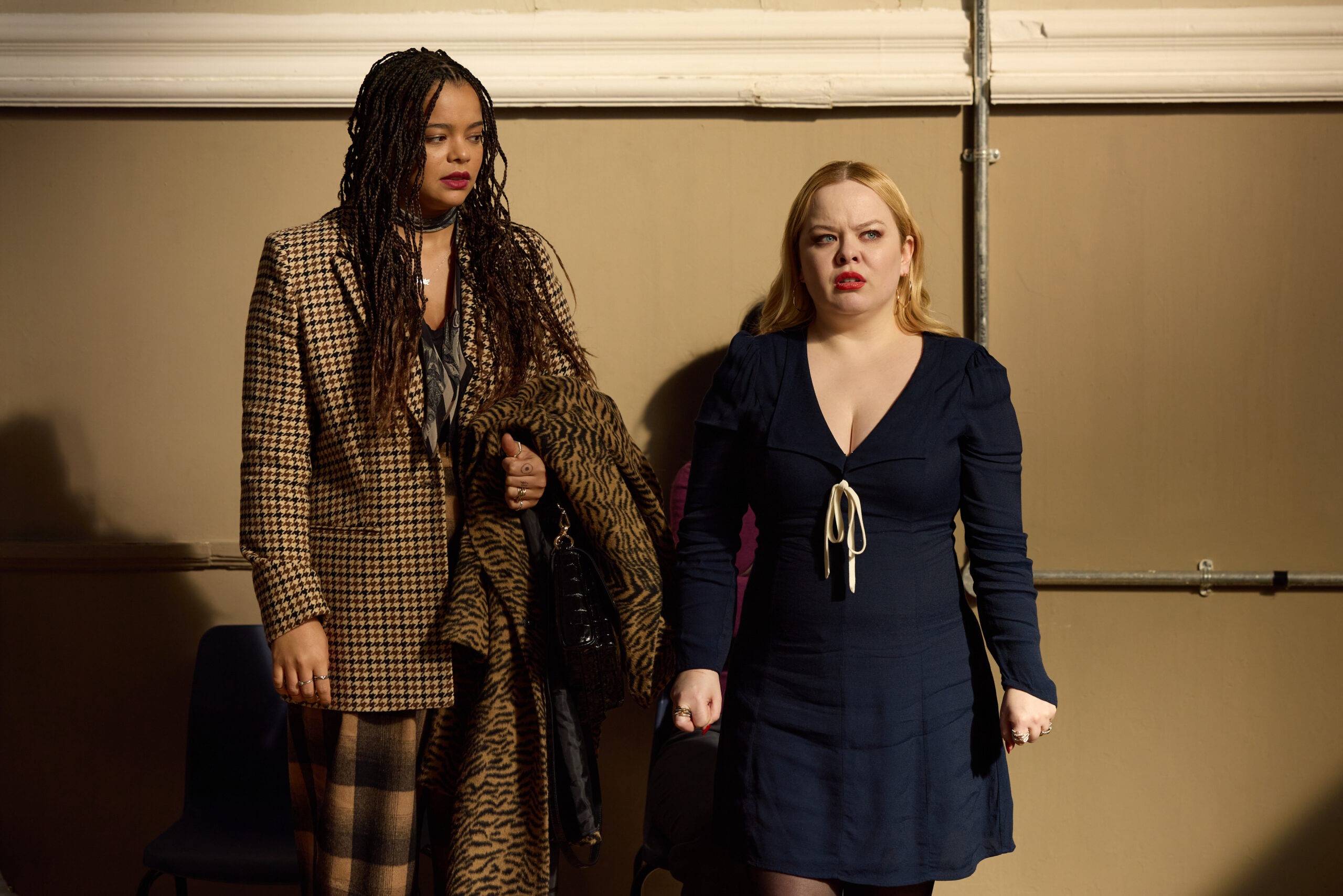
Dead Like Me. Raising Hope. The Good Place. These are just some of the shows Rebecca Asher has directed episodes for over the course of her career. Now her latest show, Big Mood, is coming to Tubi and you can find out more about it in the following interview:
Rachel Bellwoar: While you’ve directed your fair share of one-hour dramas as well, what do you think it is that keeps pulling you back to comedy and the half hour format specifically?
Rebecca Asher: I love the mystery of comedy. I love the fact that it’s much harder to explain why something is funny than why something is sad or terrifying. Comedy feels like a magic trick sometimes and trying to help all the elements come together to make something as funny as it can be, in the correct tone for the show, makes for a fun challenge. What’s the camera angle? What’s the cutting pattern or the timing? How much will a pause help or hinder a joke? There are many tiny details that go into it, and that’s fun. There is also the basic reality that when you’re working on a comedy you spend most of your day laughing. Who doesn’t want to do that?
Bellwoar: How did you first hear of Big Mood and what made you want to get involved?
Asher: I first heard of Big Mood in an email from my agents in October of 2022. The first episode and the deck were attached to it. From the moment I read episode one, I was in.
Camilla [Whitehill] is a brilliant writer, and I found her script(s) to be the perfect combination of hilarious and true. For me, comedy is most satisfying when it’s rooted in deeply drawn characters and their circumstances. I loved Maggie and Eddie immediately. I was thrilled with the balance of Big Mood‘s tone. It was clear that Camilla was not afraid to let dark and hilarious coexist and that was thrilling because that’s what life is. Those things rub up against each other all the time and unpredictably so.
Camilla also manages to not shy away from the realities of bipolar disorder. It’s not a glossy version of bipolar, it feels real to me and that only goes to normalize mental illness, which I feel is important.
If you shy away from accurately depicting mental illness, you run the risk of perpetuating the stigma around it. That’s not cool. Many people are dealing with mental illness — let’s talk about it.

Bellwoar: Was it always the plan that you would direct all six episodes and how has it been getting to work on a season from beginning to end?
Asher: Yes, that’s the case in the UK much of the time. Many of their shows have less episodes than American television and have one director, so that was the understanding from the beginning.
Working on the season from beginning to the end was an absolute joy. It meant I could work with all the brilliant people around me to create a full arc to the series and know I was going to be there for every moment of shooting to see it through. Our remarkable Director of Photography, Dan Stafford-Clark, and I worked closely together to create a look based on the tone Camilla wrote in her scripts and it was nice to work in the context of the whole series and not just one or two episodes.
Bellwoar: A lot of the episodes revolve around a single location, like Maggie’s old high school in the pilot, or Eddie’s bar, Wet Mouth, in episode two. Was that helpful, from a production standpoint?
Asher: Yes. That can be helpful from a production standpoint, for sure. I will say our shooting schedule was TIGHT, so generally we felt like we didn’t have enough time in any of the locations to get what we wanted/needed, but we had a cast and crew that smashed it. Every day on my way home I’d thank my lucky stars that everyone working on Big Mood was so strong. We absolutely would not have finished on time if that wasn’t the case. Finishing this had everything to do with the massive talents involved in front of and behind the camera.

Bellwoar: How did you approach trying to convey, visually, what it feels like when Maggie has a manic or depressive episode?
Asher: Camilla wrote a color drain in the first episode to illustrate Maggie’s shift from mania to depression. Dan and I took that idea and ran with it. We worked with our colorist, Toby Tomkins, before we shot to come up with two LUTs (basically filters to color time the image while you shoot), one for mania and one for depression. We treated those like the polar opposites they were and decided to color time the world around Maggie according to where she was on that spectrum at any given moment. I made a very nerdy chart that broke down all the scenes and where we should be on that scale based on where Maggie was emotionally.
Dan and I also wanted the scenes between Maggie and Eddie feel intimate and grounded, as opposed to the moments when they are off on their own trying to give it a go without each other. It may not be the healthiest friendship at times, but they are none the less each other’s support. We wanted to convey that as much as we were able in camera by purposefully mixing handheld and static shots.
Then, for the things in Maggie’s head, we used anamorphic lenses to give it a slightly off kilter, heightened look. It was important for us to help the audience feel what she was feeling through the six episodes. Hopefully that comes through.
Bellwoar: As a director who’s worked on some of what I personally consider the best comedies in recent years (including Primo and Teenage Bounty Hunters), is there a certain one of your credits that you wish more people would seek out?
Asher: Interesting question. I’ve been lucky enough to work on a wide range of things, so I’d love to talk to everyone individually, get to know them and then direct them toward what shows I think they’d like. That seems practical, right? How much time would that take?
Bellwoar: It’d be time well spent, so I’d sat no time at all. Thanks for agreeing to this interview, Rebecca!
Big Mood premieres today on Tubi.

