
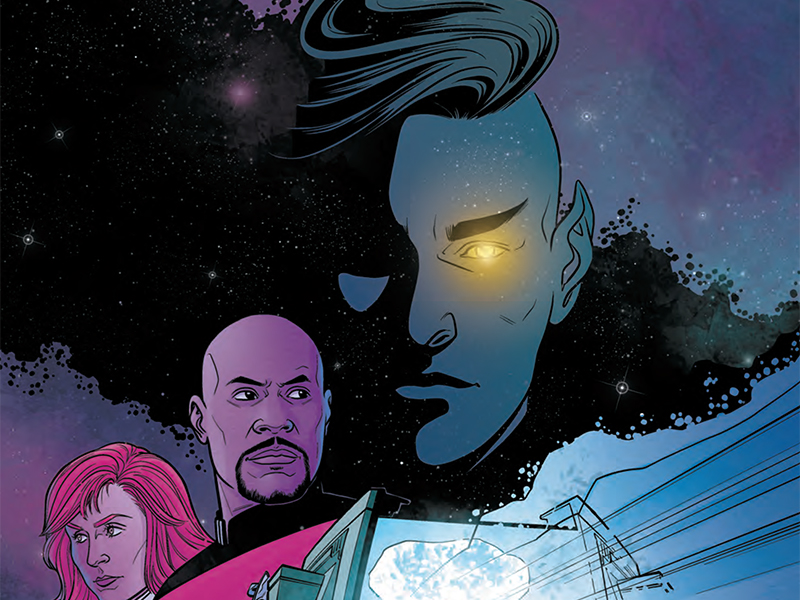
What Does A God Need With A Starship?: Reviewing ‘Star Trek’ #19
by Scott Redmond
Summary
The Klingon Emperor tried to wipe out the universe’s Gods, and they naturally aren’t too happy about it. Now the time has come to clean up the mess left behind, as the Theseus crew debates the merit of a new mission in Star Trek #19. A perfectly Trek-type of issue, colorful and emotional, getting to the very heart of the issue and what it means to be alive.
Overall
9/10Saving the universe, and all manners of existence within, is tiring business. Just ask Captain Sisko and his weary crew.

Kahless’ war on Godly beings has consequences through time and space as a familiar face drops a bomb in Star Trek #19. It’s a thread unraveling time from Collin Kelly, Jackson Lanzing, Megan Levens, Lee Loughridge, and Clayton Cowles.
Since very early in the series, the question of who or what T’Lir, a Vulcan of Starfleet, truly has hovered over everything. Conveniently (for them) they left the series behind for a few issues as the crew had to deal with space dinosaurs. Now that the Tzenkethi war has been averted, the Godly beings of the universe are gathering in the wake of the Kahless’ spurred destruction.
Spoilers are ahead, so turn back now if you’re not ready.

Out of all the names that were thrown out there, by myself and those I know, as far as I recall none of us accurately landed here. That being the fact that T’Lir is the corporeal form taken by the very last Organian in existence. Yes, those beings discovered in the original series who used to have human forms before they evolved and became God-tier level beings of pure energy and thought (Star Trek: The Original Series – “Errand Of Mercy).
Basically, long story short, Kahless use of the Orb of Destruction to kill Godly beings tore apart space time itself. Reaching back and wiping out the Organians in the past. T’Lir, formerly Tandela, survived and basically took over the embryo that is T’Lir so that they could be born into the corporeal world to be here to help stop these events. Wild, I know.
Because of the more recent movies, and some shows, people would be forgiven for thinking that Star Trek is a very action heavy series. Sure, there is action, plenty of firing of phasers and ship battles, but it’s really more of a talky exploratory piece of work. Showcasing philosophical or emotional questions that speak to the very core of the ‘humans’ experience. Jackson and Lanzing are really good at capturing those beats, as well as the action.

This one is very much an issue that is conversational, as T’Lir explains things, characters debate what to do, the Prophets weigh in again, Doctor Crusher makes a choice, and emotions are shared (some angrily) with one another. It’s really solidly handled as an intro issue, setting up the whole arc and what is at stake.
With the arc shift we also get an art shift. Levens is no stranger to Trek, having drawn the recent Star Trek: Strange New Worlds series as well as some of the series focused on the Mirror Universe.
Character likeness is captured pretty well, where it’s close but different enough to avoid that uncanny valley effect. Matching what this book has been good at no matter the artist. There is a somewhat lighter tone to the work that Levens produces, leaning a bit more toward the whimsical in many respects. Which isn’t wrong for a series like this, because it can provide a good contrast to the heftier weighy subjects at hand.

Some of the detail takes a back seat, fading out somewhat in many cases, with the characters taking up most of the focus. Many of those panels turn to pure color backgrounds. Being a very character heavy issue, that takes place mostly on the Theseus, it’s an effect that works. I imagine there will be more of an emphasis on those aspects once they are in the Godly realms and the fantasy takes over more. The space scenes come somewhat close at a few points, with big swirling light shows.
Those light shows are very vibrant and colorful, because Loughridge is still here providing the best sorts of colors for the run. Here the colors pull back some in many cases, staying in a sort of toned-down neutral. Even the normally very colorful Theseus is pretty normal lighting wise, probably because the story mostly stays in a couple places (meeting room, engineering, outside). Again, the somewhat heavier hand taken here provides that solid welcome contrast to the lighter touch of the artwork itself.
Leaving plenty of room to still have splashes of color that break out of the box just enough to feel unique. Letting those sci-fi feelings run wild.

Characters doing plenty of talking and emoting means plenty for Cowles to bring to the page. Dropping bubbles around the page with precise deft touches, so that nothing is running over one another or crowding the page. Sprinkling in modifiers, such as bolds or font shifts, to let the voices rind loud and clear. Emotions and tones plain as day matching the facial expressions or body language so easily.
Star Trek #19 is now available from IDW Publishing.
