
An Interview With ‘Into The Unbeing’ Writer Zac Thompson
by Rachel Bellwoar
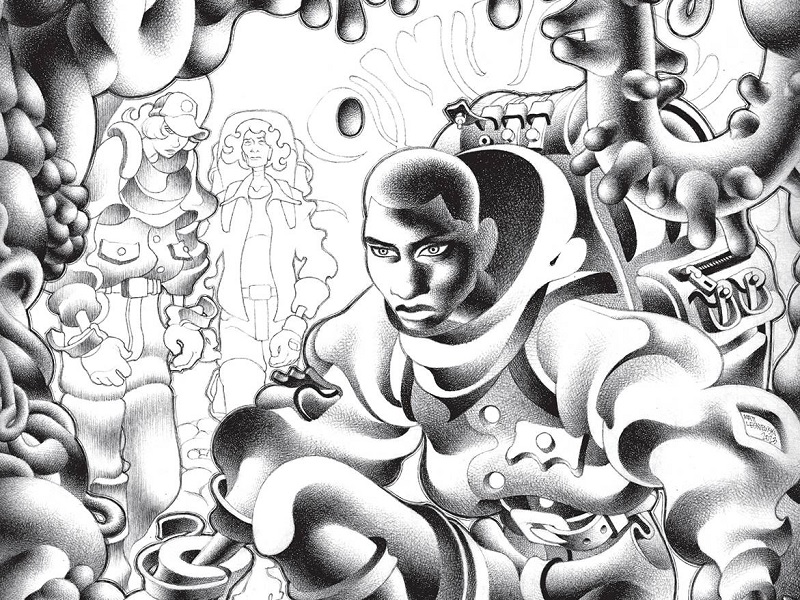
Curiosity has been known to kill a cat or two, but what will it do to the scientists in writer Zac Thompson and artist Hayden Sherman‘s eco-horror series, Into the Unbeing? With letters by Jim Campbell, find out what Thompson had to say about setting the story in Australia and its depiction of the future in the following interview:

Rachel Bellwoar: “Into the wild blue yonder” sounds hopeful. “Into the unknown” sounds scary but not necessarily bad. Into the Unbeing, though – when you actually focus on the word “unbeing” – sounds terrifying. Is it a verb? Is it a noun? What does the title mean to you?
Zac Thompson: It’s something we’ve toyed with for a while and I don’t want to put a label on it necessarily. It’ll likely mean something different for everyone who reads the book. There’s a very specific thing it’s referencing in the pages. But to me, it’s almost a feeling. The sense that’s evoked from getting lost in nature. A sublime sense of being cosmically small in a world that’s indifferent to your existence. I’ve felt like an “unbeing” when I’ve hiked to the top of a mountain and witnessed sprawling nature in every direction. I’ve felt like an “unbeing” when driving through the Rocky Mountains while they were literally on fire. And I felt like an “unbeing” when stumbling out of my house in the aftermath of a destructive hurricane.
Bellwoar: Along with Into the Unbeing (which takes place in Australia), you also have a series going on for Boom! Studios which takes place in Antarctica (Blow Away). How do you pick the locations for your stories?
Thompson: First and foremost it always comes down to what’s the setting for this story. Then it’s about what’s interesting to me about that place as an author. For both Into the Unbeing and Blow Away the setting is a character unto itself. It’s a space where we can explore isolation and what that does to our sense of humanity. By setting stories in the remote wilderness you’re removed from all the comforts of modern life and get to expose your characters for who they really are. There’s no one watching in the Australian outback. There’s no modern technology. So you’re left with this base sense of humanity. A ceaseless frontier that is dangerous and mysterious and doesn’t care about you in any way. There’s something really powerful about that.
Bellwoar: The ’70s and ’80s were filled with films set in the distant future. Into the Unbeing takes place in 2034 and it’s not looking great. Why do you think it’s important to take away that distance and address near future scenarios?
Thompson: I think in a lot of ways we’ve lost sight of the future. We live in an ever-evolving-present. We’re flooded with things that are meant to occupy our attention at all times. So we rarely get to really speculate about where we’re headed. I think that’s part of a concentrated effort to get us to give up on the future. When you think about the literature or films of the past there was this constant sense of where we were headed as a species, a sense of wonder and hope. We’ve all but lost sight of that. William Gibson said you rarely hear the phrase “the 22nd Century” and I agree. There was this sense about the 21st Century that things were going to be better and more holistically equitable. And we’re just not there. The table has been tilted by corporate interests. So Into the Unbeing is partly about that stolen future. That sense that we’ve lost sight of what matters and that we’re heading in a very dire direction. Humanity is on track for extinction. We may have bought some time but in the measure of deep time it’s more akin to minutes than years.
Bellwoar: Into the Unbeing is about a team who work for S.I.N.E.W.. Readers are told what that acronym means (The Scientific Institute for Nascent Ecology and Worlds) but who are they exactly?
Thompson: S.I.N.E.W. is an emerging organization that’s willing to spend billions to fight climate change. They’ve got federal grants, international seed money and deep pockets. They are the radical face of the climate revolution. They do this in a multitude of ways but are committed to working in cells. So one team working for S.I.N.E.W. knows nothing about the next. That’s partly how they’re able to do what they’re doing and succeed. Though that sounds awfully mysterious doesn’t it?

Bellwoar: Each of the issues is told from a different member of the team’s point-of-view. Which member’s voice do you feel came the most naturally?
Thompson: Issue #3 follows the team’s Entomologist Selva Yacoub and she has this disposition that’s basically “the world will break you if you hesitate.” That resonates with me deeply. She’s decisive and action-oriented. She’s suffered a great loss and while it’s on her mind at her weakest moments – she doesn’t let it define her. I think there’s something about that resilience that I see in myself. That I see in the future of our species. I really try to meet the world with that energy and deal with the things I see as problematic quickly and conclusively. Though some problems are so existential – I don’t know where to start. Haha. In that way, I think we’re alike.
Bellwoar: One of my favorite pages is in the first issue, when the team are getting all this meaning out of a map and in each panel Hayden Sherman zooms closer and closer, yet nothing about this map becomes clearer as a civilian. Is it difficult writing a series where all of the characters are scientists?
Thompson: It was! But things got progressively easier as we got deeper into the book. I started writing the series in 2020 long before Hayden was able to get started. So I had a lot of time to do research and get into the mindset of each character. I genuinely had to learn about Botany, Geology, Entomology, and Surveying in order to write dialogue that made sense for these characters. It was an incredibly challenging exercise that really indulged my worst impulses because I got to spend months researching and writing long backstories for each of the characters. Most of that stuff doesn’t even make it to the page as text but it adds flavor and depth to the world.
Bellwoar: Speaking of Hayden Sherman, how has it been working with them on this series?
Thompson: Working with Hayden was a dream. We’ve done quite a number of things together now so we have a really great working shorthand when it comes to developing pages. More than that though, Hayden is this brilliant singular mind that’s inking every page and coloring the whole book. They had this stylistic idea about how the book would evolve from Part I to Part II and slowly turned the art style and layouts on their head as the book progressed. They’ve been incredibly collaborative and have built on my scripts at every level. The end result is truly something magnificent to behold. The scale and the layouts on display are unlike anything else on the stands right now. We also had a really innovative way of developing the book. Hayden would send me a layout for a page every morning. We’d chat about the layout and they’d go ink that page. Then the next day we’d start over again. The end result was a really fluid development process that evolved as the days went on. We’re still talking about the book every day now almost 3 years on from when the art started.
Bellwoar: A lot of stories create drama out of the choices characters make. Much of the drama in Into the Unbeing, however, comes from characters not getting a choice and having their hand forced. What was that like to work with as a writer?
Thompson: Well, that goes back to talking about the setting being a character in and of itself. I wanted to make sure that while the setting is wild and deeply cosmic – that in essence we’re dealing with a survival story like Deliverance or The Descent. Where you have a group of people that are bound together by circumstance and have to do whatever they can to survive. So their goals are the same but their ideologies are VERY different. Like any good survival story, that really comes to a head at the end of Part I (issue #4). So while they’re begrudgingly pushing ahead (the more we learn about their backstories) the more it becomes clear that this can’t last forever. It’s them versus the environment. Until it’s them versus each other, the environment, and whatever following them through the dark…
Bellwoar: And on that ominous note… thanks for agreeing to this interview, Zac!
Into the Unbeing #1 goes on sale June 12th from Dark Horse Comics.
