
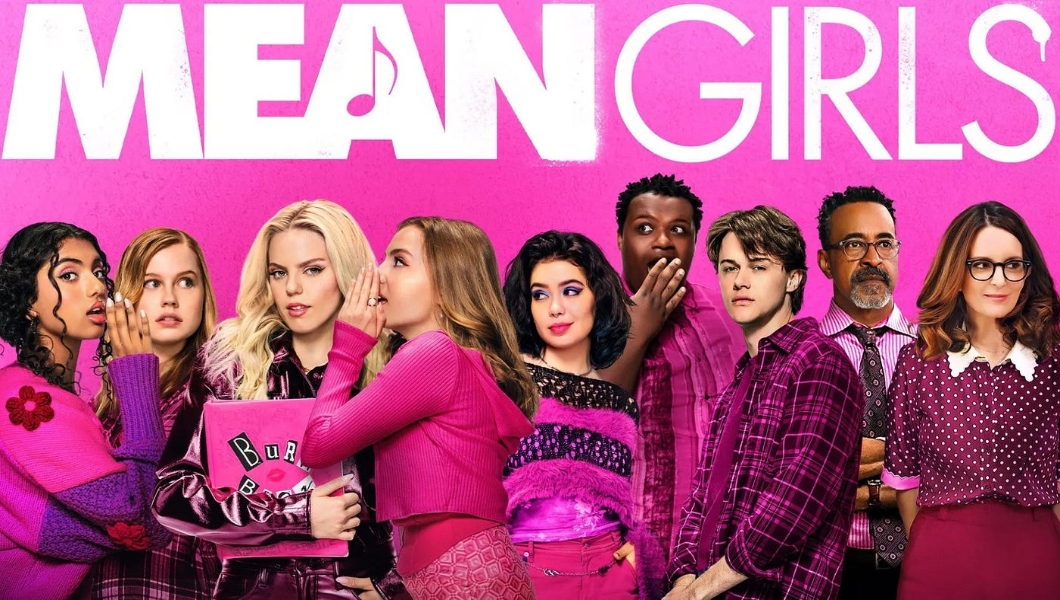
Commentary: ‘Mean Girls’ Demonstrates Why Musical Adaptations Are Difficult
by Frank Martin

It’s important to remember that not every story — whether it be a movie, a TV show, or even a play — is supposed to embody the same experience. Every work of art is different and they emphasize different tools in order to accomplish their goals. This is especially true in terms of musicals, and doubly so for stage musicals, which are formatted much differently than their film counterparts. This is why adapting a stage musical to the screen can be difficult, and it’s evident in the recent Mean Girls film.
The plot focuses on a new student in school named Cady (Angourie Rice). She likes a boy who is claimed as property by his ex-girlfriend, the queen bee in school named Regina (Reneé Rapp). The overall moral of the story is that in her efforts to discredit Regina, Cady becomes just like her in the end. At one point, a Halloween party becomes an opportunity for the students to socialize and a chance for Cady to form a relationship with the boy she has a crush on. In preparation for the event, one of Regina’s friends, Karen (Avantika), sings a song describing what Halloween parties mean to high school social life.
In the grand scheme of the film, the song and scene are both meaningless. They don’t do anything in terms of moving the plot along and highlight nothing in regards to characterization. They are simply there to entertain through music while offering a flashy sequence of girls getting ready for the Halloween party using social media as a platform. But that’s perfectly fine. If this were a standard narrative, the scene should absolutely be cut as it’s unnecessary. But considering this is a musical adapted from the stage, the scene works in that specific context. It also demonstrates that not every work can be judged the same way. Its origins and intentions are important.
Mean Girls is now streaming on Paramount+.
