
Review: ‘Kingdom Of The Planet Of The Apes’ Is A Worthy If Lighter Apes Adventure
by Erik Amaya

While Kingdom of the Planet of the Apes may not be as accomplished as some of its predecessors, it is still a worthwhile time at the movies and an adventure worth taking.
Following 2017’s War for the Planet of the Apes, the storytelling could have gone anywhere. It could have followed Caesar’s (Andy Serkis) son as he helped to establish Ape society. It could have moved onto the Lawgiver, a figure from the original Apes series who may yet present another leap forward for the new continuity. The films even had the option of returning to astronaut George Taylor (played by Charlton Heston in the original series), who went on his infamous space voyage at the very end of 2011’s Rise of the Planet Apes and has yet to reappear from the time warp his spacecraft encounters.
Instead, Kingdom sets itself “generations” after Caesar’s passing and introduces chimpanzee Noa (Owen Teague), a new Ape character whose journeys across the world the Caesar trilogy established, allowing viewers to see the planet’s development in the years since War. In lieu of a more modernized Ape society, things appear to have stagnated. They live in disparate clans across an eventually familiar landscape. Noa’s people, the Eagle Clan, have settled in an idyllic forest where they live a simple but stable existence far from larger ape groups and “Echoes” — their local term from humans.
This being an Apes adventure, though, expect that paradise to be upended so the protagonist can go on his quest.
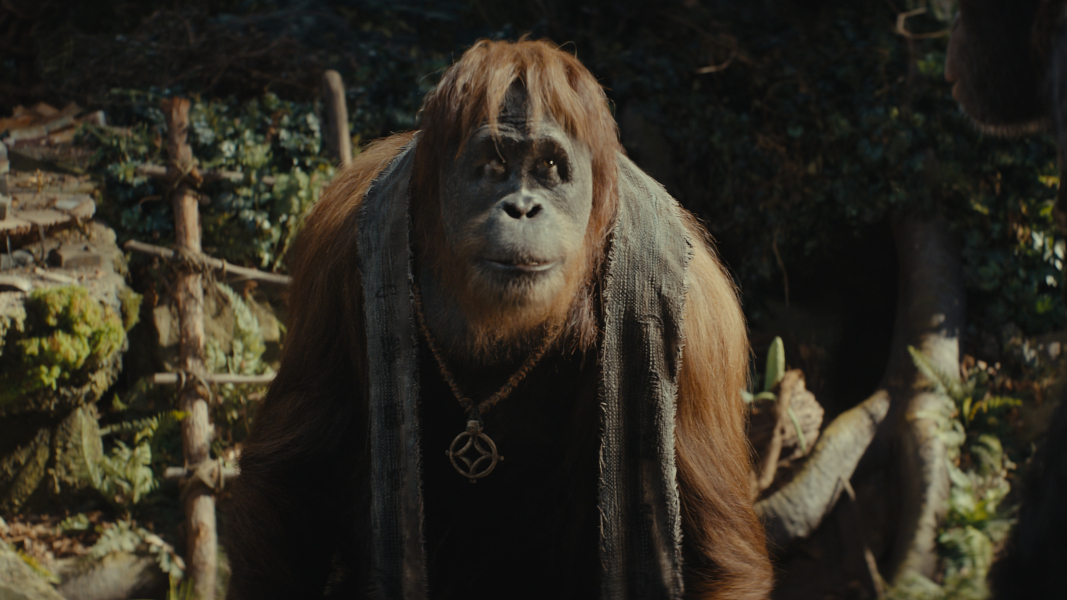
And that quest is the most satisfying element of the tale. Along the way, Noa builds a party with Orangutan historian Raka (Peter Macon) and a human woman initially called Nova (Freya Allan) — a nod to Apes history across both film series — who proves to be more than she seems. The three make their way on foot and horseback, learning about each other, the words of Caesar that Raka holds dear, and the nature of the planet outside of the Eagle Clan forest. Macon’s Raka proves to be the scene stealer in this section thanks to some clever writing (credited to Terminator: Dark Fate‘s Josh Friedman) and the actor’s motion capture/vocal performance.
Of course, the trio eventually run into an antagonistic force led by Proximus Caesar (Kevin Durand), a questionable leader of another Ape clan who is curiously more nuanced and complicated than the story requires. Nonetheless, we appreciate Kingdom director Wes Ball‘s attempt to keep the conflicts layered with character motivations that will leave the viewer to ponder who best to champion. On the flip side, though, the nuance does not lead to the level of tension or conflict seen in War or Dawn, where Serkis’s Caesar faced off against heavies played by Woody Harrelson and Gary Oldman.
Part of that may be the focus on Noa, who is on a hero’s journey and must come off as more of a callow youth than Caesar ever felt. Before the crisis begins, his major goal is a coming of age ceremony. This presentation of a character on the cusp of maturity naturally means the strength Serkis brought to Caesar is missing. And though it is a little unfair to compare the characters, it is inevitable as viewers will expect a Serkis-style performance from the new lead.
Also, it is clear Ball does not mean for Kingdom to be as weighty as Matt Reeves‘ pair of Apes films. Those movies were about the end of humanity’s dominance. This one is set before the Apes assume complete control of the planet. The tone is obvious lighter — even with the themes Proximus brings to the proceedings — and it is why we think the quest sequence in the middle is the most successful. It feels the most like the right move following War‘s conclusion. At the same time, it is clear Ball is more comfortable with Apes speaking English as sign language takes more of a backseat here. That is a necessary step, both within the fiction and technologically, if the film-to-film continuity is meant to eventually bring Taylor into the mix.
Although, it is worth noting that Kingdom teases a different idea by its conclusion.
The result is a film that is lesser almost by design. Like Rise, it is setting up new characters, goals, and conflicts. Presumably, we will be seeing an older and wiser Noa in a subsequent film, but his first journey across the planet requires a softer touch. That means a more youthful (for good and bad) adventure that has it appeals, but may leave fans of the harder-edged Apes films cold. Nonetheless, we think the film succeeds more than stumbles.
Kingdom of the Planet of the Apes is now in theaters.


