
Review — ‘Essential Judge Anderson: Satan’ Is Exactly What It Says It Is… Essential Reading
by Richard Bruton
Summary
The second volume of ‘Essential Judge Anderson: Satan’ – continues Alan Grant and Arthur Ranson’s exploration of the complexities of Grant’s creation. In Satan, Grant dives deep into the character of Anderson, unleashing all her doubts around her life and her role, makes her question so much – what does freedom and faith truly mean in this dystopian future – and finally brings it all to a magnificently done finale as Anderson faces Satan himself in a final test of herself and her beliefs.
It’s a beautifully done book, the art by Ranson as exquisite as you’d always expect, with Grant’s four tales here really bringing out everything absolutely essential about the character. Highly recommended.
Overall
10/10The second volume of the Essential Judge Anderson series contains the whole of Alan Grant and Arthur Ranson‘s epic Satan, but adds more tales that make this a truly essential volume for any fan of Mega-City One’s most intriguing Judge.

We’ve already had one volume of these Essential Judge Andersons: Shamballa, one I absolutely adored, one that absolutely captured everything that makes Anderson one of the most layered, empathetic, and fascinating characters in the whole of the Dreddverse. I covered that in a review here and loved it for the way that the extra stories included alongside Shamballa really added so much to the impact of the book as a whole, further refining the humanist viewpoint Alan Grant brought to the world of Anderson, as well as, of course, the incredible artwork of Arthur Ranson.
Well now there’s a second Essential Anderson volume – Satan – and again, I set about previewing it for you to show and tell you all about it.
And again, just as with Shamballa, that preview turned into something far more than just a show and tell, something that turned quickly into a long-form review of the book simply because I just had so much to say about what makes it so damn good.

Again, as with Shamballa, this is Grant writing his creation from his own viewpoint, exploring so many aspects of Anderson’s life and her state of mind. It questions the big issues, becomes a meditation on the concepts of freedom in a fascist regime controlled by Anderson and her fellow Judges, with Anderson questioning her role in the system. It’s also an exploration of faith and belief in all its forms, all culminating in the ultimate showdown – Anderson versus Satan, the perfect way for Grant to end the series of perfect Anderson stories that gave the character so much more than just being the kooky Psi-Division Judge with a heart.
As you’d expect, particularly if you’ve already read Shamballa – and if not, why the hell not, I’ve told you how absolutely essential and essential volume it is already – this is something totally different from the adventures of Dredd, somewhere Grant gets to ask more fundamental questions, with a character he’s using as a conduit to his own mind and his own humanist beliefs, Anderson’s basic empathy and tolerance always at odds with the role she has to play in this life.
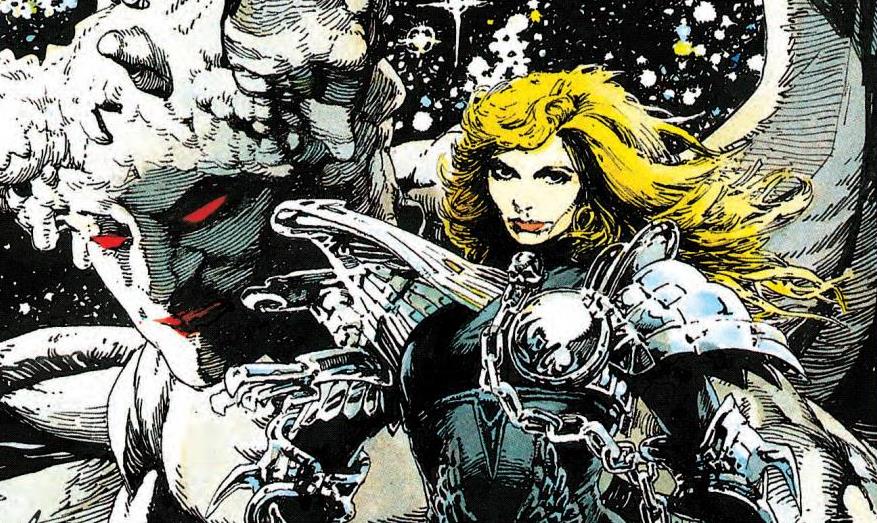
Similarly, you should already be well aware of just how absolutely beautiful and impactful every page of Ranson’s artwork is here – there’s simply been no other artist who draws Anderson this way, this well, this incredibly. Ranson’s art has always been the sort of comics art that goes heavy towards the fine art end of things, along with the likes of Barry Windsor-Smith et al, each image being so well constructed, so easy on the eye.

Interestingly, the stories here are deliberately printed out of order, beginning with the single-episode ‘The Protest‘ from 1996, followed by ‘R*Evolution’ from 2001, and then headed back to 1993 for ‘The Jesus Syndrome‘ before getting deep into ‘Satan’ from 1995. It’s only something I noticed when typing up the final bit of this and has absolutely no effect on your reading of this.
In fact, putting them in this order absolutely enhances things, with the narrative theme now going like this – Anderson’s doubt in the system (‘The Protest‘ ) and her understandable yet impossible wish to abdicate her role in it (R*Evolution’ ), followed by an exploration of faith and how the simplest message of most faiths – love – is corrupted by religion and its followers (‘The Jesus Syndrome‘). All of which makes Anderson, already doubting her purpose, deeply affected by Shamballa and what she underwent there, having seen how simple and pure faith can be on an untainted and impossible level, a perfect foil to come up against the epitome of evil (Satan).

‘The Protest’ is a perfect little introduction as it’s a simple tale of individual protest amongst the cits bringing Anderson to the conclusion that the balance between order and chaos, between good and evil has been upset by the actions of her and her fellow Judges in MC1. So there’s the seeds of doubt sprouting in her mind, showing us the troubles she has with her lifelong role.
‘R*Evolution’, very deliberately a mix of revolution and evolution there in the title, is a longer thing, on the face of it going into the sort of ridiculous farce that Grant could do so well, as Anderson goes up against mega-rich Vernon D’Arque on his own private asteroid Chiron between Neptune and Uranus, his decaying body containing seven different minds, with a view to making Anderson’s the eighth.
‘The Jesus Syndrome’ takes us into the world of false prophets and the ability of religion to deceive and manipulate, yet also has Anderson (and Grant of course) conceding that the fundamental belief of so many religions is love, misguided as it may be, but still that simple love of whatever your creator is for his/her/its creation is felt so strongly.
And as before, it plays into Anderson’s conflicted mind, the temptation of a simpler way so obvious, yet knowing, with all she’s seen, that although the concept of love may be perfect it doesn’t stand a chance when its the flawed creations that have to enact the message.

That’s more than half the book already gone, but those three tales, reshuffled in order a touch, are just as essential to the whole effect of this volume, giving the final 40-odd pages of ‘Satan’, already a great story, more depth, more resonance, more meaning than if it were to just stand alone. So congratulations for those choosing how to present the tales here, they’ve done the impossible and made it so much better than the sum of its, already highly impressive parts.
And finally, ending the book, with ‘Satan’ we have Anderson (and Dredd, comically reduced to a mere disbelieving bystander incapable of being much use at all) coming into contact with Satan him/her/itself – is it actually Satan? Well, that would be telling, suffice it to say if it’s not then it’s doing a damn fine impression and has the power and the belief to back it all up.
Faced with an impossible to beat adversary – the adversary perhaps – everything Anderson’s suffered, all the doubts and the questioning she endures all come to the fore, all have a purpose and a meaning in the end.

And whilst it’s not, perhaps, as perfect as a whole as the previous Essential Anderson: Shamballa, coming a close second to that one still means that Essential Anderson: Satan is another example of both the brilliance of Grant and Ranson and of Grant’s creation, the perfect epitome of the complicated character that is Cassandra Anderson as she grapples with questions of faith and freedom.
It’s called Essential Anderson for a reason and this volume more than lives up to that billing.

ESSENTIAL JUDGE ANDERSON – VOLUME 2 – SATAN
Written by Alan Grant
Art by Arthur Ranson
Letters by Annie Parkhouse and Steve Potter
Out now from Rebellion/2000 AD
Originally serialised in Judge Dredd Megazine 3.14 (The Protest), 2000 AD Progs 1263-1273 (R*Evolution), Judge Dredd Megazine 2.22-2.24 (Jesus Syndrome), Judge Dredd Megazine 3.01-3.07 (Satan)

