
An Interview With ‘Student Ambassador: The Silver City’ Writer Ryan Estrada
by Rachel Bellwoar
For only being eight years old, Joseph Bazan has accomplished a lot in his time as student ambassador. In The Missing Monkey he helped improve relations between West and East Rhutar. Now in writer Ryan Estrada and artist Axur Eneas‘ follow-up, Student Ambassador: The Silver City, Joseph is visiting the mines of Zacatecas, Mexico to help former President Olman with his diplomacy. With letters by Alejandra Zuñiga, find out why Estrada chose Zacatecas to be Joseph’s destination in the following interview:

Rachel Bellwoar: While the magic in fantasy stories can feel out of reach, the Student Ambassador graphic novels show how magic can be achieved in the real world through new experiences and travel. How important was it to you to ground Joseph’s adventures in events that could actually happen?
Ryan Estrada: The Silver City is about Joseph discovering where his family came from and realizing it was not like what he’d seen on TV, and that was straight out of my own experience. Despite it being my grandfather’s home, I had the image in my head of every run down, dusty, Mexican village that appeared in Hollywood movies and TV shows. So, I was blown away when it was the most gorgeous, amazing city I had ever laid eyes on. And the buildings were hundreds of years old, so it’s not even like the stereotypes I grew up on were depictions of how it used to be. That made me think of all the other kids’ stories I watch supposedly set in real places that just depicted imaginary cliches, like how every cartoon character went to Africa just to be put into a boiling pot by a witch doctor in a giant mask. Even movies that are shot in the real locations often make no geographic sense. Since every setting of a Student Ambassador book is a place I know and love, places where I know what sights, sounds, and smells are down every alleyway, I had the opportunity to give readers the experience of what it’s like to actually be there.
Each book is plotted out so that every step a character takes is followable. For the first book, I actually acted out the climactic chase scene in Seoul to photograph every step and make sure it looked real. For Silver City, I prepared a dossier for what it’s like to travel under, over, and around the city with maps the artist, Axur Enas, could follow so it was like he was there as he drew. I hope giving kids the real experiences they would get while traveling will change their lives the same way the original travel changed mine.
As an author/artist/adventurer, I have been all over the world and seen so many amazing things that, as fun as it is to invent new fantasy worlds, I have enough real places to share that I never need to! And I figure if kids can memorize the map of Middle-earth, or the hierarchy of magic society, why not use really cool fun details about the world they live in as fodder for adventures, mysteries, clues, and jokes? I don’t set out to make educational books, but my hope is that by enjoying an adventure in a part of the world they know nothing about, one day they’ll realize that they learned something useful! I’ve heard of kids who read The Missing Dragon driving past a Korean restaurant sign and realizing that they knew how to read it! So it will be amazing to see what kids learn from this new one.
Bellwoar: Nang may have been king in The Missing Dragon, but he was also the same age as Joseph. What was it like getting to pair Joseph up with an adult this time in former President Olman?
Estrada: Nang is such a fun character to write because he has zero filter and blurts out every bit of selfish, childish idiocy that pops into his head. There are a lot of world leaders like that! But if I’m teaching kids about how the world works, it’s important to teach them that many people in power are more practiced at being convincing than that. Olman makes mistakes and has selfish tendencies, but knows how to wrap them up in a cloak of positivity and selflessness. It was a different approach to show a leader that Joseph could look up to, become disillusioned by, then accept as a real person with flaws that he can help be better.
In the opening scene, Joseph is on a field trip to the Tex Olman presidential library and the kids do a video game reenactment of one of the former president’s most controversial actions. The game rewards them for making the same decisions that the president did, and makes it seem like more cooperative, peaceful solutions were impossible. This is based on a real game at the Reagan Library. So, I let Joseph hack the game and involve the actual world leaders in a gaming stream to give kids a fun way to know what propaganda is and know how to consider the sources of their information.
Bellwoar: How early did you know you wanted to set volume two in your Grandfather’s hometown of Zacatecas, Mexico?
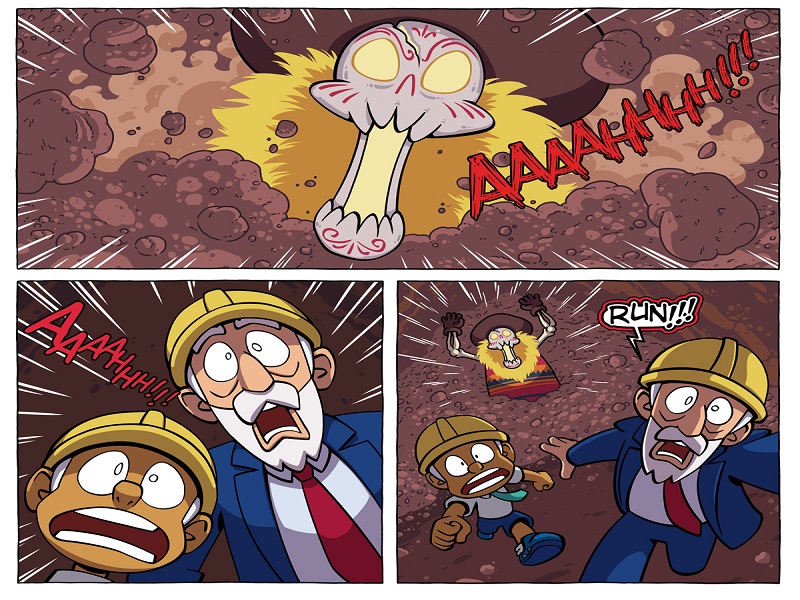
Estrada: I knew as soon as I arrived in Zacatecas that it was one of my favorite places on Earth, and the perfect setting for an action-adventure story. It was originally built as a mining town, but as both the city and the mine grew, they began to overlap, and they realized that if they kept going the city would fall into the mine so, it became a second city inside a cave! There’s a train, a museum, a night club, and you can walk completely underneath the city, take an elevator up through the center of a mountain, and then take a cable car over the city. And every inch of downtown is a UNESCO world heritage site. There’s not an angle you can look at the city, whether you’re on the ground, in a cave, or in the sky that’s not the most beautiful thing you’ve ever seen. So I was super excited to send Joseph there for an adventure!
Bellwoar: My favorite place that Joseph visits is the bullfighting ring that was transformed into a hotel. Is this a well-known spot in Zacatecas or is this where being familiar with the area helps unveil hidden treasures?
Estrada: It’s something I discovered while wandering and exploring the city. I wondered why this rich people hotel had such a unique design and the locals explained it to me. It really explained so much of what made Zacatecas great. The city is so proud of its history that it never tears things down, it turns them into something new.
Bellwoar: In the same way that Joseph uses comic books to learn Korean in The Missing Dragon, The Silver City shows how video games can be educational, too. Do you think people are still too quick to rag on children’s media?
Estrada: Kids media is an important way that we learn about the world we live in! I can still recite “Yakko’s Nations of the World” from Animaniacs. I read Hamlet because of The Lion King. I know about renaissance painters because of certain turtles. I don’t want kids to think they can only learn important things about society from dusty old history and social studies books. Those books are great, but often it’s because a story kids were excited about introduced them to a concept that they wanted to learn more about. The stories that meet kids at their level in ways they can get excited about stick with us for the rest of our lives. SO never tell a kid who’s excited about comics to “put it down and read a real book.” Kids want to learn, and even the things our adult brains might see as “junk food” can give lifelong knowledge.

Bellwoar: President Olman likes to use his security concerns as an excuse, but what are people missing out on when they allow their fears to get in the way of them trying new things?
Estrada: I’ll be clear, as far as this plot: I do not think that anyone with access to classified data and nuclear codes should go wandering off alone in an abandoned mine. But for non-world leaders, I know that facing fears and trying new experiences makes life better and makes the world a better place.
When I do school visits, a popular workshop I do is called “Learn to Be A Fearless Storyteller.” I start with a room full of kids terrified with stage fright, and through a series of games, I end up with a room of kids jumping and screaming for their chance to ham it up on stage. The most helpful part is the “bad storytelling contest.” I have the kids list out all the mistakes they are afraid of making, then I challenge them to make as many of those mistakes in one minute as possible. Once the pressure to be perfect is gone, so is all the fear. And I explain to kids that this has applied to my entire life and that every good thing I’ve ever done has started with a mistake. And being open to new experiences outside of our comfort zone make the world a more interesting, vibrant, and fascinating place!
Bellwoar: What was it like working with Axur and getting to make yourself a comic book character for the backmatter?
Estrada: Bringing on Axur to draw the Student Ambassador books was one of the greatest decisions I ever made. His art is so vibrant and expressive, he captures each real location in such a colorful, exciting way that makes me feel like I’m there. And it helps set the books apart from the non-fiction books I’ve drawn about my real travels. But it’s always fun to draw my own little bonus chapter in the back where I get to talk to the readers directly and share what it is about the places in the book that made me so excited to put them in the story.
Bellwoar: When did you and Axur come up with the idea to hide Morse code messages throughout the book?
Estrada: In the first book, we gave kids the chance to learn Korean, so we hid a bonus game in the book where, the second time they read it, they could discover secret hidden messages in the backgrounds. I wanted to add something similar to this story. I joked that I could teach kids how to read the Spanish alphabet but that would just be Joseph saying, “J sounds like an H and there’s an N with a little line on top that sounds like NY.” So I looked for something else I could weave it that fit the story. And I thought Morse code was something kids could have real fun with, especially for a story that took place deep in hidden mines where cell phones might not work.
Bellwoar: For any readers who might be interested in becoming a student ambassador, are there any resources they should look up?
Estrada: As a kid, I traveled to Australia through the government’s People to People Student Ambassador Program. But that eventually turned into a for-profit program and then went out of business in 2015. For me, being a good ambassador is not about a title or a role. It’s about representing the place you come from and making a good impression by learning about others, sharing your own culture, and doing good in the world. Talk to your teachers, parents, and counselors about what opportunities there are in your community to be a good ambassador! This could be volunteer work, student trips, exchange programs, or even just being kind to those around you.
Bellwoar: Do you have a favorite memory or trip from your time as a student ambassador?
Estrada: At the end of our trip, we wanted to thank our local guide for everything he did for us. So, we all secretly rehearsed and choreographed a performance of the Australian song he taught us, since we knew he remembered it fondly from his childhood. Afterward, he cried and said “I just started this job, and this is my second tour. After my first, I felt sad that all these people I had gotten to know for a month were leaving, and when I met you, I was suddenly with a bunch of strangers and I didn’t want to know any of you. But you guys are amazing. That other group was a bunch of jerks compared to you. I’m going to miss you all so much!” I met so many people on that trip that I’d never seen before or since, and we all made such big impacts on one another’s lives, so I try to live in such a way that I bring positivity to anyone who’s life I even fleetingly make an impact on. I’m not saying I do, but to be a good ambassador is to try.
Bellwoar: Thanks for agreeing to this interview, Ryan!
Student Ambassador: The Silver City is on sale now from Iron Circus Comics.
