Characterization In The Buffyverse — ‘Angel’ Season 1, Episode 17
by Benjamin Hall
This is part of a bi-weekly series concerning the characterization of Buffyverse characters. The first installment in this series can be found here. Arguably the best place to begin reading this series is at the beginning, but that is up to each reader. As a reminder this column will cover major and some minor characters from the shows Buffy The Vampire Slayer (1997-2003) and Angel (1999-2004). Other Buffyverse media, such as the graphic novel Spike: Into The Light (2014) are not pertinent to this series. Also there will be no referencing real world events that have direct relation to either show in this bi-weekly series.

This week: Angel (David Boreanaz) attempts to help someone famous with a problem. Yet, the problem might not be the one he sees.
(Warning of spoilers from this point on!)
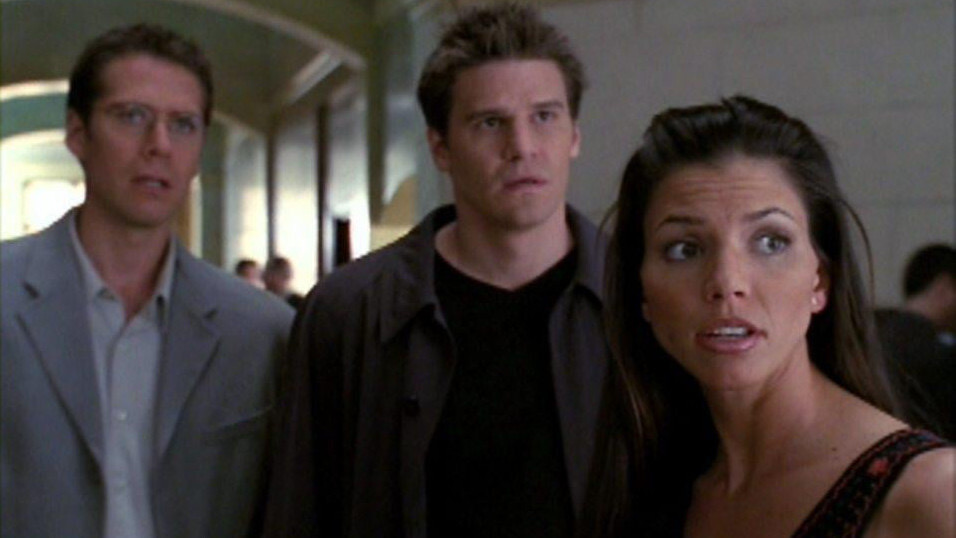
Angel apparently knows less about his curse’s escape clause than Wesley Wyndham-Pryce (Alexis Denisof) does. Wesley realizes that Angel “losing himself to pure happiness” is not equal to Angel having sex. Also, Angel seems to be less able than Wesley to endure Cordelia Chase’s (Charisma Carpenter) talentless professional acting. He makes a statement essentially comparing it to the torment of the hell dimension he went to (Buffy The Vampire Slayer Season 2, Episode 22, “Becoming, Part 2.”) There is also a little bit of egotism at play when he finds out he is not in the news at all. Angel, while high on a drug, is temporarily back to his Angelus persona. But because it is not a real form of happiness, he reverts back to Angel by the end of the episode.
Cordelia Chase is much better at improvising on the spot with the fake holy water than acting in a professional capacity. She also shows the ability to be sensible about Angelus and his curse. This is despite acting like too much of a fan or social climber around Rebecca Lowell (Tamara Gorski). Thus, Cordelia is kind of both a fool and a hero in this episode. It is also worth mentioning that of the three main leads in this episode, she is the only one to show some growth when it comes to the aftermath of Angelus’s first reappearance since Buffy The Vampire Slayer Season 2, Episode 22, “Becoming, Part 2.” It is noticeable from her caution when meeting him with a cross at Lowell’s house, and her comment about his attire.
Wesley Wyndam-Pryce provides some exposition and regular dialogue in this episode. Unfortunately, his job here is to talk and shove Angel/Angelus down the elevator shaft.
Rebecca Lowell is an actress who is very lonely due to her fame and its apparent fading. She has major concerns about the latter, and therefore drugs Angel in the hopes he will turn her into a vampire, which she fails at.
Oliver Simon (Michael Mantell) makes his second appearance on the show (the first being Season 1, Episode 1, “City Of”), this time as Rebecca’s manager. He seems to care about Rebecca’s career and, possibly, her. Nevertheless, his attempts to drum up publicity for her via a fake stalker suggest that he has more concern for her career. Well that, and the ageism. This tactic also suggests that he is not as great a manager as Cordelia originally thinks. Finally, Oliver does not seem to recognize Angel during their second meeting at the beginning of this episode.
The masseuse (Robin Meyers) is an extra character who serves no real purpose other than to help show the vapidness of Hollywood and ageism. At the same time, without this character’s presence the episode feels a little more empty of people
The message of ageism being a thing in Hollywood is present throughout. However, it overtakes most of the episode, including limiting the amount of characters and growth.