
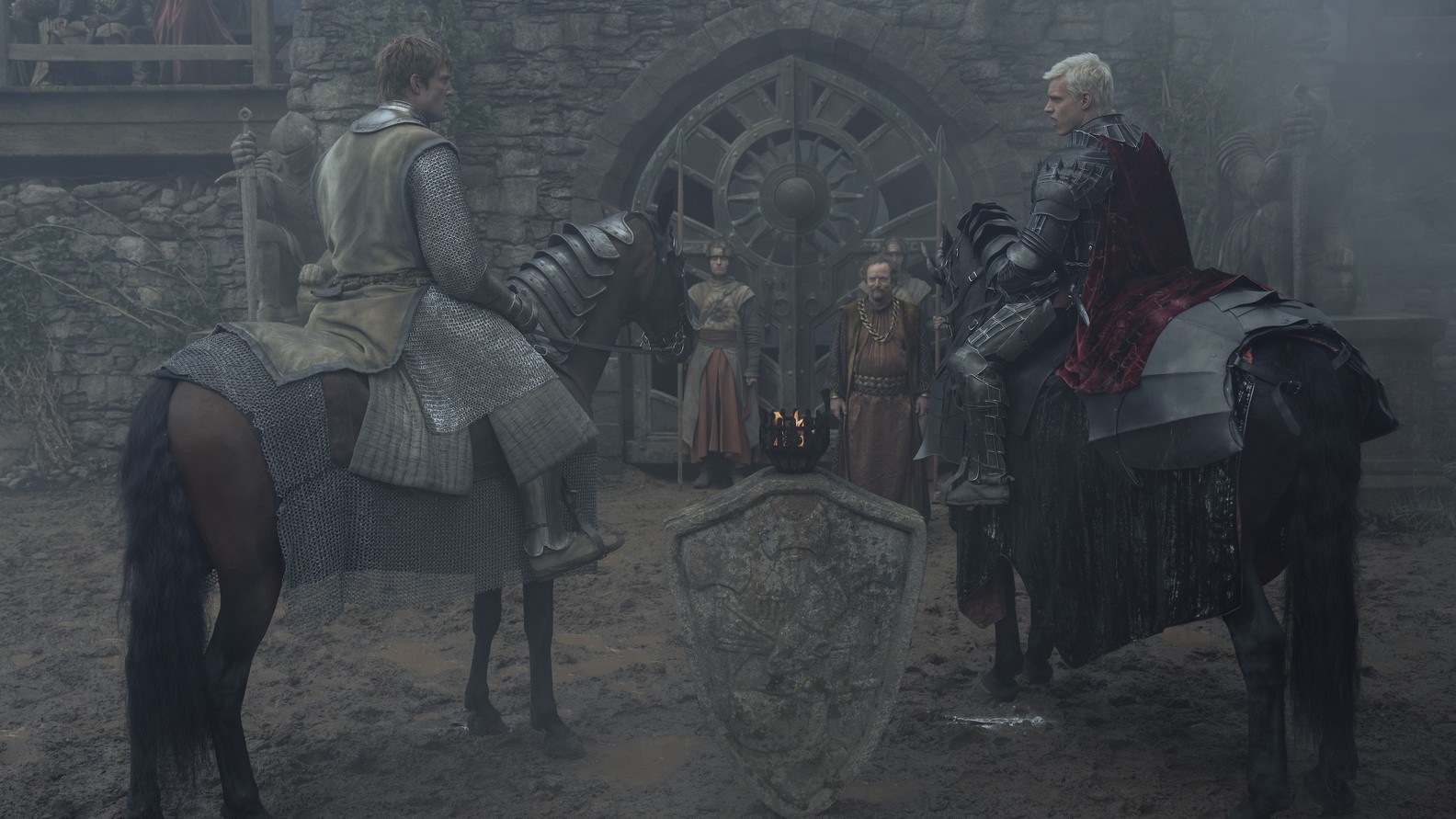
Fire & Blood Files: Who’s Who & What’s What In The Trial Of Seven
by Austin Gorton
The concept of “trial by combat” is hardly new to A Knight of the Seven Kingdom viewers with at least a passing familiarity with previous stories set in Westeros. We first saw it deployed all the way back in the first season of Game of Thrones, when a sellsword named Bronn (Jerome Flynn) chucked a dude out the Moon Door of the Eyrie while serving as Tyrion’s (Peter Dinklage) champion.
It was the vehicle which brought us the unforgettable battle of the Mountain vs. the Red Viper of Dorne at the end of Season 4, and the threat of a trial by combat with the zombified Mountain hung over all of Cersei’s (Lena Headey) dealings with the High Sparrow and the Faith Militant throughout the fifth and sixth seasons.
But in “Seven,” the most recent episode of AKOTSK, the series introduces a new-to-us twist on the concept: the Trial of Seven, which transforms the traditional one-on-one combat into a kind of seven-on-seven basketball game, but with swords and death instead of balls and fouls (both feature flopping). Before the trial commences in the next episode, let’s dig into the history of Trial by Sevens, and lay out who exactly is on each side of the upcoming battle.

As noted in “Seven”, the concept of a Trial of Seven is an ancient and rarely-invoked one. In fact, throughout the history of the Targaryen dynasty in Westeros, there is only one other recorded Trial of Seven to date. It occurred in 42 AC (roughly 167 years before the events of “Seven”), during a broad uprising by the Faith Militant against King Maegor I aka Maegor the Cruel (second son of Aegon the Conqueror).
Ser Damon Morrigen, leader of the Warrior Sons (an order of knights especially dedicated to the faith who directly serve the High Septon, kind of like the Knights Templar), challenged Maegor to a Trial of Seven on the grounds that Maegor did not have the right to rule the Seven Kingdoms. What followed was a deadly melee in which everyone was killed except Maegor — who succumbed to injuries shortly after killing his last opponent and was unconscious for weeks until, according to rumor, he was revived via blood magic (after which his disposition only got crueler). Amongst the Warriors Sons fighting in the trial was one Ser Dickon Flowers; we’ll come back to that name.
Given its strong ties to the Faith of the Seven (which grew less antagonistic towards the Targaryen dynasty after the death of Maegor and the ascendancy of his nephew, Jaehaerys the Conciliator, who pledged that the crown would always protect and defend the Faith of the Seven in exchange for the sunsetting of groups like the Faith Militant and the Warrior Sons) and the sheer cost in lives it could produce, after Maegor’s trial, the practice seemingly was never invoked until prime shit-stirrer and walnut aficionado Aerion Targaryen (Finn Bennett) dusted it off over 150 years later.
Whether Aerion did so, as his father suggests, to try to avoid fighting Dunk (Peter Claffey) one-on-one, assuming the hedge knight would be unable to assemble six champions, giving Aerion the win by default, or because his whole “I’m an actual dragon” delusions of grandeur drove him to engage with Maegor the Cruel and the older, more dominant days of his family’s dynasty, or just for kicks, is unclear.

Regardless of Aerion’s rationale, the trial is now set, and each side has assembled their seven man rosters. Let’s breakdown who is on each side.
Team Aerion
- Aerion Targaryen – one of the accusers
- Daeron Targaryen (Henry Ashton) – Aerion’s older brother and co-accuser. No fan of fighting, he has promised Dunk he’ll flop after the first charge.
- Maekar Targaryen (Sam Spruell) – father of Aerion and Daeron. You get the sense that Maekar is exasperated with all his children (at least the three at Ashford Meadow), but presumably feels honor bound to join his sons in the melee. It’s also worth noting that while not as celebrated as his older brother Baelor (Bertie Carvel), Maekar is still an accomplished warrior in his own right.
- Ser Donnel of Duskendale (Bill Ward) – he is one of the two Kingsguard with whom Dunk interacted in “Hard Salt Beef,” the one who is the son of a crabber (but still plenty wealthy, according to Egg) and was most talkative with Dunk.
- Ser Roland Crakehall (Wade Briggs) – the other member of the Kingsguard Dunk has met.
- Ser Willem Wylde – the third member of the Kingsguard on hand at the tournament.
- Ser Steffan Fossoway (Edward Ashley) – #2 shitheel on the team, second only to Aerion, for pledging himself to fight with Dunk only to be bribed away by Aerion.

Team Dunk
- Ser Duncan the Tall – the accused.
- Ser Lyonel Baratheon (Daniel Ings) – he is here for the fame and glory of fighting in the first Trial of Seven in over 150 years, and for the chance to mess up some Kingsguards. But the show has done an effective job of establishing a rapport between him and Dunk prior to this, helping sell the idea that Lyonel would also come to this new friend’s aid (in the novella, the first time they interact is when Dunk learns he’ll be fighting by his side in the trial).
- Ser Raymun Fossoway (Shaun Thomas) – in both the novella and the show, someone who seems like a genuine friend of Dunk. His outrage over his cousin Steffan’s betrayal leads to Raymun being knighted to fight on Dunk’s behalf, as well as split in House Fossoway.
- Ser Robyn Rhysling (William Houston) – this is the one-eyed knight Egg (Dexter Sol Ansell) met while training Thunder last episode. The show is actually giving him a little more development by making him a religious zealot who uses collective pronouns.
- Ser Humfrey Hardyng (Ross Anderson) – the knight whose horse got stabbed out from under him by Aerion. As in the novella, he’s mostly in it for the chance to get revenge on Aerion.
- Ser Humfrey Beesbury (Danny Collins) – this is the one member of Dunk’s crew who has yet to get a line on the show. In the novella, he and Humfrey Hardyng engage in a joust earlier in the tournament in which they break 12 lances before it’s over, an event that gets dubbed “the Battle of Humpfrey.” They are also brothers-in-law, which may be why Beesbury has joined Team Dunk (the novella doesn’t make his reasoning clear, either). In a neat detail, remember Ser Dickon Flowers, from the earlier Trial of Seven against Maegor? He was a bastard of house…Beesbury! Meaning the Beesbury are the only family to have particpated in BOTH Trials of Seven).
- Prince Baelor Targaryen – Crown Prince, Heir to the Iron Throne, Hand of the King. Baelor’s late-breaking entry into the Trial of Seven is the story’s second big “oh shit” moment (after the Egg reveal) as it immediately lends legitimacy to Dunk’s side, while also putting one of the most accomplished warriors in Westeros on his side – one who happens to significantly weaken almost half of the other side (it’s tough to fight to the death the guy you are sworn to protect). If his armor looks a little snug or familiar, it’s because he’s wearing his son Valarr’s armor (having not intended to participate in the tournament he hadn’t brought his own armor.

If the members of Team Dunk feel a bit random and/or abrupt, well, that’s true of the novella as well as the show (arguably more true of the novella). Some of that comes from the stylistic choice in both formats to center the story firmly in Dunk’s point-of-view, and his whole deal is that he doesn’t know much about the lordly and knightly classes of Westeros (notably, the extra detail the show gives on Robyn Rhysling occurs during a brief segue into an Egg POV). And part of it is because the story wants Dunk to feel isolated and alone heading into the trial, and for the knights that do come to his aid to be doing so for reasons beyond family, or because they were ordered to, or blatant cronyism. Not all their motivations are virtuous, but each, in their way, are much closer to Dunk’s embodiment of chivalric ideals than anyone on Team Aerion.