
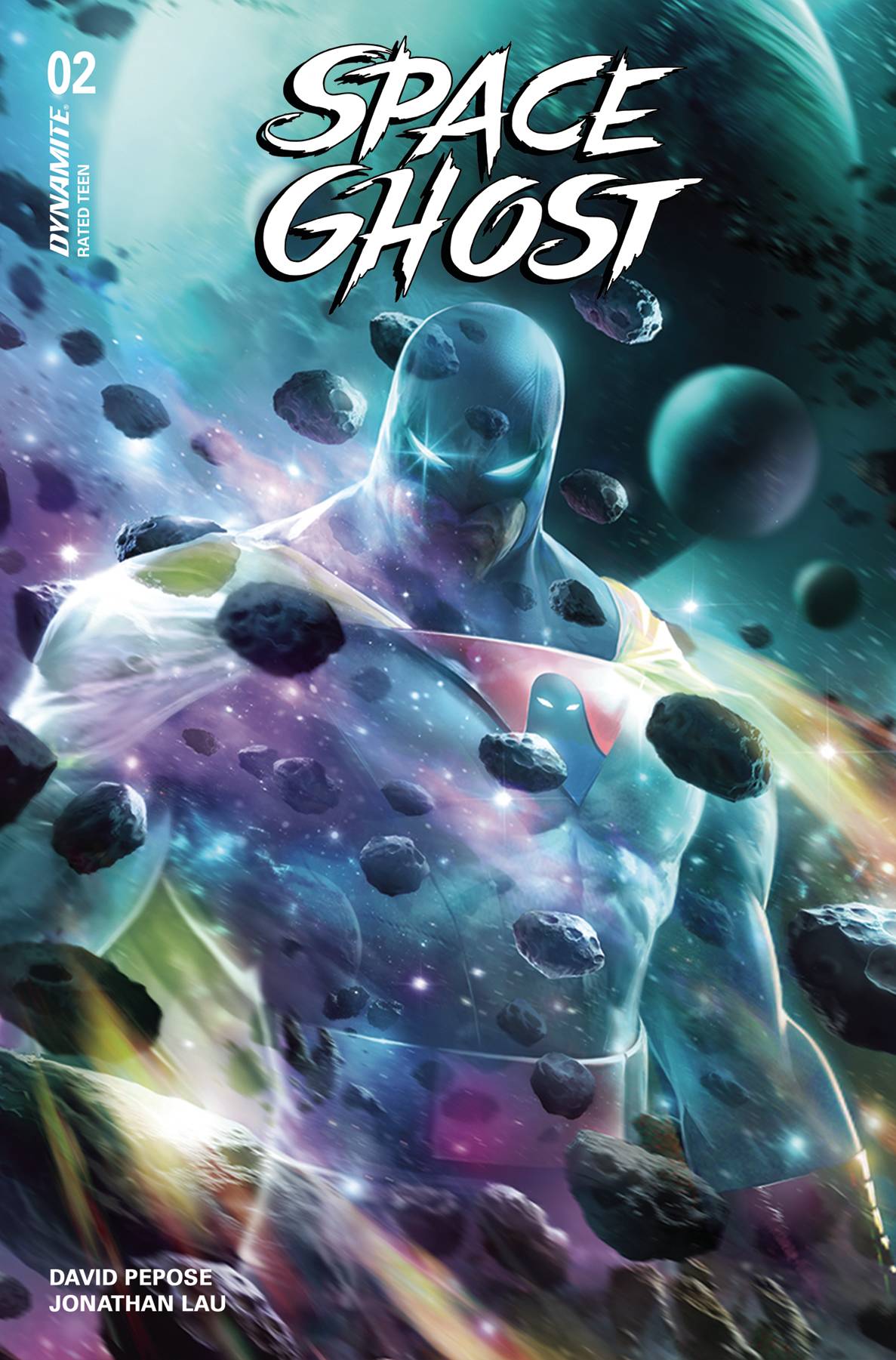
‘Space Ghost’ #2 Review: Less Grimdark, More Superhero
by Austin Gorton
Overview
Space Ghost #2 gives its title character an arc and is all the better for it; how much that will continue – and how much it succeeds thanks to borrow glory – remains to be seen.
Overall
7/10Given the popularity of the parodic and satirical Space Ghost Coast to Coast making it the most popular iteration of the character — at least within certain segments of the population — it’s worth asking: is there a demand for a relatively straight riff on the character in this day and age? That’s the question this series is implicitly answering, whether it knows it or not.
The first issue largely presented its title character at a distance, from the perspective of characters meeting him for the first time (the better to introduce him, in turn, to readers). Space Ghost #2 zooms in a bit. It’s still telling its story chiefly from the perspective of Jace and Jan. But as they are taken deeper into Space Ghost’s world, we get a better understanding of who he is. Ironically, given the central question at the core of the series, the bits in this issue that work the best are the ones which flirt with a more comedic take on the character.

The issue opens with a flashback to the title character’s pre-Space Ghost life and the events which led, at least in part, to him becoming a space vigilante. Admittedly, I am not deeply versed in Space Ghost lore (I didn’t even watch Coast to Coast — I know, I know). All I know is what I remember from watching the old Hanna Barbera cartoon as a kid — which isn’t much.
So I have no idea if this bit of backstory — in which Proto Space Ghost’s wife and daughter are killed via an attack on the Planet Vector — is a key piece of Space Ghost lore. Is this his “crime alley” or “Central Park mob war crossfire“? I can’t say (at least without doing some research). But it does immediately invoke similar vigilante characters, like Punisher and Batman, who are driven to crime fighting (or in Space Ghost’s case, space crime fighting) by familial tragedy.

The Batman parallels in particular continue throughout Space Ghost #2. Space Ghost flies Jace and Jan into his hidden headquarters inside a bat space cave. Their arrival is staged not unlike Vicki Vale’s in Batman ’89 (or if you prefer, Rachel Dawes in Batman Begins). Like the comic book Batcave, Space Ghost has trophies of past adventures adorning his cave. This Space Ghost’s words are short and brusque. He is ill-equipped to relate to — or even feed — his new young charges. The only thing they have in common is the tragedies in their respective pasts.
Intentional or not, the dynamic between Space Ghost, Jace and Jan mimics that of Batman and Robin, particularly the stories set in the early days of their partnership (furthermore, Jan is a bit of a computer whiz like Tim Drake, while Jace seems to share’s Jason Todd’s flagrant disregard for rules). By the end of Space Ghost #2, the subtle becomes overt: both kids are in superhero garb, similar to but more colorful than Space Ghost’s look, ready to fight by his side.
It’s hard to say how much writer David Pepose and artist Jonathan Lau are intentionally drawing these parallels. Even within the lexicon of superhero stories, there’s a specific language to these kinds of characters inspired by the old pulp heroes that makes some repetition impossible to avoid. But whether they intended to draw them or not, the parallels between Space Ghost and Batman open up some interesting avenues for the series.
For one thing, it gives the book an angle beyond “this isn’t your daddy’s sardonic talk show host Space Ghost!” You don’t have to squint very hard to see this series becoming a book where Pepose and company simply do riffs on Batman and similar pulp archetypes in a sci-fi setting. That could be fun. Combined with the strong character design that is really the thing that keeps Space Ghost a going concern, it could be enough to carry the series.

Yet the more the story embraces the Batman parallels, the further it moves away from the grimdark Space Ghost of the initial issue. That’s essentially the arc of this issue, moving Space Ghost from a super serious nigh monosyllabic loner to someone willing to dress Jace and Jan (and Blip) up in matching costumes and offers them a place fighting by his side. A Space Ghost who is a little less serious, a little more goofy, is probably more sustainable as a (entertaining) protagonist. But it still runs the risk of crossing into Space Ghost Coast to Coast territory.
A grimdark Space Ghost doesn’t seem terribly captivating, but it’s at least distinct from the more established version of the character. By splitting the difference, the series risks becoming bland and pleasing no one. But that’s a problem for the future. For now, Space Ghost #2 does the necessary work of fleshing out Space Ghost as a character, making him more than just a cool design kewly punching out bad guys. The larger concerns are future issues’ problems.

