
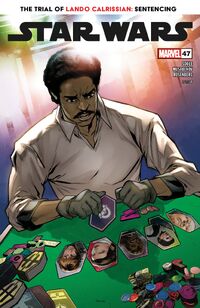
‘Star Wars’ #47 Review — It’s the System, Not Lando, That’s Out Of Order!
by Austin Gorton
Overview
“The Trial of Lando Calrissian” reaches its expected conclusion in Star Wars #47, but its success lies in the details of how it reaches that conclusion.
Overall
7/10The challenge always facing this series is finding ways to be unexpected. Furthermore, it has to do it in terms of both its characters and plotlines. This is important for any story, but it’s especially important in a book telling a series of stories featuring numerous characters and plotlines in which readers already know the ending.
Following the narrative and character zag of the previous issue, in which Lando helps rescue Mon Mothma but doesn’t get exonerated for it, Star Wars #47 continues to showcase the creators’ ability to do the unexpected, zagging yet again to end the trial in a way that leaves Lando more or less where he is when Return of the Jedi starts, but still contains a few twists and turns.

With all the judges back with the Rebel fleet, Star Wars #47 resumes Lando’s trial. But first it features a bit of action, as Lando suffers an assassination attempt at the hands of a Gonk droid expelling its poisonous waste gas into his cell (making Lando almost certainly the first Star Wars character to survive an attack by robot farts). Jokes aside, artist Madibek Musabekov does a particularly good job at rendering Lando choking on the toxic gas in his cell.
After making it clear she’s not buying the official explanation for the attack — a lingering droid malfunction due to the events of Dark Droids, Salli Georgio begins her defense of Lando. Her first witness is Lobot, who does the expected thing and speaks to Lando’s virtues. He points out that the crimes against the Alliance Lando’s on trial for were the results of his efforts to save Lobot. He also makes the point that Lando is loyal to a fault, he simply “tiers” his loyalties, meaning his loyalty to Lobot overrode his loyalty to the Alliance. Lobot’s overall point is that Lando’s not a bad guy, he simply got stuck in a situation where he had to betray one friend to help another.

Writer Charles Soule smartly uses this testimony to set up the next turn of the plot. For most of the trial, Lando has been reserved, offering little defense of himself. He didn’t even try to leverage his actions rescuing Mon Mothma into clemency. But hearing Lobot’s defense snaps Lando out of his funk. After making a deal with Leia to trade his knowledge of Han’s whereabouts to assure Lobot’s safety (thereby offering up an indirect explanation for why Luke and Leia’s RotJ plan takes so long to execute once they know Jabba has Han — they need the specific locational knowledge Lando now possesses to execute it), Lando basically flips off the court.
He points out to his judges that, in terms of the law, he’s no more guilty than anyone in the Alliance, all criminals of the highest order in the eyes of the Empire. Every one of them takes actions, regardless of the law based on their own morality. That’s ultimately all he did. He cares about his friends, he cares about the Alliance. If they can’t handle it, so be it.
Not only is this a fun twist — Lando neither continuing his sad sack response to the trial nor trying to echo Lobot’s defense of him — but it makes Lando an active player in his own exoneration (in a way other than helping rescue Mon Mothma or Han). Lando basically lays the “I’m not out of order, the whole system is out of order!” card, and it works.
It works (for readers) because Lando is an outsized character (even in a cast of princesses and warrior monks) and because readers are both already primed for him to win the trial and feel the Alliance’s prosecution is unfair (because we know Lando was only trying to help Lobot).

That it works in-universe is a little harder to swallow, given just how vociferously General Madine has been shown to be against Lando. While the tribunal coming to the conclusion of, essentially, punishing Lando by making him work for them doesn’t really make a ton of logical or legal sense, it works in the context of the Alliance as an organization looking to maintain some level of moral high ground (in this way, Mon Mothma’s discussions with her captor in the previous issue serves a dual purpose, pre-emptively setting up Lando’s morality argument here).
Yet Soule perhaps went too far in casting Madine as the necessary “bad cop” amongst the judges. In rendering him as someone almost frothing at the mouth to toss Lando out an airlock, it makes it harder to believe he’d go along with Lando’s “sentence” (to say nothing of stand in the same room with him plotting the assault on the Death Star in Return of the Jedi).
That misstep aside, Star Wars #47 is a successful conclusion to the “Trial of Lando Calrissian”. It finds ways to reach a known outcome in fun and unexpected ways, while keeping its title character an active contributor to his own defense (in implying that Salli was behind both the droid attack and Mon Mothma’s kidnapping, it also seems to be winking at the way the story sets up the most obvious out for Lando only swerve away from it).
The story ends, in general, exactly where we always knew it would end. But in taking some surprise turns along the way, it shows that the journey matters as much — if not more — than the destination. Any time this series pulls that off, it’s a win.
