Talking With Liam Sharp About ‘Ore: A StarHenge Graphic Novella’
by Olly MacNamee
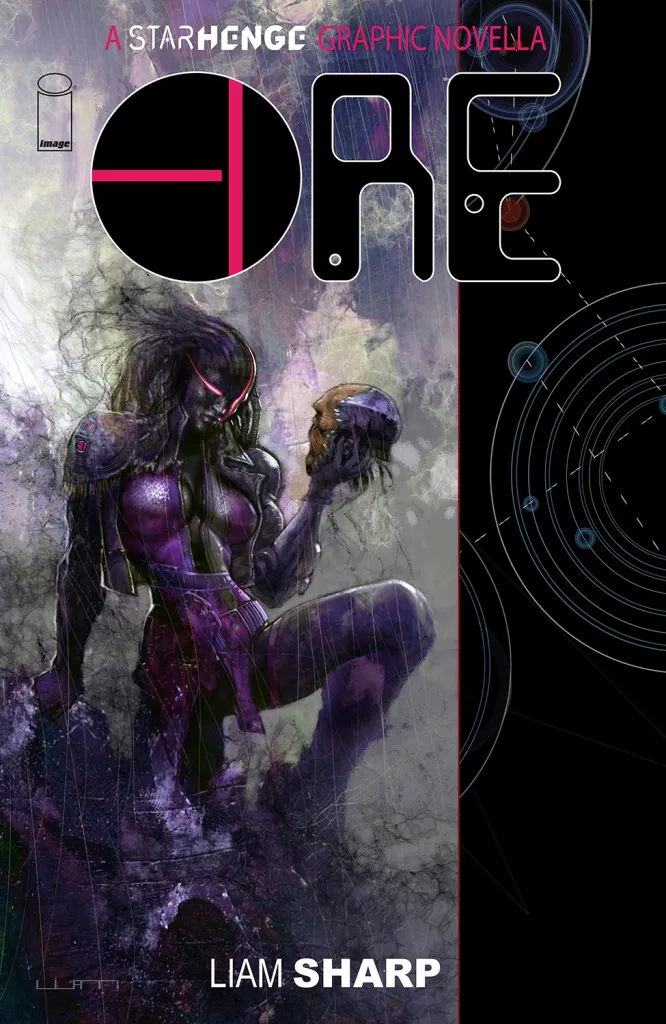
Liam Sharp‘s StarHenge — now nominated for an Eisner Award — has a sequel coming out later this year, Ore: A StarHenge Graphic Novella from Image Comics. Another blend of science fiction and fantasy filtered through the lens of Sharp’s creative words and imaginative and majestic art. The announcement alone was enough of an excuse for this fanboy to drop Liam a line and catch up with him to talk all about his upcoming new book. And his nomination, of course.

Olly MacNamee: First, let me congratulate you on both your recent comicon ‘Best Series of the Year’ inclusion and the far more impressive Eisner nomination. Given I know just how personal a project this is for you, how much does this Eisner mean to you?
Liam Sharp: Ah, bless you, mate! Appreciated! And yes – it means a ton. I’ve been at this for 39 years and it’s my first ever nomination. When it takes so long to feel like you make those kinds of lists there’s a bit of mental gymnastics you have to do, and you get good at brushing it off and doing your best to buy into the notion that awards don’t really matter. But then you get one and discover that they actually do – even if it’s just a personal thing! There’s a kind of sense of vindication, which people will say you shouldn’t need, but there it is! The late Paul Neary, who was an important mentor to me, was so incredibly proud of his Eisner. I think that gave the award extra heft in my young, impressionable mind.
I’m going to attend the event in San Diego, but I’m going to try to remember what Mel Brooks said about awards – that the nomination is the industry recognition, and winning is just politics. But obviously, it would be bloody amazing if I did win. I’d love that!
MacNamee: In Ore: A StarHenge Graphic Novella we’ve firmly moved away from the earthy Arthurian backdrop of much of StarHenge and into the realms of hard sci-fi and a universe-spanning epic of god-like proportions. I don’t think that’s too hyperbolic. But how would you best sum up this elegant-looking graphic novella?
Sharp: Honestly, Olly, as with StarHenge, I’m flying by the seat of my pants! I didn’t have any sense of whether it would land with audiences or not. I just made something for myself, that I know I would have loved. I’ve spent a lot of my career second-guessing what ‘might’ be popular, and that’s not always wise! Truly authentic work comes from a place where the creator is doing it with zero cynicism or expectations. This is very much that. It’s me trying approaches I’ve dreamed about for a very long time – full-colour work, epic scope, and a mix between sci-fi, fantasy and horror, as well as a kind of blurring of the lines between comics and illustrated books. But I think you summed it up pretty well. It’s large-scale hard sci-fi, which almost by definition means it is built on ideas as much as plot. At its most basic it’s the story of what happens to the Ur-Queen from StarHenge after her physical death, and how she weaponizes the new freedom afforded her in that process in order to directly wage war on the CAST, the automated alien AI antagonists.

MacNamee: While StarHenge was informed by various literary and artistic influences, what would you say were your main influences on Ore? Artistically it’s highly evocative of both classic Metal Hurlant and those classic prog-rock style sci-fi covers of the seventies. But what of your dense and sophisticated writing style? It reminded me of A A Attansio and his work on his Arthurian cycle of books that include a good deal of cosmic inspiration and densely written prose.
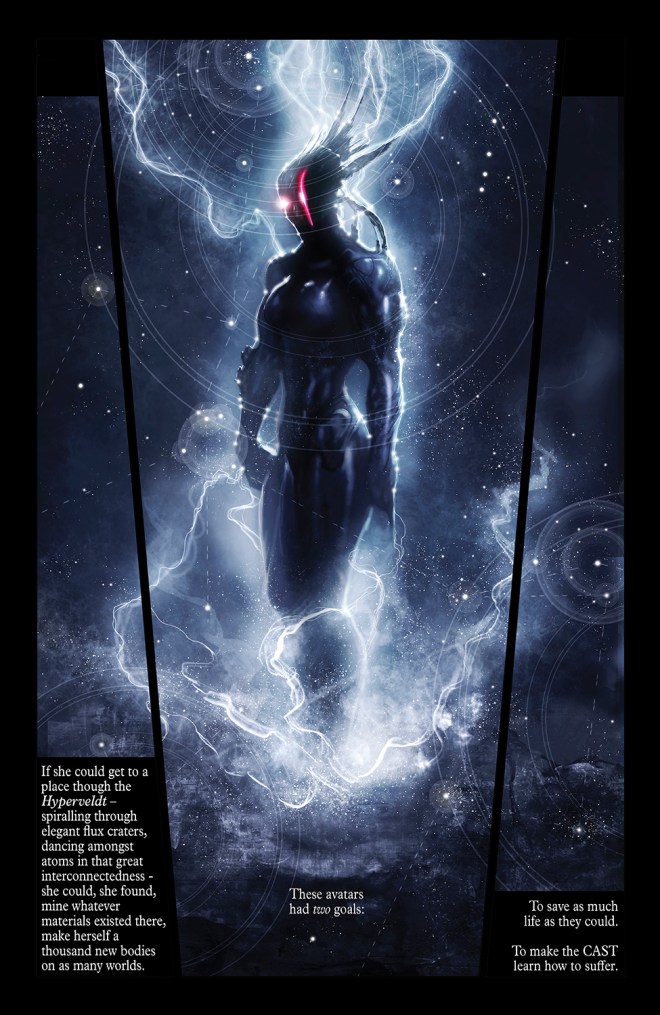
Sharp: I think with ORE the biggest influence, in many ways, is Howard Chaykin’s adaptation of Alfred Bester’s The Stars My Destination. That takes the entire novel and juxtaposes it against Chaykin’s wonderful sequential illustrations – so it is very much a graphic novel, not just a collected comic series. It hasn’t been made with 22 pages in mind, requiring the prerequisite cliff-edge endings of that format. It’s written in chapters. I think of ORE as a chapter in this massive saga, and similarly it is largely illustrated prose, with some comic-style sequences – and that’s why I called it a ‘graphic novella’. At 60 pages it’s not big enough to call it a novel, but it wouldn’t have taken much for it to be a pure prose novella either. I think the art, though, gives it added scope. I didn’t have to describe the scale of the ship hanging over a planet surface, I could just show it.
MacNamee: Since moving to digital art at the end of your Green Lantern run, how do you think that has helped develop your art to better realise your vision. Particularly on StarHenge where I felt your use of digitally assisted art certainly helped you better realise the various artistic influences you draw upon from the word of fine art. I’m thinking in particular of all those amazing landscapes that harken back to the landscapes of the 19th century artists like Robert Burns and Edward Charles Williams, or any number of Victorian painters specializing in landscapes.
Sharp: ORE is probably the last of that pure digital style I’ll use for a while, though I enjoyed it hugely. And you’re right – for some of the landscapes and hard sci-fi material it was the perfect medium. I’d have liked to have painted it traditionally, but it would have taken me years! When I was in my teens, and starting to seriously consider my future, I wasn’t sure if I wanted to be a comic artist or sci-fi or fantasy illustrator. A lot of my heroes were actually illustrators – Foss, Vallejo, Frazetta, Jim Burns, Peter Jones… the list goes on and on! And I loved to write too, so I often dreamed of making the kind of illustrated books popularized by the Dragon’s Dream and Paper Tiger imprints of Roger Dean and his brother. Both StarHenge and Ore are very much me scratching that itch, while just about staying in my lane as a long-established comic creator.
MacNamee: other than being immensely time consuming, are there any additional downsides to digital painting?
Sharp: Actually digital painting can be very fast, and you have the benefit of the medium being very elastic. You can keep changing it to your heart’s content – much harder to do traditionally! If you put a spaceship in the wrong place you’ve got to live with it or re-paint the whole thing! The only real downside is the lack of original art to sell. But I was putting the material first – in the same way Richard Corben viewed things, the printed book IS the art. That’s the end-game, the work you want to endure.
MacNamee: Without giving too much away, this graphic Novella seems bode nothing but bad news for the Celtic characters of StarHenge. So, what can we expect next in this ongoing space and time saga?
Sharp: Our protagonists have a long journey through multiple ages ahead of them, but I’m hopeful they’ll get through it!
MacNamee: And if any readers have a burning desire to read around the Arthurian source material your making use of, where might you pint them beyond Geoffrey of Monmouth’s The History of the Kings of Britain?
Sharp: I always suggest Nicolai Tolstoy’s The Quest for Merlin, which I’d say was the main source of inspiration. I’ve not read it since I was about 16, but the information and ideas it instilled have lived with me all this time. It really kicked off my wider interest in the material at the heart of the StarHenge saga. As for ORE, that’s a life-long love of hard sci-fi. It’s probably teaming with direct influences still sloshing around my subconscious!
MacNamee: It’s always a pleasure to catch up with you, Liam. So, here’s to catching up with you again soon and slainte to you!
Sharp: You too, Olly! Thanks again mate!