
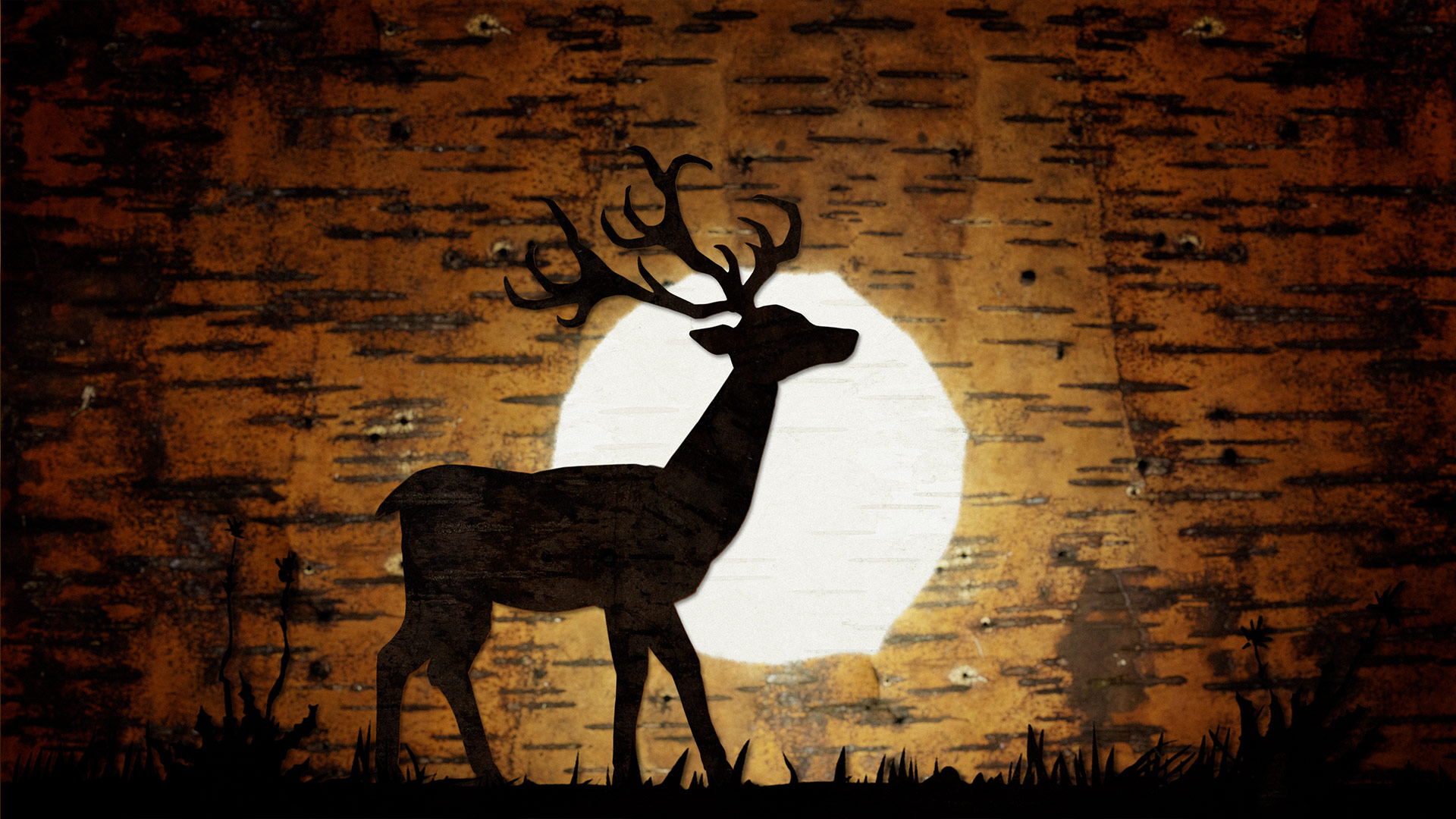
Phillip Gladkov Chats About His Birch Bark Animated Film ‘Story Of The Sun’
by Tito W. James
Phillip Gladkov is an ecologically-driven, sustainably-focused filmmaker who’s created the first film in history to be made completely out of birch bark. I had the chance to chat with Gladkov about his passion project, Story of the Sun.

Tito W. James: What compelled you to work with birch bark for animation?
Phillip Gladkov: Story of the Sun is a tale about how early humans discovered fire… How fitting, then, that this film is crafted entirely from birch bark — a material used to start fires as early as Neanderthal times. To tell you how I came to work with birch bark, I first have to tell the story of the birch trees themselves… Birch trees are pioneer species; they were one of the first trees to repopulate the land as the last ice age ended and the glaciers receded. From there came their symbolism of healing and rebirth. In areas where they grow, they are often the first to return after natural disasters, and they make the soil more “healthy” or tolerable for other trees and plants to follow. There is so much that we can learn from them.
Aside from their striking beauty, very quickly, early humans discovered the many uses and special qualities of these beautiful trees. From the nutritious and medicinal leaves and buds, to the nourishing sap, the glue-like (and also bug repellent) tar, resonant wood, and of course the pliable and incredible rot-resistant and flammable bark… this tree has served many uses for us throughout human history. All around the world, humans established a reverence and relationship with these trees.
And now we get closer to why I chose to work with birch… Not only did it fulfill our basic needs for survival, but it fulfilled our creative needs as humans. The bark peels easily from many species of birch trees, and it became one of the earliest forms of paper we used as humans. From 1st century Buddhist manuscripts, to the doodles and homework of Onfim, a young child from 13th century Russia, to the Wiigwaasabaks of the Anishinaabe here in North America, birch bark has played a pivotal role in human record-keeping and storytelling. In my own way, I am continuing that tradition while making art and teaching people about birch trees, ecology, and our relationship with the world around us.

But I’m sure you’re wondering how the birch bark actually came into my life… this is where the story gets more personal. Around 2015, my father came back from visiting his home country of Russia. He brought us back birch bark slippers, a birch bark container for storing bread, and a beautiful birch bark medallion (that I still wear almost every day). This medallion immediately mesmerized me. I do not know its symbolic significance, though it was clearly made in the style of older Slavic symbols and motifs. Birch bark is culturally revered in Russia and most of Eastern Europe, where it is widely used for utilitarian and craft purposes. At the same time I received this necklace, I was working on a documentary film titled 5 in upstate New York. I began to notice these beautiful white trees all around me. I was also beginning to explore and learn more about mycology and ecology, and naturally, it all began to coalesce. I started collecting the bark from dead trees, and soon I began making fine art collages out of it.
Birch bark, for me, became a way to connect with my cultural roots, a way to commune, learn more about, and interact with nature, and a way to participate in a creative expression that is tied into millennia of human existence. Naturally, my birch art merged with my passion for filmmaking and resulted in the world’s first birch-bark stop-motion animation: Story of the Sun.

Tito W. James: Folklore appears to be influencing Story of The Sun. What is folklore’s role in today’s society?
Phillip Gladkov: Folklore is the cultural DNA of humans. It is the thread that connects us to the knowledge and experiences of the past, but just like DNA, it also evolves and changes over time. I personally grew up on a lot of Slavic folktales as well as ones from all around the world. I do feel like our dominant culture here in the US has lost a lot of reverence for the art and practice of folklore. Maybe that has something to do with the struggle to preserve cultural identity through generations of assimilation… I don’t know. But I feel like that loss is tied in with a lack of reverence for the magical, the unknown, for nature, and for ways of perceiving, thinking, and living beyond the mainstream Western lens.
Some could argue that modern books, films and cartoons are today’s folklore, and in many ways, that is also true. After all, Story of the Sun is a contemporary myth, not one that has been passed down for generations (though I certainly wanted it to feel like one). I think what I like most about folklore is that, more often than not, stories are interwoven with morality and other lessons. It is a way to pass down knowledge in an entertaining and engaging way, and I think that is still happening to this day.
I believe it is equally as important to pass on folklore and myths from our ancestors as it is to adapt them and create new ones that reflect the world as we know it today – both for ourselves and for future generations.

Tito W. James: We are seeing animation being used to tell more layered and mature narratives. Are there some ideas that are better explored in animation?
Phillip Gladkov: I would say that animation is limitless. I’ve worked in both live-action documentary and narrative, and now with this latest film: animation. All mediums have their place at the table, but what I’ve fallen in love with about animation is the sheer vastness of what you can explore visually.
I think most narrative films could also be made as animations, but I don’t think the same applies in reverse. We’ve seen this often with live-action adaptations of animations. They just feel… off. Maybe it is because, although CGI has come such a long way, we can only suspend our disbelief so far. And yet, with animations, it seems that we can accept magical realism so much more easily. I think, for that reason, it is one of the strongest mediums. It can invoke the same amount of compassion from us as seeing a real live human, and yet it can explore so much more complexity visually. At the end of the day, the medium you choose is the one that is best for the story you wish to tell. I’m certainly excited to continue exploring stories through animation, but I know that I will continue working in other mediums as well.

Tito W. James: Many filmmakers explore ecological themes in their work. What filmmakers have inspired you?
Phillip Gladkov: There are so, so many… Firstly, though not related to ecology but important nonetheless, I have to shout out Lotte Reiniger. I highly recommend everyone look up her story and her work. She was a pioneer of animation and the creator of the world’s oldest surviving animated feature. Unfortunately, despite being a first in the world of animation, her legacy is often overshadowed by another famous animator who will not be named. Reiniger’s shadow-puppet animation style is a direct inspiration for Story of the Sun, and my birch puppets are a loving homage to her brilliance and innovation.
Staying on the topic of animation, my partner and I recently rewatched the Avatar: The Last Airbender series by Michael Dante DiMartino and Bryan Konietzko. While the series covers a lot of different themes, I loved the way they presented the harmony and interconnectedness of humanity, nature, and the entire world in a way that was both digestible for children and equally enjoyable for adults. That is no small feat. I think I’ve rewatched that entire series three times throughout my life…

Continuing with animation, Hayao Miyazaki is one of my biggest inspirations, both in terms of storytelling and illustration styles. Nausicaä of the Valley of the Wind and Princess Mononoke are two incredible films that portray a version of the world that is thrown out of balance due to the selfish behaviors of humans. Though, just like Avatar, there is a lot of magical realism, I think the lessons that are presented directly reflect the reality of man-made climate change and our disharmony with the natural environment.
Outside of animation, the film that inspired me to go to film school was Koyaanisqatsi by filmmaker Godfrey Reggio. His work touched me deeply, and I had not seen a film before this that helped me process and understand the world so profoundly. In the Hopi language, the word koyaanisqatsi means “life out of balance,” and that is exactly what Reggio’s film presents us with: a world of decimated nature, replaced by the chaotic onslaught of never-ending urban growth. Reggio’s work inspired me so much that, as my thesis film at NYU, I directed my own non-narrative film exploring similar themes. I would later send the film, titled 5, to Reggio, and he graciously called it “… a cinematic beacon of simplicity and beauty…” This inspired me greatly and reaffirmed my desire to continue making films about the things I felt were important.
There are so many more filmmakers that have touched and inspired me, and I am so grateful to them all. My hope is that someday, I can inspire others to care and to feel, just like those filmmakers inspired me.
I’d like to thank Phillip Gladkov for taking the time to do this in depth interview.
