
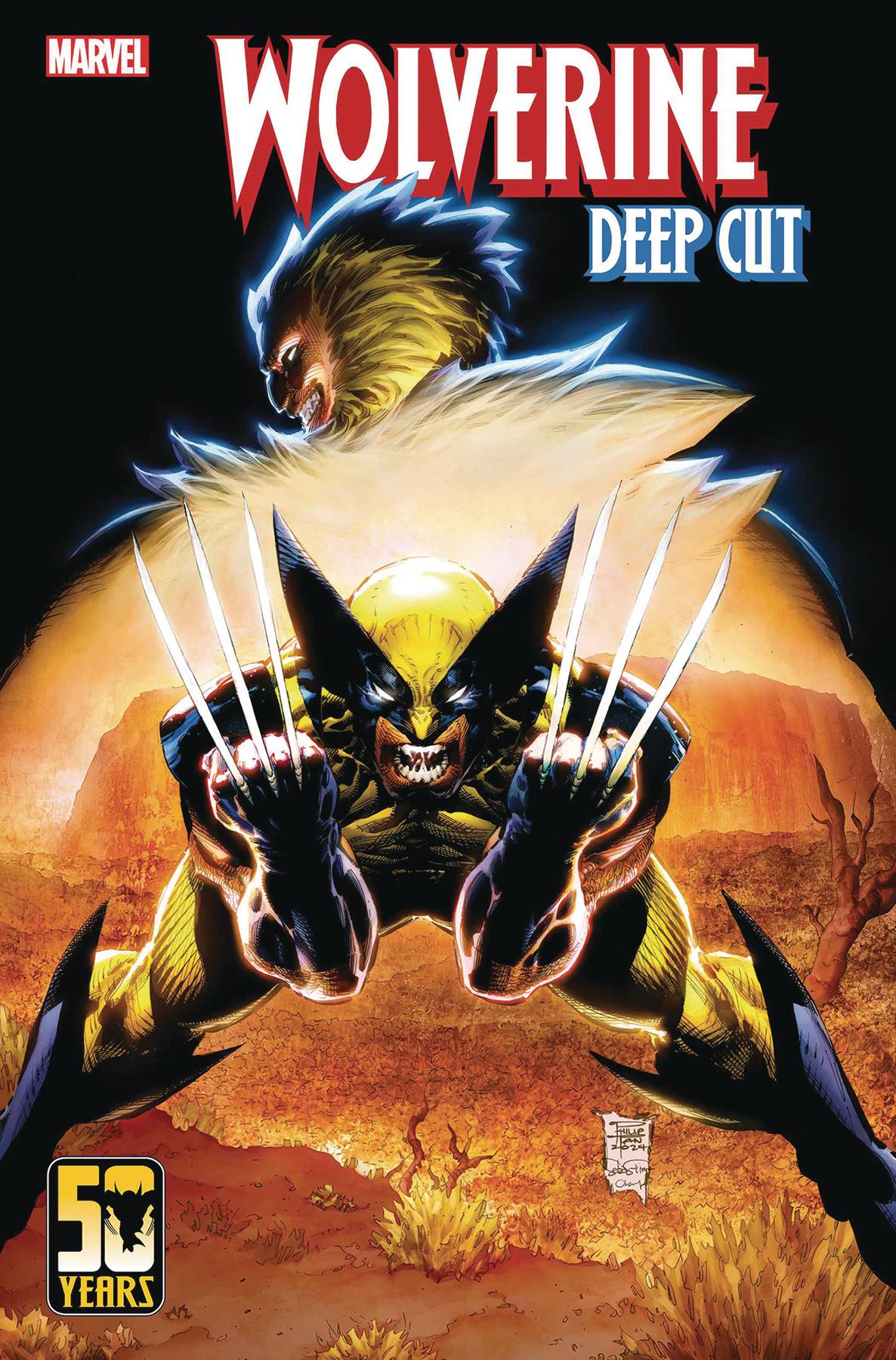
Reviewing ‘Wolverine Deep Cut’ #1 — Chris Claremont Is Still The Best At What He Does
by Austin Gorton
Overview
Chris Claremont’s mastery of Wolverine’s voice and X-Men continuity make Wolverine: Deep Cut #1 a successful start to another continuity insert miniseries, even if the immediate plot of the issue grows repetitive.
Overall
7/10Coming just one week after the conclusion of the last continuity insert Wolverine story, Wolverine: Deep Cut #1 is another Wolverine story set in the character’s past from the creative team of writer Chris Claremont and artist Edgar Salazaar.
Where Madripoor Knights chose as its somewhat questionable starting points the events of the Jim Lee-driven Uncanny X-Men #268, Deep Cut goes back a little further, to the time when the world believed the X-Men were dead but they were actually operating out of the Australian Outback as visible-only-to-the-naked-eye “legendary” heroes.
It’s an area of continuity with a little more room to explore. While Claremont, as is his wont, is careful to place this story in a specific point in that continuity, the setting of this issue feels a bit more engaging than the ultimately-successful Madripoor Knights did at the start of its tale.

Wolverine: Deep Cut #1 focuses on an untold encounter between Wolverine and Sabretooth. It takes as its starting point the convention (established by Claremont) that Sabretooth always stalks and/or attacks Wolverine on his birthday. Because at the time this story takes place the world believes Wolverine to be dead, this leads Wolverine to worry that for this birthday, Sabretooth will instead focus his violence on someone Wolverine loves: Mariko Yoshida.
To prevent this, Wolverine reveals himself to Sabretooth on the grounds of the Yoshida estate. What follows is an extended issue-long brawl between the two characters.
Right off the bat, Wolverine: Deep Cut #1 succeeds in large part because Claremont remains a master of Wolverine’s voice. While he didn’t create the character, perhaps no author aside from Larry Hama is as responsible for crafting the now-foundational characterization of Wolverine. All these years on, Claremont remains confident in his use of that characterization.
Other details may reveal otherwise (no knock on artist Edgar Salazar, but he’s no late 80s-era Marc Silvestri or John Buscema, nor is comic art today even constructed in the same manner as stories in those days, which were beholden to much more rigid panel and page constructions, amongst other things), but Claremont’s Wolverine still sounds like the Wolverine of the era in which this story is set. And because Claremont’s Wolverine still remains the definitive Wolverine, that voice doesn’t feel dated despite its setting.

It’s also impressive just how firmly Claremont sets this in continuity. Specifically, these events take place at the same time (or shortly after) Uncanny X-Men #246. In that issue, there’s a brief sequence in which Wolverine has a conversation with Storm that ends with him leaving for an unstated adventure; he would not return to the book until issue #251, the famous issue in which Wolverine is crucified by the Reavers because the X-Men have disbanded and the villains have moved into their base in Wolverine’s absence.
At the time, Claremont writing Wolverine out of Uncanny X-Men with issue #246 was meant to create a window in which stories from his solo series could occur. By recreating (and then embellishing) the Storm/Wolverine exchange from that issue here, Claremont and Salazar are establishing that the events of this limited series are the ones Wolverine initially left the team to participate in.
The creators also explores the continuity of this era beyond the recreation of those Uncanny X-Men panels. Salazar draws Wolverine in his yellow-and-blue costume, not his period accurate brown-and-tan one.
Claremont in turn is careful to note, via Wolverine’s narrative captions, that this is because Wolverine hopes it will confuse Sabretooth (why he isn’t using the laughable Patch identity Claremont established in Wolverine’s solo series as a means to maintain the “the X-Men are dead” ruse doesn’t receive an in-universe explanation; we can reasonably assume it’s because editorial and/or marketing wanted Wolverine to appear in this story in a more recognizable and marketable way).
Using the threat to Mariko as the impetus for the Sabretooth/Wolverine conflict is also a smart use of the characters’ history, one which Claremont often neglected at the time of the original stories (in which Mariko disappeared for large swathes of Claremont’s run).
Claremont and Salazar even sneak in a cameo appearance from Kitty Pryde, who at the time was part of Excalibur and believed the X-Men to be dead; she is shown keeping watch on Mariko alongside Wolverine’s long time ally Yukio, having reached the same suspicions regarding Sabretooth’s likely actions as Wolverine. It’s a little detail Claremont could have easily omitted, but it speaks to both Wolverine and Kitty’s characterization, and is a fun inclusion for continuity wonks like me.

Less successful is the actual plot of the issue which, all the continuity setup aside, is basically one very long fight scene. Claremont does his best through his command of Wolverine’s voice to make it engaging. And artist Edgar Salazar does his part as well, changing up the panel layout to keep the action from getting stale.
He also turns in some truly grotesque (in a good way) depictions of the toll the fight takes on both combatants as it goes on, to a degree that would have been impossible had this story been published in the late 80s. But at the end of the day, it’s hard to deny all the fighting in this issue doesn’t become a bit repetitive.
That aside, this is a successful first issue. While the extent to which Marvel continues to cannibalize its past at the expense of its future remains a concern, this issue is at least centered in a narrative cul-de-sac that offers richer narrative opportunities than the similar backwards-facing Madripoor Knights miniseries.
And in Chris Claremont, it at least features one of the defining authors of the title character, who illustrates his command of Wolverine’s voice throughout the issue. The action may, in the end, be a bit repetitive, but Wolverine: Deep Cut #1 is still a satisfying showcase for both its characters and its creators.


