
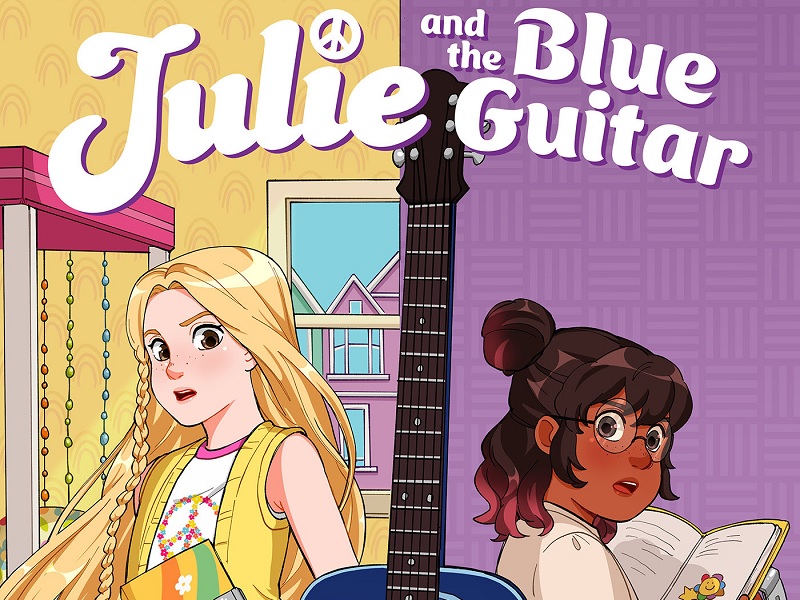
Talking ‘Julie And The Blue Guitar: An American Girl Mystery’ With Casey Gilly And Felia Hanakata
by Rachel Bellwoar
Emma isn’t exactly looking forward to starting a new school in the middle of the school year, so when she discovers the journal of a young girl from the 1970s, she’s happy for the distraction. Little does Emma know but she’s about to get pulled into a mystery thanks to writer Casey Gilly and artist Felia Hanakata‘s upcoming graphic novel, Julie and the Blue Guitar: An American Girl Mystery. With layouts by Sarah Stern, colors by Sunbiscuit, and letters by Joamette Gil, find out more about Emma’s investigation in the following interview with Gilly and Hanakata:

Rachel Bellwoar: Growing up, were you a fan of the American Girl doll books and, if so, was there one girl’s books you always read first?
Casey Gilly: Although I loved historical books as a kid, I wasn’t really aware of American Girl until I was in high school. Looking back, I’m not sure I would’ve connected with any of the girls at the time, since I was a super anxious kid with asthma who spent most of my time reading horror, watching X-Files … which is why I was so stoked to be able to work on this book! There’s such a thing as being too close to a license and it can be tricky if you’re both a huge fan and someone hired to write for the thing you love. Because I had separation, I was able to really focus on what I could do to make a unique imprint on American Girl and how I could include traits that would be important to kids like me. More on that later though when we talk about Emma!
Felia Hanakata: Unfortunately, American Girl doll books weren’t available where I lived, but I was a big fan of the Enid Blyton mystery books, so working on a mystery kids GN was like a dream come true!
Bellwoar: For this graphic novel, did you have a choice over which American Girl doll would be featured or was Julie always part of the pitch?
Gilly: Julie was always a part of it! This comic is actually an inspired adaptation of The Silver Guitar: A Julie Mystery, an American Girl book written by Kathryn Reiss in 2011. While the stories share similar beats, I was able to create the newest character — Emma Dhillon — and put my own spin on the original story.
Bellwoar: Usually American Girl doll books are set in the past. What was it like having to go back and forth between the past and the present and was it easy to make those transitions?
Gilly: It was very easy. I love writing licensed comics because I have a very natural ability to sink into the voices of characters, so it was always clear for me when I was focusing on Julie and when Emma was telling the story. They have a lot of similarities in terms of who they are, but their voices, vibes, and lives are very different.
Hanakata: Going back and forth between the past and present was fun and difficult at the same time, and I think the colors definitely helped differentiate the eras and set the tone of the book.
Bellwoar: While readers might be familiar with Julie, can you tell us a little bit about Emma and how you came up with that character?
Gilly: Emma Dhillon is an adorable, creative, thoughtful, and somewhat socially anxious kid. She and her father have just moved to San Francisco from a smaller Bay Area town and Emma is getting ready to start at a new school, which is making her incredibly nervous. She’s making a documentary as part of a school project and through that we see how much Emma loves telling stories. That’s where I started with her. I knew the new character would find Julie’s diary and I really thought about what kind of a kid would be activated and intrigued by that discovery — and then Emma began to take shape.
Hanakata: We created Emma to be a lovely, refreshing contrast to Julie — I had fun drawing her! She is a bit insecure but kind and determined, and I think her character arc and story wrap up the whole book in such a satisfying way.

Bellwoar: Is there anything from the ’70s you wish would come back in style and which clothes did you enjoy drawing more – Emma’s or Julie’s?
Hanakata: Hmm it was fun to draw the boho style from the 1970s and I think we still see their influence and inspiration these days! The 1970s clothes were a challenge to draw sometimes because of the cut and distinct silhouette, but I still had fun drawing them.
Bellwoar: Both Emma and Julie live in San Francisco. Has the city changed a lot since the ’70s and what was the research process like for this project?
Gilly: I lived in the Bay Area for over a decade and am a California native, so the research process was as simple as using the time I spent there as my starting point. San Francisco has a beautiful, empowering, and inspirational history–way too much to go into one 80 page graphic novel meant for young audiences–but what I wanted to focus on was the spirit of community. The people of the Bay Area are brave. They are activists, artists, organizers, and fighters who have stood up against injustices, people who faced cruelty and violence, and still stood for what was right. While the area has changed massively due to gentrification, politics, and industry, there is still a sense of community there unlike anywhere I’ve ever lived. I wanted that to be the connective thread between Julie’s childhood and Emma’s modern experience of the city, showing that this has always been a place where people cared about making the world better.
Hanakata: I studied in SF for a while and I think the city has definitely changed a lot since the ’70s. The editorial team was very detailed and thorough. Whenever I was stuck with something, they would help and provide me with relevant materials. Which were always a delightful surprise (phones looked so different back then!).
Bellwoar: Julie and the Blue Guitar could sound like Julie’s a musician but the blue guitar is actually part of a mystery Julie’s trying to solve. Was it fun getting to create a mystery from scratch and hide clues in plain sight?
Gilly: I didn’t completely create it from scratch–the idea of Julie trying to find the missing guitar was part of the original novel–but I did approach it differently due to the nature of the medium. When I write comics, I’m telling three stories at once: the story in the dialogue, the story in the panel/art direction, and the story that lies in the disparities between those two things. It’s harder to hide things in a comic because each moment, each beat, needs to drive the story forward both narratively and visually–so you’ve gotta be clever about what clues you show. I had a great time doing it and I truly hope everyone has just as much fun reading it!
Hanakata: Part of why I love comics as a medium is how we can pace the story with drawings and text. So it was incredibly fun putting the clues everywhere, panel by panel, while still keeping the mystery up. The back and forth between past and present also helped with clues and a sense of progression, and I think the story ended beautifully. I think one of my favorite moments to draw was Ethan chasing the cat across the mansion.
Bellwoar: Emma first learns about Julie after discovering her journal. Have you ever kept a journal or diary?
Hanakata: Yes! I have a diary and a planner I write in every day. It’s always nice to look back and flip through them.
Bellwoar: Thanks for agreeing to this interview, Casey and Felia!
Julie and the Blue Guitar: An American Girl Mystery is on sale now from IDW.
