Commentary: ‘Smiling Friends’ Pushes Animated Storytelling
by Frank Martin

Comedic animation is uniquely positioned to experiment and try new things, stretching the bounds of what’s possible with the medium. Stories are always trying to utilize new tools to tell a tale, but not everything is as versatile or flexible as comedic animation. It encourages wild ideas and concepts in order to capitalize on something out of the box. Smiling Friends does this by using not just one but an assortment of different animation styles to give off a unique feeling for every character and episode.
Created by Zach Hadel and Michael Cusack, the Adult Swim series focuses on absurdist comedy. The plot revolves around a company named Smiling Friends whose job it is to go around and make people smile. However, they don’t do this randomly. They are specifically hired and have clients who need to smile, and the company’s eclectic cast of characters works towards that goal.
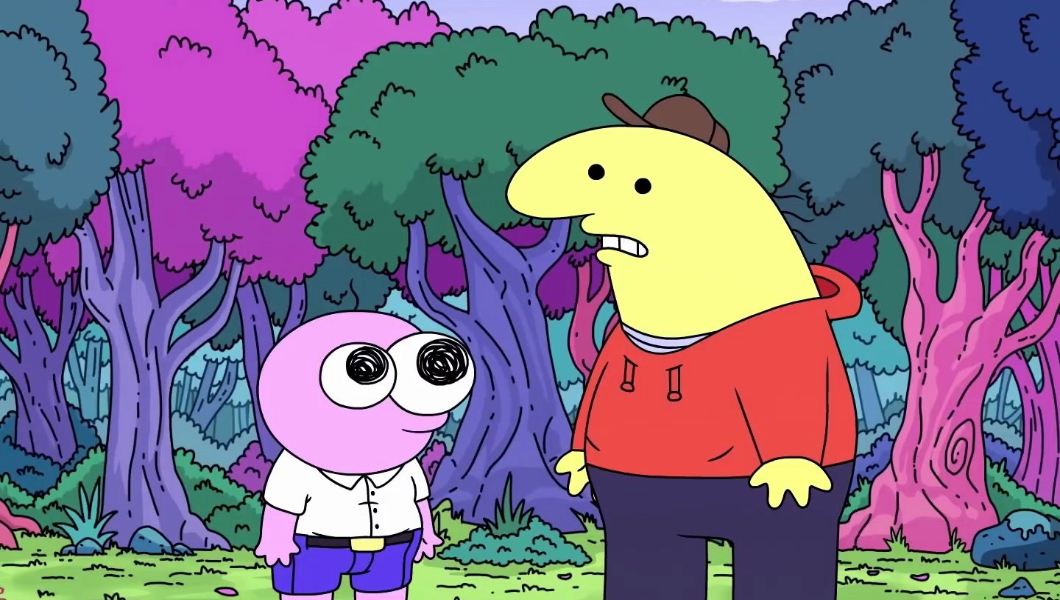
Smiling Friends can be so random and absurd at times that it’s hard to think of its storytelling as clever and purposeful, but utilizing different animation styles for its individual characters isn’t a random decision. Right from the beginning, it gives a sense that something is off with the show because the animation doesn’t match up. Even the main characters, who share an animation style, are depicted differently from the start, such as having different facial structures and body types. But the animation goes further by depicting guest characters as stop motion, rotoscoped, CGI, and even live action. This allows each character to have their own unique profile that separates them from the rest of the cast. The starker the contrast, the more that character stands out in the story. And the tone of the program allows this because of just how eccentric it can be.
Smiling Friends is now streaming on Max.