
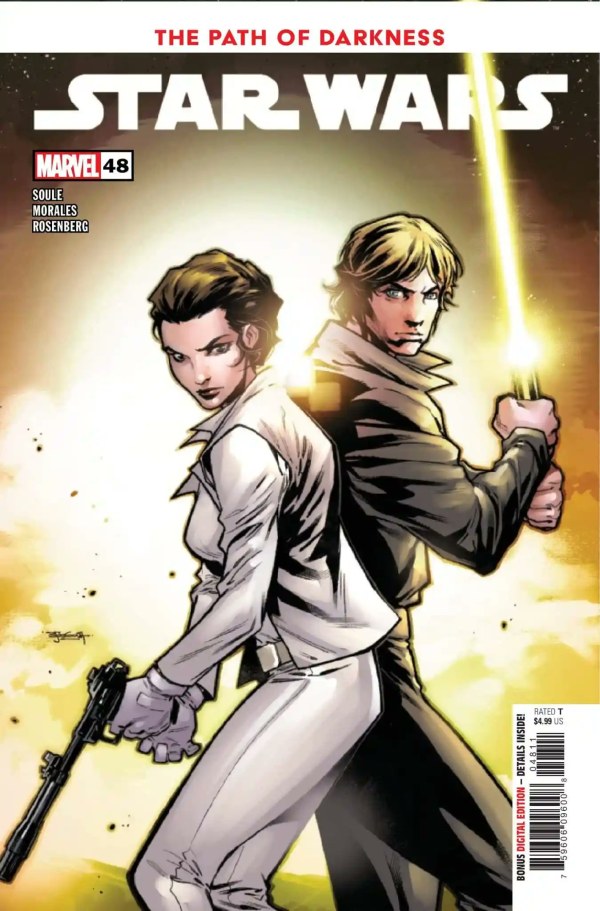
‘Star Wars’ #48 Review: A Strong Start To An Unfortunate Finish
by Austin Gorton
Overview
‘Star Wars’ #48 is a strong start to a Leia-centric story. Unfortunately, with the announced end of the series looming, it’s also a weak start to the book’s final story.
Overall
6/10It’s difficult to say that Leia has been entirely absent from the series of late. Even with the previous story being focused on Lando’s trial and the one before that on Luke’s journey inside a Kyber crystal, Leia has been around (particularly as part of Lando’s trial). Nevertheless, Star Wars #48 decidedly puts Leia in the spotlight as the focal character and driver of action. Given that this iteration of the series is drawing to a close, this makes sense: She has been the bedrock character of this volume, the person around whom the others (Luke and Lando) — and much of the supporting cast — pivot. Her return to the spotlight here is appreciated and helps elevate the issue.

The issue opens with a harrowing dream in which Leia is both witnessing and experiencing the destruction of Alderaan at the same time. This prompts a crisis of purpose for the multi-titled princess: with the second Death Star looming, the Alliance needs her. With the new information Lando gleaned from his sojourn through Jabba’s palace during the “Dark Droids” crossover, the potential for rescuing Han is greater than ever. And the survivors of Alderaan remain a scattered people on the run from the Empire. Her issue-opening dream prompts her to wonder: what does she owe them?
Of course, this is Star Wars, and a comic book, so Leia’s efforts to reconcile her struggle comes in the form of action, as Evaan Verlaine (the Rebel pilot and fellow Alderaanian survivor introduced in Leia’s first miniseries) pops up saying a fleet of refugees needs help. Before long, she and Leia (along with Luke) set out to help. Not only does this crossroads at which Leia finds herself give Star Wars #48 an internal and an external struggle to resolve, it helps set the stage for the end of the series — which is, of course, Return of the Jedi. Positioning the second Death Star and Han’s rescue as the focal points of Leia’s anxiety puts them front and center in the overarching series’ narrative. Anyone who has seen Return of the Jedi knows Leia will be addressing these concerns, more or less consecutively. Establishing they’re top of mind here underscores the looming conclusion of the book.

At the same time, the issue calls back its own history (another important “series finale” indicator) with the return of Commander Zahra. Now the seeming leader of a pirate band and much physically worse for wear, Zahra was once, for all intents and purposes, the central antagonist of this volume of the series. More importantly, she was a specific foil for Leia. The kind of dark mirror that the best antagonists serve as, Zahra was as dedicated to the principles of the Empire as Leia is to the Rebellion, with a particular zeal for Grand Moff Tarkin (the man who ordered the destruction of Alderaan), making the Leia/Zahra feud personal as well as philosophical.
On the flip side, the focus on Leia here has the unfortunate effect of narrowing the series at a time when it should be getting wider. This book has often set its characters off on adventures solo or in small groups (when it’s not participating in the semi-annual linewide crossovers). That’s certainly the case with an issue that starts in the midst of the Rebel fleet but zeros in on adventure featuring just Leia, Luke, and Evaan. But at the risk of writing an alternate story instead of reviewing the one presented, with just a few issues left before the series’ wraps, a bigger plot — something that pulls in all the books’ disparate characters and threads in the run-up to a Return of the Jedi handoff — feels necessary. Feature the central “Triple L” trio, certainly, but toss in Lobot, Chewbacca, and Mon Mothma; Admiral Ackbar and General Madine; Kes Dameron and the Pathfinders. Let’s send off the series with the larger Rebel Alliance coming together ahead of the big offensive in Jedi, not just a Leia-centric mission, no matter how personal or thematically-laden.

The lack of sweep, and the focus on a smaller “final mission” creates the impression — rightly or wrongly — that the end of the book is occurring abruptly, that this is just the next story on the docket rather than the one meant to end the book’s run. To be fair, writer Charles Soule does to counter this with Leia’s early-issue dream and struggles with prioritization. Bringing Zhara back for the book’s denouement also helps in this regard. It adds to the sense of looming finality, creating a “full circle” sensation that counterbalances, at least somewhat, the sense of abruptness surrounding the book’s upcoming end. Thus, taken on its own, Star Wars #48 is a strong start to a much-needed Leia-centric adventure. As the beginning of the book’s end, unfortunately, it’s much less successful.


