
Snap Into Marvel!: Cassandra Nova Is Already Tearing Up The Meta
by Austin Gorton
First Comic Book Appearance: New X-Men #114 (May 2001)
First Multimedia Appearance: Deadpool and Wolverine (2024) played by Emma Corrin
Powers: Telepathy on a scale that rivals Professor Xavier’s, as well as the ability to duplicate/manipulate her DNA and regenerative abilities.

Comic Book Chronicles
Cassandra Nova is the evil twin of Professor X — or his “Mummudrai”, a Shi’ar/Grant Morrison term for “dark self”. Introduced in the opening pages of Morrison’s foundational New X-Men run, Cassandra Nova introduced herself by orchestrating a massive Sentinel attack on Genosha that killed millions of mutants (a sequence recently adapted in the animated X-Men ’97, though Cassandra Nova wasn’t involved).
Motivated by the fact that Professor X tried to kill her when the pair were in utero (forcing her to be stillborn and live as a cluster of cells for a good chunk of her life), Nova followed up the attack on Genosha by trying to use Cerebro to wipe out all mutants on Earth.

A timely neck-snap from Emma Frost stopped her, but she transferred her mind into Xavier’s body at the last moment. Posing as Xavier, Nova outed Xavier as a mutant to the world, went into space in order to use Xavier’s relationship with Empress Lilandra to destabilize the Shi’ar Empire, then came back to Earth to again try to wipe out mutantkind with Cerebra.
Having grown wise to her ruse, the X-Men forced her back into her original body (still with a broken neck), after which Xavier and Jean Grey began a process of psychic re-education on her. Not long after, Nova popped back up in Joss Whedon and John Cassaday’s Astonishing X-Men, having planted a psychic suggestion in Emma Frost’s mind that led Emma to briefly turn on the X-Men. Nova’s ultimate goal was to get out of her injured body and into a new host, but she was stopped before this happened. Then the character more or less fell off the board for a number of years.

She returned to serve as the main villain in Tom Taylor’s X-Men Red, in which Nova battled a team of X-Men led by Jean Grey. There, her evil scheme involved using nanobots to stoke anti-mutant fervor. But Jean defeated her by forcing her to feel empathy for the first time, after which, Nova promised to atone for her evil deeds.
This came to fruition in the second volume of the Krakoa Era-Marauders, wherein Nova joined a time-traveling team of X-Men led by Kate Pryde on a mission far into the past. Though her intentions at the time seemed legit and the Krakoa Era was defined, at least in part, by offering a lot of villains second chances, neither Kate nor Emma Frost ever forgave Nova for her attack on Genosha. Together, they executed a plan which left Nova stranded in the past as punishment when the rest of the team came home, which is where she remains as of this writing.
Fit and Finish

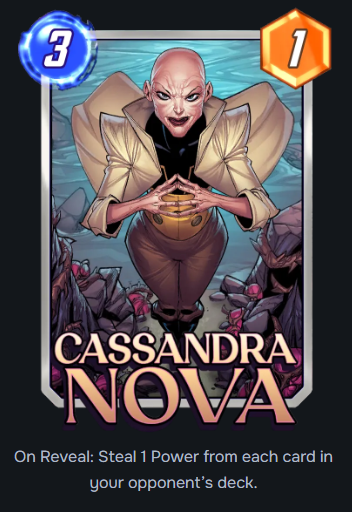
One could argue that Cassandra Nova’s base card is a good example of how to balance the comic book look of a character with her cinematic counterpart. Despite the fact that her card is released the week of the character’s appearance as the chief antagonist in Deadpool and Wolverine, it isn’t as obvious a movie tie-in as, say, most of the Eternals’ cards. With the jodhpurs and sharply-tailored coat, she certainly matches the look of Emma Corrin’s cinematic Nova.
Yet at the same time, the look isn’t far removed from the character’s earliest appearances in New X-Men. All the Cassandra cards also feature the character’s “older”, more wrinkled, appearance, vs. the younger (but still bald) cinematic version. Even the Kael Ngu variant is an image lifted directly from a cover of Marauders. The end result is a Marvel Snap character who is recognizable to both comic book and movie audiences, which really should be the goal of most cards.

Form and Function
In her short existence, Cassandra Nova has already made a significant impact on the meta. Arishem decks were losing their steam a bit prior to her release in Deadpool’s Diner, but has she’s found her way into more and more players’ hands, the “Arishem Meta” has cooled precipitously, giving players another key counter card beyond Darkhawk.
Even beyond countering Arishem, Cassandra Nova is a great card. Play her on curve against a ‘regular” deck and she’s a 3/7 – one of the highest-powered 3 drops available with the added benefit of gaining that power at the expense of every card your opponent is going to draw for the rest of the game. Increase her effect — either by bouncing the card, or via Wong, Grandmaster, Absorbing Man, etc. — and she becomes an even better card. Honestly, aside from the limitations that come with every On Reveal card, the biggest drawback Cassandra Nova has is that she becomes increasingly less valuable the later in the game she’s played (against any but Arishem decks). And even then, there’s ways to pad her stats in the late game (Korg, Rockslide, Black Widow, Master Mold, all of which also contribute to buffing Darkhawk). That simply means, even if Arishem play dwindles, there will likely still be a place in the meta for Cassandra. It also wouldn’t be surprising to see her get nerfed in the near future, so enjoy it while it lasts!

In terms of how Cassandra Nova’s Marvel Snap ability maps to her comic book abilities, the connection is a little murky. Her ability seems very specifically designed to counter Arishem. Given that her comic book power — massive telepathy — is one of these broad powers that can be represented a lot of different ways, it wouldn’t be at all surprising if this was an ability Second Dinner had worked out as an Arishem counter and then just found a post-Arishem release to assign it to. Yet for all that, it’s definitely not a random ability. The idea of growing powerful by taking power away from others very much fits Cassandra Nova’s vibe, particularly the way she manipulates others and/or uses her vast telepathic abilities to take control of them. It’s just a much less direct connection than, say, the card of a shapeshifter who copies the ability of another card.
