
Talking ‘Navigating With You’ With Jeremy Whitley And Cassio Ribeiro
by Rachel Bellwoar
Making new friends is not on Neesha’s agenda when she walks into Durham Western High for the first time, except she’s not the only new student that day, and, unlike Neesha, Gabby is very eager to make friends. Will Gabby’s natural charisma wear Neesha down? For more on their upcoming graphic novel, Navigating With You, check out this interview with writer Jeremy Whitley and artist Cassio Ribeiro below:

Rachel Bellwoar: For all of their different experiences, Gabby and Neesha start Navigating With You from the same place of being new students. Did you always want them to have that common ground?
Jeremy Whitley: Yes! My family moved around quite a lot when I was a kid and there’s nothing like that stomach churning feeling of your first day at a new school, especially when it’s not everybody else’s first day there. That’s a powerful and horrible feeling and you’ll find yourself holding on to any and everything that provides comfort. Even for somebody like Neesha who is resistant to meeting new people and making new friends, that’s enough to weaken those walls just enough.
Bellwoar: For some reason I didn’t see the switch coming but I really like how the book goes back and forth between Gabby and Neesha’s point of view. What was it like planning and pulling off those transitions?
Whitley: Thanks! We spent a lot of time filling out both characters and figuring out where they had come from and what they were dealing with when they weren’t with each other, so I knew I wanted to make that switch at some point. Figuring out how to pass the baton in a way that made sense on the page and let the reader know what we were doing was important. The breakthrough of using the texting pages to transition actually didn’t come until the second or third draft. The script had run longer than intended and we needed to make up some space. The text interchanges were great both for handing it off and covering more events in a small space. It also had the added advantage of really letting us into that intimate space of the text chat with the two of them. It helps us to see how they communicate and how their dynamic changes over time.
Cassio Ribeiro: The texting pages were a great idea because, in addition to advancing some events and the characters’ emotions, you also get a glimpse into their lives when they are not together. Sometimes one of them is watching a movie, another is sewing, or exercising. These small things add a lot to the characters.

Bellwoar: As someone whose often worn t-shirts with the hope of connecting with other people who share the same interests, I love that Gabby and Neesha start to bond after Neesha notices stickers from a manga she used to read on Gabby’s school supplies. How early did you know manga would be their ice breaker?
Whitley: That was part of the plan from the very beginning. There is nothing that immediately lets you know that a person is your type of person as sharing love for a very obscure piece of pop culture. I am a person who has owned a lot of very niche t-shirts in my day.
Beyond that, shared fandom sparking a lasting relationship is something that was really central to the idea of the book. Both at my table at conventions and online I’ve had the pleasure over the years of meeting lots of friends and couples who have bonded over my work and other pieces of media I love. In a world where so much discussion of fandom can be aggressive and toxic, I think it’s important to remember that some of the cutest couples and best friend I know started hanging out because they loved the same thing. Media has incredible power that way.
Bellwoar: Did you always want to include actual passages from Super Navigator Nozomi in the book, and were you inspired by any other manga when creating the look for the series?
Whitley: Yes! That was always the dream. I’m always disappointed in media when they talk about how good a piece of art is and you never actually get to see it. In our case, the fact that we were already making a comic made switching over to the manga make perfect sense to me. In fact, my original hope for it was a little bit too ambitious, because I had hoped we could letter it like a manga and then put the pages in our book upside down, so people would have to flip the book over and read right to left. That proved a little bit too difficult to pull off, but I’m really happy with how ours came together.
As for the inspiration, I wanted a little bit of that Sailor Moon “our heroine is kind of a wreck” flavor and some of favorites of mine like Revolutionary Girl Utena. I also wanted the feeling to shift a little bit and go from feeling like a traditional romance manga to a yuri. As for the visual style, I let Claudio play and do what he thought made sense. I think it came out looking amazing.
Ribeiro: Ever since I read in Jeremy’s script that Super Navigator Nozomi was an old manga, specifically a shoujo, I started looking for classic shoujos and remembered Rose of Versailles. So the art style I used in the manga is inspired by it and Space Battleship Yamato. It was important that the paneling was completely different from the main story. I was trying to think more of layers of panels like a lot of shoujo mangas do, instead of just grids one after another.
Another interesting thing is that I planned Nozomi’s pages in the Eastern reading direction, so the pages you read are actually flipped, as they used to do with some manga publications in the West.
Bellwoar: Both Gabby and Neesha make very conscious decisions about their attire. What was the process like, of figuring out how they would express themselves through their clothing?
Whitley: That’s something I’ve always admired about manga and that I think having a more diverse pool of creators has brought to modern American comics. You can tell so much about a person about how they dress and what they choose when it comes to fashion. It tells you about their motivations, their history, the things they pay attention to. It is a power comics have that is so much harder to establish in prose.
And I remember being a teenager. It always feels like life and death then. It also gave us a chance to highlight issues like school dress code and the way it condescends to girls. It also shows you a lot about Neesha’s insecurity and how she opens up and shares herself with Gabby by literally letting her see more of her.
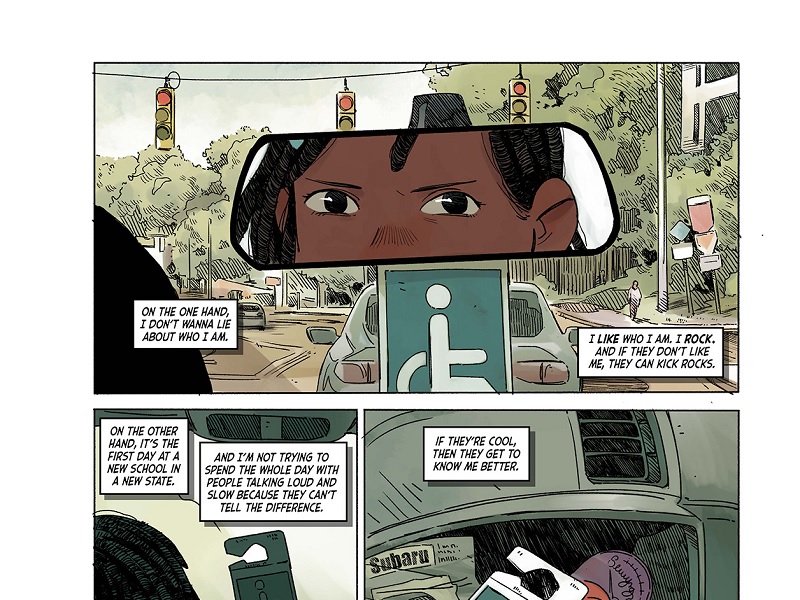
Ribeiro: Neesha wears multiple layers of clothing, along with long skirts and boots, to hide her disability. Besides that, I’m a fan of Twin Peaks, so sometimes I dressed Neesha like a character from the series without telling anyone, which matched well with the type of clothing Jeremy had envisioned for the character. As the story progresses, Neesha stops hiding and her style begins to change with her.
On the other hand, Gabby likes to be free and move around, and the clothes she chooses reflect that. She’s like an athlete; even in winter, you can see her wearing a windbreaker instead of an overcoat or a heavy jacket.

Bellwoar: It takes time for Neesha and Gabby to open up to each other and be vulnerable about their pasts. Did you have a master time line for when those reveals would happen and was it fun getting to show their growing fondness for each other through their facial expressions and body language?
Whitley: Some of it was pre-planned – like when Neesha would let Gabby push her wheelchair and when Gabby’s trauma would come out, but some of it ended up just being a nice surprise. I had the information about their exes noted down and I didn’t know what I was going to do with that, but the two of them going on a road trip during an awkward moment in their relationship really gave me a chance to open up that information and share it.
Ribeiro: It was important for the characters to behave differently from each other. While Neesha is more reserved and tries to stay grounded, Gabby is more like an extrovert, constantly moving her legs and arms, sometimes even in an exaggerated way, as if she were performing, which we later see she is actually doing. I tried to show the development of this romance visually. At first, it was only Gabby who leaned in and tried to get close to Neesha, sometimes even with a physical barrier between them. As their relationship progresses, they start to talk closer and touch each other more.
Bellwoar: Age doesn’t always determine maturity. Gabby and Neesha may be teenagers but Navigating With You treats their relationship seriously. Was that important to you from the start?
Whitley: Yes. I think even if we look back on our teen relationships as older people and see them as “not as serious”, that stuff is deadly serious to you as it’s happening. In the case of the two characters here, they’re both in very difficult places in their lives, trying to find where they fit in this new town. Neither of them is actually very receptive to starting a new relationship, but this one is sort of forged out of mutual trust and admiration and it grows into something special. I don’t think most people will have many relationships like that in their lives, so it’s important to me to take that seriously, whether we think this relationship is forever or not.
Bellwoar: Throughout the book we see Neesha have to advocate for herself and make calls over whether or not to speak up about her cerebral palsy. It’s a story that doesn’t get told and speaks to assumptions people have about what it looks like to have a disability. Is this a story you’ve been wanting to tell for a while?
Whitley: Yes! When I wrote Unstoppable Wasp at Marvel I created an engineer character named Taina as a supporting character. Taina has cerebral palsy and I got some great input into her character from a reader I met at the time, Quade Reed, who also has CP. I wanted to do a ton of more stuff with Taina, but unfortunately she was a supporting character who was part of a large cast in a book with a limited run, so I didn’t get to do half of what I would like to. Through talking to Quade and other people who loved Taina in that book, the desire to tell a story with a character with CP at the center grew. More importantly perhaps, to tell a romance story with a physically disabled character at the center where their struggles were treated seriously became something I really wanted to do. I brought Quade with me as a reader and consultant on this book because i wanted to hit on the common day to day stuff that goes with being a disabled person in a world that rarely has any concern for your wellbeing. Having Neesha not only deal with that, but be an intelligent and sometimes difficult character who is worthy of and wants love was so important. Hopefully that reaches people who need to see it and, perhaps more importantly, people who can see themselves and the assumptions they make about disabled people in the rest of the cast in this story. Maybe they’ll think twice next time they find themselves in the same spot.
Oh and I do think it’s important to mention when we’re talking about “what it looks like to have a disability” that Gabby very much has a disability of her own. It may not be physical or easily visible, but PTSD has a very serious effect on her life as she struggles with issues her friends can’t even guess at.

Bellwoar: Thank you so much for agreeing to this interview, Jeremy and Cassio!
With letters by Nikki Foxrobot and Micah Meyers, Navigating With You goes on sale August 13th from Maverick.


