
Review — ‘Alien: Romulus’ Is A Dark Horse Comic Book Come To Life
by Erik Amaya

The most important, non-spoilery take away from Alien: Romulus: it feels like a 1990s Dark Horse Aliens comic book come to life.
Set more or less 20 years after the original Alien, Romulus centers on a group of young people desperate to flee a failing Weyland-Yutani mining colony as the Company keeps changing the conditions of their contracts. Or, more accurately, the contracts their parents agreed to and they inherited. When a space station wanders into the colony’s orbit, the team find their opportunity to escape by using its cryo-tubes and cryo-fuel to reach a reported paradise nine light years away.
Of course, this is Alien movie, so you know that plan almost immediately gets upended when they encounter xenomorphs aboard the Romulus space station.
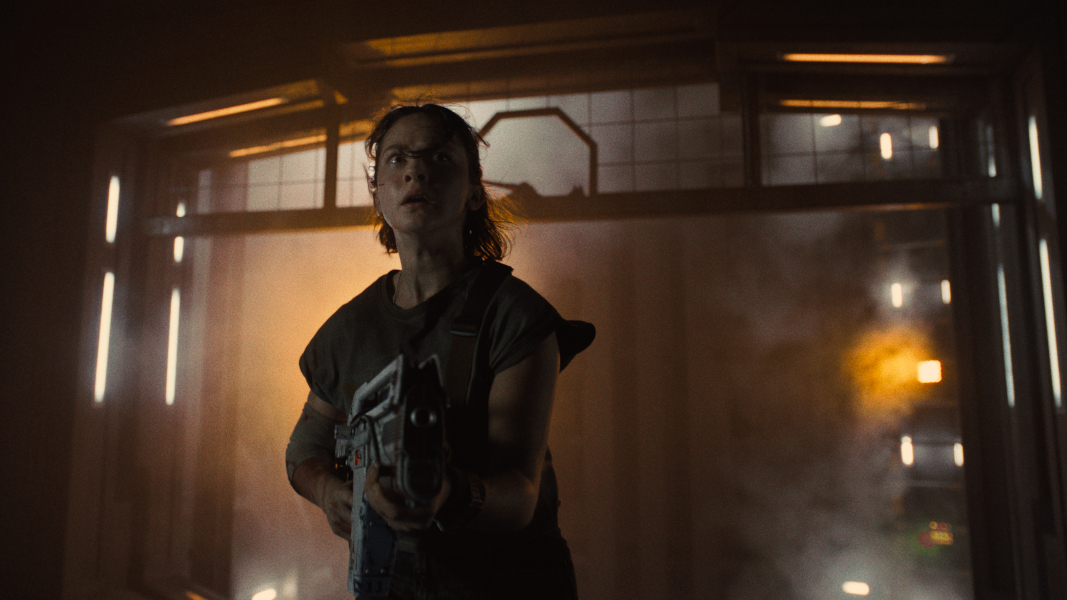
And once the Xenos make their presence known, writer/director Fede Alvarez and co-writer Rodo Sayagues execute some pretty tense, original, and wonderful set pieces with the creatures. In fact, the film features the best use of the alien in its facehugger stage to date. But there is a reason to note the setup prior to the mayhem. It reveals the dire straits of certain Weyland-Yutani colony worlds and gives the cast, headlined by Cailee Spaeny‘s Rain, motivation to face a techno-organic horror more preferable than the conditions they faced back home. In that, the story feels very much inspired by Dark Horse comics like Aliens: Genocide — tales more or less disconnected from Ellen Ripley’s (Sigourney Weaver) ongoing conflict with the Xenos, but nonetheless informed by the fact the real villain is (and always will be) the Company. Of course, the sensation in those comics and in Romulus has its source in the deeply cynical European sci-fi comics of the 1970s. Make no mistake: leaning into that is a genuinely good thing for Romulus.
Also a good thing is Spaeny as Rain. While the studio continues to embrace an Alien future without Ripley, it still respects that the protagonist must be a woman with a more awareness than her compatriots. In this, Spaeny proves an excellent addition to a roster which includes Weaver, Noomi Rapace, and Katherine Waterston. The reality of her circumstances is always there on her face, and the increasing desperation to survive the aliens and escape her world is palpable. We also appreciate that she’s not super-capable at the outset and is only part of the mission because of her relationship to an obsolete (yet still useful) artificial person called Andy.
David Jonsson is a revelation as Andy. The Industry veteran is just remarkable as a synthetic. He feels uncanny in a very appealing way and as circumstances change him, he even gets to be creepy. And for those who enjoy the ever-expanding lore of Alien, he also becomes the viewer’s guide into a new angle of Weyland-Yutani’s ambitions. It’s a pretty interesting wrinkle in the Company’s well-established aim to get a Xeno into its bi0-weapons division for study and, we hope, it continues to be an element of subsequent Alien films.

The two leads are supported by Archie Renaux‘s Tyler — a young man whose history never gets fully explain, but is more compelling for that ambiguity — Aileen Wu as kick-ass shuttle pilot Navarro, and Isabela Merced as Kay, Tyler’s sister with a secret. In Alien dynamics, she is also the Veronica Cartwright of the group; almost always in tears. Thankfully, she never grates in that aspect. That said, we expect some may come away from the film feeling she was short-changed.
Spike Fearn also appears in the film as Bjorn. It’s a thankless role, but he does a good job with it.
There is one other member of the cast. They do a remarkable job, but we won’t spoil the nature of that performance here (and don’t look at Romulus‘s IMDb page as it is spoiled there) except to say it is intensely creepy throughout.
Special recognition also goes to the special effects artists and stunt performers in the Xeno suits. Alvarez made a choice to do as much practical filming with the aliens as possible and the results make Romulus a much stronger picture.
In fact, we’d say 95% of it points to a good film — but the 5% that doesn’t work could ruin it for certain audiences. The biggest criticism to levy against it is, oddly enough, the callbacks to previous Alien films. While it makes some very clever use of ideas from Prometheus and Alien: Resurrection — in fact, its use of a Resurrection concept is so well executed, we wish that other film never used of it — other echoes, particularly in dialogue, fall flat. One quote references an event that will not happen in the Alien timeline for another 30 years, so it feels inorganic and out of place. So much so, we have to wonder if an executive demanded it be put there to “please the fans.” But as a fan of this series going back to the late 1980s, I can tell you it had the opposite effect and moved an A or A- movie into B+ territory.

Additionally, fans of Alvarez’s previous films may find Romulus a little bit tame. Sure, its tension is top notch and a handful of moments are pleasingly repulsive, but it also lacks for the filmmaker’s usual gory flare. Granted, a level of restraint is a hallmark of Alien storytelling to make the more intense moment pop. Nevertheless, those who enjoy the director’s penchant for grotesque images may be disappointed.
Alternatively, this reviewer may be desensitized to Alien gore and this is a much more graphic movie than he thinks.
Despite that 5% of flaws, we think Alien: Romulus is a tight (just two hours long!) and well-crafted Alien film. It knows its job and does it well without trying to be grandiose in its aims. It also proves the series has the best potential out of all the titles Disney purchased in the last 15 years to be a proper director’s showcase. The only throughline required is the goals of the Company. For the moment, though, it is nice to have genuinely tense Alien film in theaters.
Alien: Romulus opens this Friday.
