

Review: ‘X-Factor’ #1 Works Too Hard For A Weak Premise
by Austin Gorton
Overview
A disappointment, X-Factor #1 features an overly-complicated, muddled premise which relies too much on mischaracterization and mean-spiritedness to land its satirical punches.
Overall
2/10Though it’s only week six of From the Ashes, it feels like the rollout of new series has been going on forever. This is, in part, because every book has thus far been entirely distinct from the other in terms of setting/setup, meaning every first issue has to do all the work of establishing its premise (instead of being able to lean on shared elements, beyond “Not Krakoa,” across the line for shorthand).
The feeling of “new status quo exhaustion” may also be heightened this week due to the release of X-Factor #1, the most premise-heavy of the new books yet. This is a book with a very distinctive hook and tone, and moreover, one which seems to have something capital-M More to say than the other new X-Men books. As such, it spends a lot of time setting up its premise. Unfortunately, the end result leads to an open question about whether or not all that work was worth it.
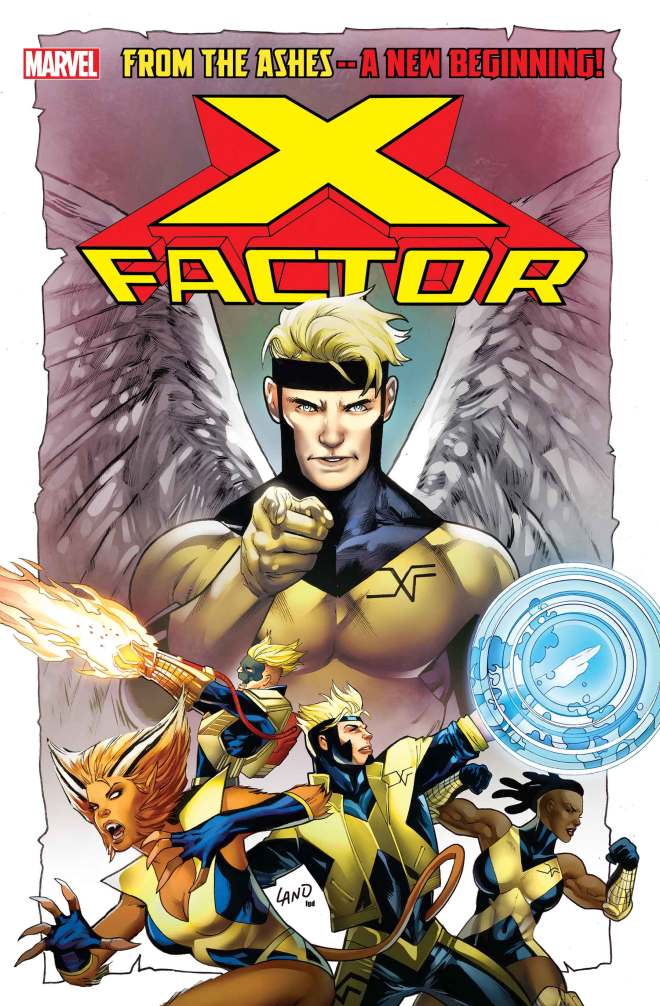
Through the years of its existence, the team name “X-Factor” has been applied to groups with a wide variety of missions: fake mutant hunters trying to rescue mutants, public-facing mutant superheroes, government agents, private investigators, corporate-sponsored heroes-for-hire. The “From the Ashes” iteration of the group introduced in X-Factor #1 represents a hodgepodge of several of those “takes”.
The brainchild of media producer Rodger Broderick with financial backing from the US government while their adventures are broadcast across social media platforms like the thinly-veiled TikTok stand-in “ClikClok”, this version of X-Factor combines elements of the corporate-sponsored, government-backed, public-facing and, at least for their first mission, mutant-hunting iterations of previous groups. As such, it is a series primed for social and political satire. Which is not surprising, coming as it is from writer Mark Russell, who’s made a name for himself using familiar IP as a vehicle for satirical commentary on books like Snagglepus and The Flintstones.
Yet this version of X-Factor also shares DNA with a different mutant book from the past as well: Peter Milligan and Mike Allred‘s X-Force-turned-X-Statix series from the early 00s. That was also a series with a satirical bent, a cast of in-universe celebrity mutants, and a penchant for killing off said cast with aplomb. This is one of the places where this newest incarnation of X-Factor stumbles. Without getting into spoiler-y details, by the end of X-Factor #1, it’s clear this is another book which, like X-Statix, isn’t afraid to use the death of its cast members as a satirical tool.
In this book, however, that device is much less effective, largely because while X-Statix churned through original characters, here Russell is offering established (if C-list or worse) mutant characters for the metaphoric meat grinder. Rather than reading as edgy or pointed, the whole exercise comes across as mean-spirited; the book is laughing at, not with, its cannon fodder.

The issue and its satirical perspective also isn’t helped by the confusing status quo of mutants in this post-Krakoa era. When the new X-Factor is introduced at a red carpet event, Russell and artist Bob Quinn establish seemingly conflicting groups of protesters: on one side are humans who hate mutants. On the other are mutants who hate X-Factor for selling out.
Other “From the Ashes” books suggest that the post-Krakoa mutant diaspora is a scattered, largely-underground one. Mutants are being hunted, by remnants of Orchis or the US government. Yet here, mutants are presented as a cultural force, albeit one now missing the foundational support of the mutant nation of Krakoa, able to stand side-by-side at a public event with its anti-mutant counterpart. During the protest, representatives from both sides are depicted in one panel with a shared speech bubble, each shouting “Go back to Krakoa”. What the point of this is, is unclear, aside from a vague and regressive “both sides-ism”.
Similarly regressive is a later scene between Havok and Polaris. These are two characters who have a history with X-Factor (having served as members of both the government-backed team and the PI teams), so their presence isn’t unexpected and, on the surface, appreciated. Yet their discussion about the nature of this new X-Factor paints Havok as even more of a himbo than other recent stories; just because his apparent stupidity is acknowledged on-page doesn’t make it any less palatable to see him championing this new X-Factor’s mission (it’s also not 100% clear whether we’re meant to agree with Havok or Polaris in this argument).
The redevelopment of their romantic relationship (which technically happened in an issue of the Marvel Unlimited-specific X-Men Unlimited series meant to set up this issue) is another notable bit of backtracking; despite their shared history, both characters had largely moved past it in recent years, yet here they are, romantically linked once more.

That kind of “mischaracterization for the sake of making a point” is present throughout the issue. Feral, a savage mutant who served on Cable’s first militant X-Force and later the terrorist Mutant Liberation Front, has apparently never used plastic explosives before. Another X-Factor recruit is Cecilia Reyes, a mutant doctor whose defining characteristic for decades has been explicitly NOT wanting to get drawn into traditional superhero shenanigans. The antagonist of the issue is Darkstar, a Russian mutant from the 80s who has never been written as being expressly pro-mutant let alone as a militant mutant supremacist but now is one, because the book needs some “bad” mutants for the team to fight in order to make its grand point.
Ultimately, these kinds of lapses in characterization or thematic heavy-handedness can be overlooked if the end result is exceedingly thought-provoking or entertaining. X-Factor #1, unfortunately, is neither. It works too hard to establish its premise for too little gain. Its characters are misused in a manner that feels more mean-spirited than cuttingly-satirical. All in service of a broader point that is, at best, muddled and, at worse, deeply regressive.
History suggests X-Factor is a book that can support a unique — and often, more political and/or humorous — status quo within the broader context of the X-Men narrative. The question this iteration of the series inherently asks — and, in this first issue at least, answers in the negative — is whether it even should.


