
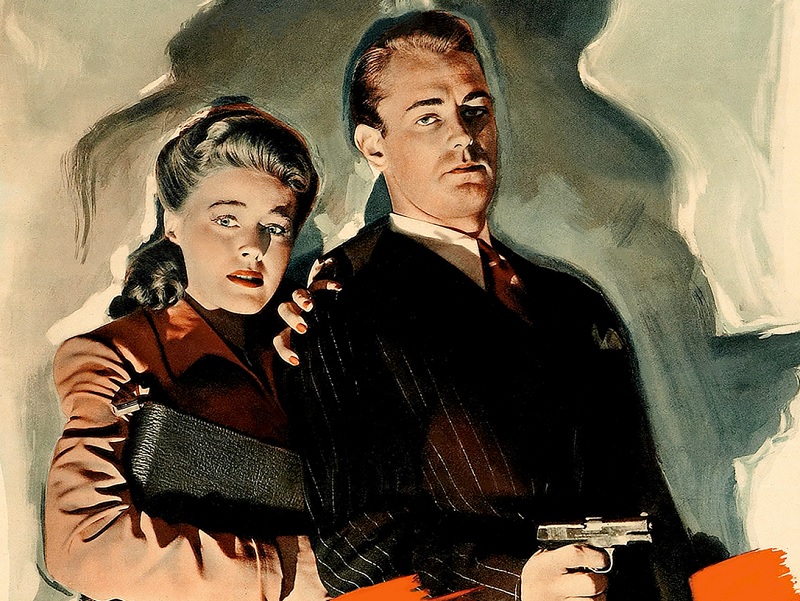
Alan Ladd Double Feature: ‘Thunder In The East’ And ‘Lucky Jordan’
by Rachel Bellwoar
Alan Ladd plays a gangster and a criminal in two films where how people respond to his character can make all the difference.
Frank Tuttle‘s Lucky Jordan (1942)

If I hadn’t been reviewing it, there’s a very good chance I would’ve turned Lucky Jordan off early. I’m glad I didn’t, though, because Lucky Jordan is a tough film to categorize. What it starts out as isn’t what it stays being.
As a gangster, Lucky Jordan (Ladd) is used to buying his way out of everything, which is why he thinks he can bribe his way out of being drafted. Instead of the army whipping Lucky into shape, though, he ends up deserting and getting pulled into an espionage plot involving a briefcase that contains an important report the Nazis want to get their hands on.
Lucky Jordan works the least as a war film and feels more apiece with the gangster films Ladd would become known for and which I personally don’t enjoy, though they have plenty of fans. When the film starts going into propaganda/spy mode, however, it’s a lot more fun and makes incredible use of its locations, like a toy store where Lucky goes to meet one of his associates (Sheldon Leonard) and the garden that acts as the final set piece.
The biggest problem with the film is how much it coddles Lucky Jordan. His love interest (Helen Walker), for example, tries way too long to make excuses for why he’s the only soldier who can sit around all day in the canteen. Eventually, however, she catches on, and that’s when there are some surprises. There’s also a subplot involving a drunk (Mabel Paige) who Lucky Jordan tries to pass off as his mom that has a much bigger payoff than expected.
Basically, while Lucky Jordan may rub some viewers the wrong way at first, it’s a film that’s worth sticking around with to the end. Kino Lorber’s Blu-ray also includes a commentary by film historian Samm Deighan (The Legacy of World War II in European Arthouse Cinema), who provides some great historical context (like what Walker’s character’s role in the women’s auxiliary army corp would’ve been) and looks at all of the subgenres that Lucky Jordan falls into.
Charles Vidor‘s Thunder in the East (1952)
Sometimes a cast can make you ignore the warning signs and there’s no question I went into Thunder in the East braced for the worst. To that end it is a movie about the end of British colonialism in India where a number of cast members are in brownface, so that’s always going to be the case. What’s surprising is how good the film is despite proscribing to contemporary views about what was considered acceptable film makeup and casting.
Steven (Ladd) is a pilot who’s illegally flown an arsenal of weapons into India because he thinks, since the rebels are moving to seize power there, that the maharaja (Charles Lung) will want to buy the shipment from him. To Steven’s frustration, the only person he can get into see is Mr. Singh (Charles Boyer), the maharaja’s right hand man, who has a picture of Gandhi on his desk and who is determined not to use violence.
In their commentary, film historian Lee Gambin (whose recent passing is a gut punch to the film community) and costume historian Elissa Rose talk about the decision to name the fictional town where this takes place Ghandahar (a possible reference to Gandhi) and the white savior trope. What I appreciated about this movie is that Steven keeps making bad decisions long past when a Humphrey Bogart-type anti-hero would begrudgingly start to help. As the American who’s answer to everything is guns, Steven’s selfishness is called out constantly and not just forgiven (especially not by Deborah Kerr’s Joan). Rather the person who keeps trying to do the right thing and doesn’t let Steven push him around is Mr. Singh, who finds himself in this High Noon situation that keeps getting worse and worse (I always appreciate when films don’t water down the harshness) yet doesn’t cave (the last few minutes confuse the message but they also act as a reminder that this film is being made by Hollywood).
Both Thunder in the East and the commentary on Kino Lorber’s Blu-ray are well worth seeking out. Other topics covered by Gambin and Rose include the dignity Kerr brings to her performance as a blind woman, the casting of Boyer (whose image as a romantic lead gets changed when he’s asked to play someone of Indian descent) and the waste of Corinne Calvet in a Casablanca-esque subplot that never goes anywhere (unfortunately it sounds like that was par the course in her career).
Lucky Jordan and Thunder in the East are both available on Blu-Ray from Kino Lorber.


