
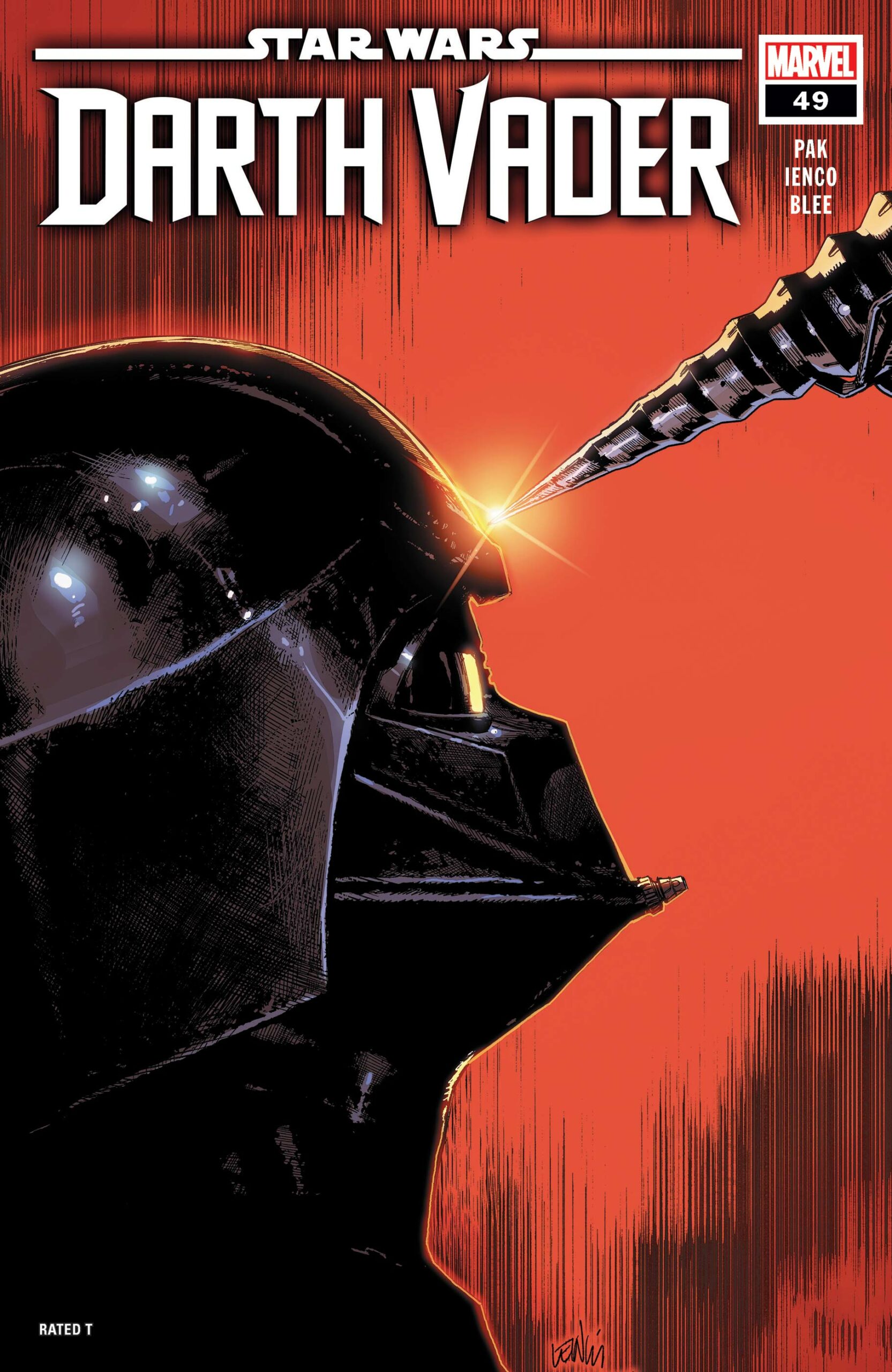
Review: ‘Darth Vader’ #49 Is Busy And Overstuffed But Finds Room To Entertain
by Austin Gorton
Overview
Darth Vader #49 is an overstuff issue filled with too many characters fighting for space, but the core premise, of Vader and Luke finally being drawn together, keeps it from being a complete wash.
Overall
6/10As the penultimate issue of this iteration of the series, Darth Vader #49 is perhaps a bit too overstuffed with plot. It’s entirely possible this is the ending, if not for the series, then for the Schism Imperial storyline, that writer Greg Pak has had in mind all along.
Regardless, it’s ultimately trying to cover too much ground too quickly, and the looming series finale does little to lessen the feeling that there’s a rush to wrap things up. That said, it’s not a complete wash, thanks in large part to the long-teased coming together in its pages of Darth Vader and Luke Skywalker. Even if the plot points to get there feel a bit rushed, it’s an important enough moment for the book to paper over the flaws.

The issues opens with Vader a captive of the Rebel M.A.R Corps following the betrayal by Administrator Moore and the Schism Imperial. Sometime between issues, they’ve hopped from Exegol to an Outer Rim planet and commenced torturing Vader by taking control of his cybernetic body the way he previously controlled them. Meanwhile, the Schism Imperial converges on Luke, Sabé and Warba, turning Vader’s Kyber weapons on Luke.
Their attack creates a “the enemy of my enemy is my friend” scenario across the issue. First, Vader uses the attack on Luke to strike an uneasy alliance with the M.A.R Corps. By revealing the threat to the hero of the Rebellion, Vader is able to reach an accord with his captors, and proceed to move in defense of Luke.
All else aside, this creates a unique dynamic within the issue. Luke is the ostensible hero of the Star Wars narrative at this point in time, yet in the context of this book, in which Vader is the hero, Luke is an antagonist. That makes this basically one of those stories where the Fantastic Four have to team-up with Doctor Doom against an even greater threat. It’s an especially interesting dynamic given that the series is about to end, and lead directly into Return of the Jedi in the process.
The image of Vader using the Force to save Luke from a Kyber blast takes on a whole new meaning when the fact that he’ll very shortly be trying to kill Luke aboard the second Death Star is taken into account. It’s also another instance where Pak’s somewhat maddening back-and-forth throughout the series regarding Vader’s feelings about Luke work to the story’s advantage. Is Vader acting to protect his son out of genuine paternal concern, or because he still harbors the desire to turn Luke and use him against the Emperor, or because he wants to be able to curry favor with the Emperor by presenting Luke himself?

Outside the interplay between Luke and Vader (which occurs almost entirely on the structural/thematic level – they still don’t physically interact with one another), the rest of the issue suffers under the weight of how much else is going on. Between Vader and the M.A.R Corps, the Schism Imperial, Luke, Sabé and Warba, there’s entirely too many characters running around.
There simply isn’t enough page space to serve them all. Sabé, once the de facto co-lead of this series, utters a few lines of expository dialogue and little else. The M.A.R. Corps get a panel to remind readers of their individual names, but there’s not enough room for any of them to do anything that makes remembering their names worthwhile.
This, in turn, leads to the art being cramped as well. With so much going on, there’s not enough room for the art to build up and sell the big moments. Because there’s so many characters involved, everything is rendered at a sort of medium focus, with multiple characters wedged into each panel, making it harder to track where everyone is in relation to everyone else.
To artist Raffelle Ienco‘s credit, the beat for beat mechanics of the plot are still easy enough to follow. It’s just that art has a workmanlike feel to it; there’s simply too much to do in terms of basic storytelling to leave room for injecting the story with any visual verve or excitement.

Yet for all that, the momentum generated by the coming together of plot threads and the impending end of the series gives Darth Vader #49 with energy to make it an entertaining read. There’s too many characters and the art struggles to keep it all straight, but at its core is the drawing together of Vader and Luke. The series has teased this often enough that to finally see it coming to fruition is enough to overcome the issue’s flaws.


