
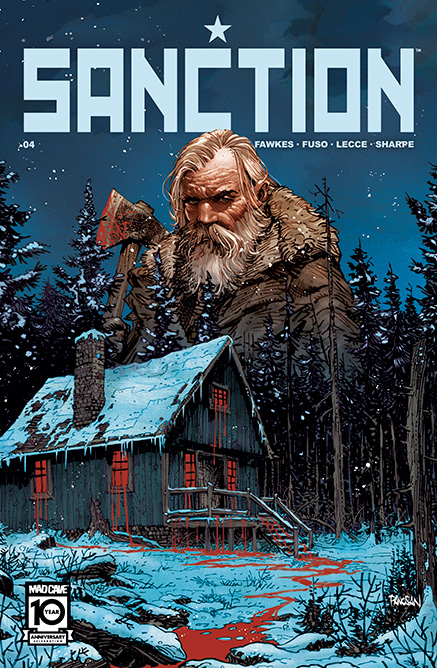
Review: The Real Villain Becomes More Clear In ‘Sanction’ #4
by Austin Gorton
Overview
With the conclusion imminent, Sanction #4 effectively offers more details on the motives behind the killings at the heart of the story, but risks undoing the thematic impact of the story in the process.
Overall
7/10Picking up directly from the cliffhanger ending of the previous issue, Sanction #4 represents the story’s most in depth analysis of the killer behind all the murders Dimtrovich (and to a lesser extent, Smirnoff) have been investigating. In doing so, it advances the overarching theme of the book — that the killer is just a symptom, not the disease, with the true villain of the tale being the Soviet state — in ways that effectively setup the conclusion of story for next issue, while also risking the loss of some impact regarding what the story is trying to say.

The interrogation of the killer, the closest thing to a name he provides is “The Angel of Ice,” quickly reveals just how much he’s more a manifestation of a theme than a character in his own right. He talks about confessions, killing people marked for death, etc. all while showing no remorse. He is basically a bunch of serial killer clichés wearing a trench coat. But that’s fine, because it’s already been established that he’s just a tool for the great evil of the oppressive Soviet state. Where the issue risks faltering: taking that idea and making it more literal.

Over the course of Sanction #4, it becomes clear to Dimitrovich that the Angel of Ice isn’t just an unfortunate by-product of the state’s insistence on covering up murders and maintaining the illusion of stability in Leningrad at all costs. Rather, he is working as the agent of a specific individual within the apparatus of the state, someone who is using the Angel of Ice as a de facto hired killer. There are ways this could work out well. The identity of the Angel of Ice’s “boss” is saved for the next issue. Depending on who it is and their motivations, the overall point of the story may emerge intact; particularly if that person, in turn, is revealed to simply be the agent operating on the behalf of a broader conspiracy.
But by making the state’s involvement in the Angel of Ice’s crime more direct and personified via a specific individual or individuals, the story risks losing the thematic punch that makes its setting so pivotal. If it all turns out to just be another guy — albeit someone part of the official government apparatchik working on behalf of the state — who is telling the Angel of Ice to kill for his own reasons, then all the Soviet trappings matter less.

More effective in Sanction #4 is the way this reveal impacts Smirnoff. He takes more of the punishment in the encounter with the Angel of Ice, and is more than happy to take the credit and adulation for his capture offered by his superiors and move on. But once he’s attacked by someone clearly ordered to take him and Dimitrovich out because the latter won’t just let the case go, he gets on board; the attack serving as proof to Dimitrovich that Smirnoff isn’t part of the conspiracy. It is, of course, a very selfish motivation: he only decides to throw in with his partner and risk his career after a failed execution attack. But it is very consistent with how Smirnoff has been portrayed throughout the story. And the end result is the two characters, fully aligned for truly the first time, charging into action (just before the issue ending cliffhanger leaves Dimitrovich in peril). Which is a great vibe to take into the story’s climax.


