
Talking ‘Godzilla’s Monsterpiece Theatre’ With Tom Scioli
by Rachel Bellwoar
Godzilla isn’t in Tokyo anymore. In fact, he’s in 1920s New York thanks to writer-artist Tom Scioli‘s new series Godzilla’s Monsterpiece Theatre. If you’ve ever wondered what Jay Gatsby would do if Godzilla threatened his beloved Daisy, now’s your chance to find out and Scioli answered a few questions about the series below:

Rachel Bellwoar: As a Masterpiece Theatre fan, when did you first latch into the idea of dropping Godzilla into a period setting?
Tom Scioli: It’s kind of a winking title, so I didn’t think too much about Masterpiece Theatre, but now that you mention it, that’s where I watched Jeeves and Wooster, which kind of fits into the 1920s Gatsby milieu. Thinking about it, an alternate title for this series could be All Creatures Great and Small. I used to watch Masterpiece as a kid. Maybe you had the same experience with it as me. When I was little and my parents would turn it on and I’d be thinking “oh noooo, this is soooo boring.” You get a little older and there’s an occasional series or movie on there that catches your interest and before you know it you’re watching Downton Abbey every week.
I was just reviewing Fantastic Four #9 for my YouTube channel, The Total Recall Show. Mister Fantastic loses all their money in the stock market and they’re being kicked out of the Baxter Building. I was thinking this is like that one season of Downton where Lord Grantham loses the family fortune. Is Julian Fellowes a Fantastic Four fan?
I didn’t expect to talk about Masterpiece Theatre, but yeah it seems obvious in retrospect. Sherlock Holmes has had a presence there too. This is the first time anybody has asked me about Masterpiece Theatre. People have mentioned Sesame Street’s Monsterpiece Theatre hosted by Alistair Cookie.
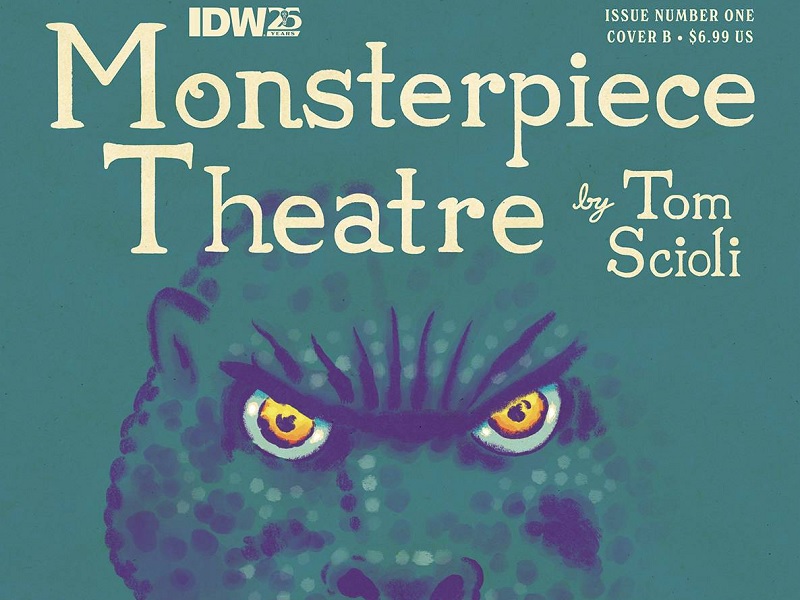
Bellwoar: Both of your covers for the first issue are showstoppers. Have you always liked Francis Cugot’s cover for The Great Gatsby and what was it like to put your own spin on it?
Scioli: We read Gatsby in high school, so I remember staring at that cover. It’s so bizarre when you really study it. I’m a fan. It was so much fun to riff on that illustration. Replacing Daisy’s eyes with Godzilla’s was impossible to resist. As an illustration, Cugot’s original is a type of mark making and a way of thinking that’s pretty far removed from the comic book mode I usually work in. It’s nice getting an opportunity to stretch like that and hopefully learn a few things in the process.
Bellwoar: While your other cover teases some of the people Godzilla’s going to be running into, there are still a few surprises. Why did you choose to have him encounter so many literary characters in particular?
Scioli: I like working with ensembles. I like world building and I wanted to give Godzilla a broad canvas to inhabit. Each of those characters brings a locale with them for Godzilla to stomp.
Bellwoar: Were you inspired by any paintings or comics from the 1920s when coming up with the look for this series?
Scioli: I’m trying to think of what visual influences were there specifically from the 1920s. General early 20th century influences and late 1800s influences would include old book and magazine cover art, etchings and lithographs. This series has a lot in common visually with comic strips of the 1920s and ’30s like Mutt and Jeff, Life With Father, Little Orphan Annie, Gasoline Alley, the limited use of color, the bold yellows that are part of early comics.
Bellwoar: Gatsby is in many ways a novel about class and in the first issue we see how blind the wealthy of Gatsby’s sphere are to what’s happening right outside their window. Why do you think they were the ideal audience to have contend with a kaiju monster?
Scioli: It’s like the 1920s era, that it’s this extended party, an era of “prosperity” and vast wealth that seems like it’s going to go on forever, until something comes along to sweep it all away. It’s an age-old story that’s been told in various eras. The fall of Rome. The fall of Atlantis. The Fall of Camelot. James Cameron’s Titanic. The story of Adam and Eve. The comics industry in the 1990s. This lost golden age where it seems like we’ve reached the pinnacle of civilization, an eternal golden age that’s gone in an instant. Except this time instead of a flood or a volcano it’s Godzilla here to “eat the rich.”
Bellwoar: Thanks for agreeing to this interview, Tom!
Godzilla’s Monsterpiece Theatre #1 goes on sale October 23rd from IDW. The FOC date is September 16th.


