
Lore Of The Rings: Who Or What Is Tom Bombadil In ‘The Rings Of Power’?
by Erik Amaya
The history of Middle-earth is vast but also incomplete. Where other fantasy realms have fully charted histories, author J.R.R. Tolkien never finished working out the finer details of his lore. In that gap lives a lot of choices in terms of transmedia adaptation. These are often in display on Prime Video’s The Lord of the Rings: The Rings of Power television series. In Lore of the Rings, we’ll take a look at some of the choices made in the series and how they line up (or diverge) from the Professor’s intentions, notes, and ideas.

While old Tom Bombadil is one of the Professors favorites, he presents a huge problem for those trying to adapt The Lord of the Rings into a dramatic presentation like a play or film. First, he inhabits a part of the narrative that, ultimately, obstructs of the primary objective: getting the Hobbits to Bree and Aragorn. Second, he undercuts the threat of the One Ring as he is demonstrably immune to its powers and corruption. Also, if one were to attempt a dramatization of the conflict with the Barrow Wights, he ends up a sort of deus ex machina — perhaps literally — in the translation.
For these and other reasons, director Ralph Bakshi, and writers Chris Conkling and Peter S. Beagle, cut him entirely from their animated The Lord of the Rings. Peter Jackson and co-writers Fran Walsh and Phillippa Boyens followed suit decades later in The Lord of the Rings: The Fellowship of the Ring. The character’s deletion makes absolute sense in the confines of a film and even noted Tolkien devotee Christopher Lee (who also played Saruman in the Jackson films) admitted that though it was “sad” to leave him on the page, the movie could go “on and on” and off the rails if it included Tom and the Old Forest material.
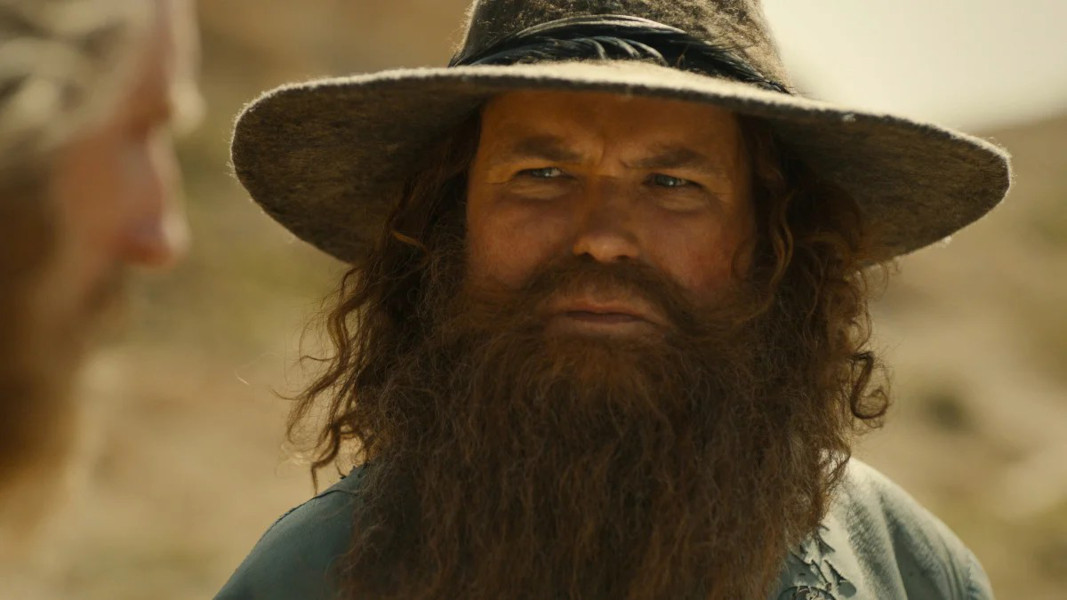
The Rings of Power plays by different rules, though. Its story takes place thousands of years prior to The War of the Ring depicted in The Lord of the Rings and, as a television program, it has the bandwidth and time to include a curiosity such as Tom. And while musicals and foreign Rings adaptation have included him, actor Rory Kinnear stepped up to play the merry fellow in last week’s RoP episode, “Eldest.” But in an equally curious twist of the writing, he is not an obstruction to the journey, but its seeming destination.
Or, at least, he leads The Stranger (Daniel Weyman) to believe as much.
And while not as whimsical as the Tom Bombadillo the Hobbits encounter in the book, he is still enigmatic and may leave those less familiar with the lore to wonder just who — or what — he’s supposed to be. Even those who delve into the lore will still be left a puzzle as the Professor never really offers a concrete answer either.
We do know his real world origin: he was a toy Tolkien’s son Michael enjoyed playing with. That joy soon spread to poems about the doll’s adventures in a mythical woodland realm. And his charm proved so irresistible that he became part of Tolkien’s Hobbit sequel even before its full shape was known to him. But with only the poems and his Lord of the Rings appearances to go by as published text, he ends up a vague and curious being Tolkien never completely accounts for and must dismiss as a possible aid in the days to come during the Council of Elrond. In that chapter, both Gandalf and the Elf-lord claims he is too unconcerned with events outside his forest to truly sense the danger presented by Sauron and the Ring.
So what does the extended lore tell us about him? Surprisingly little. We really only have the poems published in The Adventures of Tom Bomadil and his own testimony to Frodo to go on. But here’s what we can surmise: he is the “eldest” being who recalls the world before the first tree and drop of rain. The Ring has no hold over him, which suggests he may be more powerful than Sauron even if Elrond later claims the Dark Lord could best him if the forces of Mordor made their way to his realm. He is married to river-woman’s daughter, Goldberry, who is seemingly a spirit of the Withywindle river. Their wedding occurred sometime before the Third Age. He has command over the trees of the Old Forest, but his power extends only to its borders.
The paucity of information about Tom leaves many possible origins for him. Some claim he is a Maia spirit like Gandalf and Sauron, but his concern is only for the woods of the world. His immunity to the Ring suggests he may be a member of the Valar Tolkien never added to the rolls as he revised the Valaquenta, a tale about the Valar who descended into the world at the time of creation. Some also speculate he may be the embodied spirit of the world itself. Tolkien suggests something similar in his personal correspondence across the years.
Our guess: he is an Ainu, one of the entities willed into existence by Eru Ilúvatar — the Elvish conception of the Christian God — in the time before the shaping of the world. He may even be the eldest of their number, although the Vala Manwë and the Dark Lord Morgoth are said to be the oldest. Either way, he observed and participated in the Music of the Ainur and perhaps glimpsed the forests that would one day occupy most of Middle-earth in the Elder Days. He remained with Eru until just before the Vala Yavanna fashioned the “growing things” of the earth. He then descended into Arda (the Elvish name for the world), but cared little for the affairs of his brethren as they fought to keep the world away from Morgoth’s control.
It is, seemingly, the solution that fits all the available evidence, including the appearance of other spirit-like entities not aligned to either the Valar or Morgoth. But there is one other possibility we suspect the writers and producers of Rings of Power have chosen in lieu of the others — Tom is a physical manifestation of Eru himself.
This is based on one single shot in the episode: the close-up on Tom when he tells the Stranger he is the “eldest.” In film grammar, giving the line such prominence is meant to underscore what is being said and point the viewer toward a specific idea. And considering the way he leads the Stranger into believing his hermit hut is the destination the stars spelled out for the wayward Istar, it is indeed possible Tom allows Eru to guide more directly within Arda than he has at any other time in the history of the world.
Well, except for that one time, but that currently constitutes a spoiler.
The notion itself comes from Goldberry’s answer to the question of Tom’s identity. She tells the Hobbits in The Lord of the Rings that “he is” in way that recalls the Book of Exodus’s moment of revelation when God tells Moses “I am” in response to the same query. Since Tolkien was a devout Catholic, it is easy to see why he might be tempted to incorporate a physical God in such a manner, but his faith would also stay his hand. In letter 181 (as published in The Letters of J.R.R Tolkien), the Professor claimed “there is no embodiment of the One, of God, who indeed remains remote, outside the World.” In that light, physical incorporation is reserved for Jesus Christ alone.
Nevertheless, it is within the show’s remit to suggest other ideas — like mithril forming because of the Silmarils — that are in no way directly related to Tolkien’s words or intent. In which case, it is possible the program chose to give Tom the role of Eru. Such a decision would mean something significant later on in the series and further down the way for those who might take Rings of Power‘s account of the Second Age into a reading or viewing of The Lord of the Rings. Also, I freely admit tomorrow’s episode may upend this analysis with some other answer entirely. Tom and the Stranger still have work to do, after all. That may give Tom a chance to offer more than just a song or clever word.
Elsewhere, Tolkien referred to Tom Bombadil as unimportant to the wider tale of The Lord of the Rings and his absence in other aspects of the legendarium suggests Tolkien never saw him as needing to be central in any way, just as a whimsical spirit who loved forest, hill, and stream in the same way as the author.
