
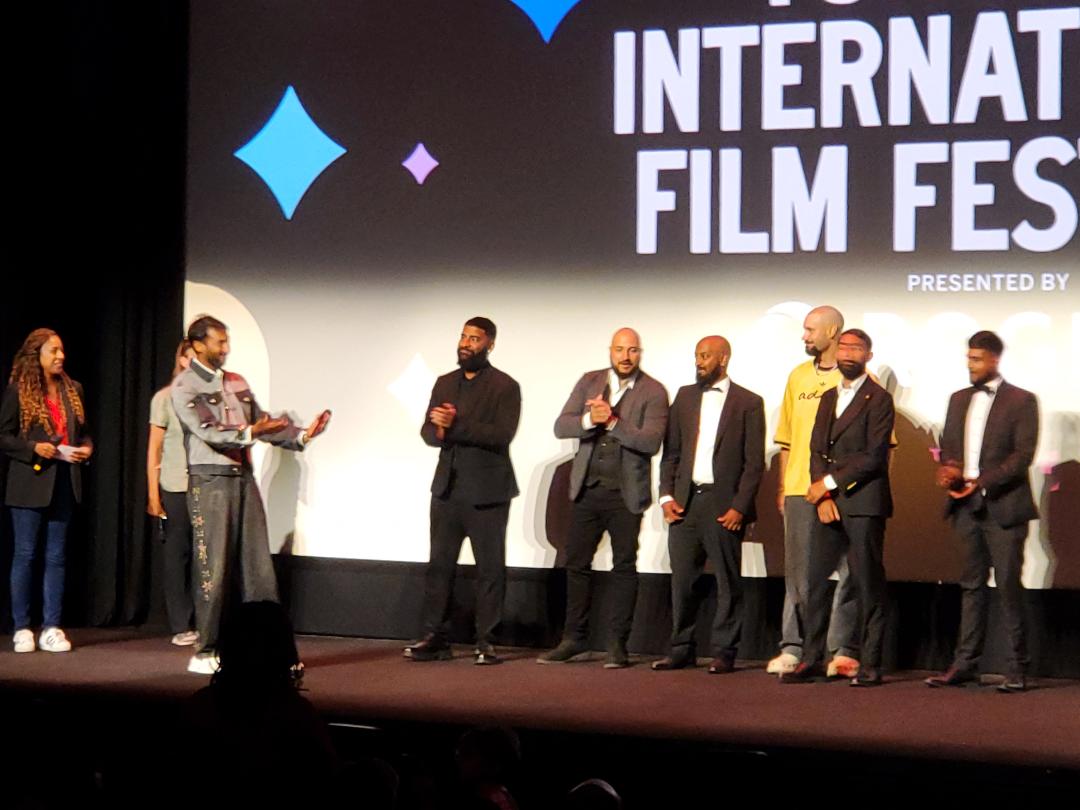
TIFF 2024 In Review
by Koom Kankesan
It’s the day after Sunday, September 15th and another Tornoto International Film Festival has come and gone. This was the second year of the festival being back after the pandemic lockdowns and there seemed to be more people than last year (which was a disappointing turnout for the festival, coinciding with the loss of a couple of its major sponsors). The weather was great and it was equally great to see people with their tickets and their lanyards bustling from one venue to another.
TIFF 2024 was not without its share of controversy as protesters objected to the screening of a documentary called Russians at War on the grounds that it is Russian propaganda relating to the invasion of Ukraine. TIFF decided to suspend earlier screenings of the film and says they will screen the film today (Tuesday, September 17th), after the festival has ended, in order to show it under safer circumstances. They are insisting that it’s not Russian propaganda, even though Canada’s deputy prime minister, Chrystia Freeland, and others criticized TIFF’s use of public funds in order to screen it. In lighter news, Eric Tisch planned to set a Guinness World Record for the number of films watched at a film festival by watching eighty movies and I believe he met his goal!
There are people who go to multiple screenings every day during the festival. I can’t do this as I don’t have the fortitude (not to mention that the films blur together for me), but I did end up seeing a number of pictures, so here’s a rundown of what I saw in the order I saw them. I have a year-round TIFF membership, which is an incredible deal given the discounts, plethora of free films, and access to events that come with it. Like last year, the festival ended up throwing free festival tickets at members when they couldn’t fill seats and a number of the films I went to were free. Some of them would have been very expensive seats and since the prices of tickets rose this year, this was an even bigger bonus. TIFF members are fond of complaining about one thing or another and since it’s a public institution, people don’t hold back their views, but there are also very generous cultural benefits that come with a TIFF membership — it literally is the best deal in town.

1. The Cut by Sean Ellis: This film stars Orlando Bloom, Catriona Balfe, and John Turturro. Since I reviewed the film on the opening night of the festival, I won’t say too much about it. Bloom tries to play against type by beefing himself up and being almost unrecognizable as a down and out boxer. The film has a very seedy style, but it’s not until Turturro shows up that real vitality is injected into the scenes.

2. Millers in Marriage by Edward Burns: I enjoyed this more than I thought I would, though the film probably won’t make great waves once it’s released. It follows the ups and downs of some very attractive characters in their early fifties as their marriages and relationships hit bumpy patches and eventually fizzle out. This is the first film I’ve seen by Burns and I’ve read that he’s been compared to Woody Allen in the past. This definitely did feel like one of Allen’s less humourous takes on people who can’t be happy in the relationships they have despite being extremely good looking and seeming to have no financial problems whatsoever. I do admit to being delighted by seeing Julianna Margulies on stage for the Q&A as I had a sizable crush on her twenty years ago. I didn’t watch ER but I thought her few scenes in The Sopranos were excellent.

3. The End by Joshua Oppenheimer: This was a film I had high hopes for. It stars Tilda Swinton and Michael Shannon as parents living in a fortified salt mine following an apocalyptic breakdown in society, along with their son and a few other people. The premise sounded so strange, with it being described as a part musical. Swinton and Shannon are such excellent actors and Oppenheimer has received raves for the documentaries he’s made. However, the only thing that really came through was the strangeness. Something is lost in the translation of ideas, characters, and drama in the film. Some people walked out during the screening. However, the visuals are magnificent and Oppenheimer certainly knows how to compose images and shots.

4. Takin’ Care of Business by Tyler Measom. This documentary, along with Lawrence Valin‘s film Little Jafna, were the heart and soul of the festival for me. I used to listen to Randy Bachman‘s radio show, despite not being the biggest Guess Who fan. I had no idea how unique his life and trajectory were. Having fallen in love with and married a Mormon, Bachman wasn’t your typical rock n’ roller though he loved creating the music. Losing his beloved Gretsch guitar (which he believed was magical and helped him write his music) and family strains that resulted from constantly touring caused his life to unravel. Decades later, during Covid, Bachman was fighting cancer through chemotherapy when someone decided to comb through images of guitars on the internet to find his lost magical guitar and finally traced it to Japan. Bachman beat cancer and was reunited with his guitar, almost fifty years after it was stolen. Kiefer Sutherland popped on stage, seemingly out of nowhere, to encourage support for the film. After the screening and the Q&A with the director, Bachman appeared on stage in order to play music with his son and daughter-in-law. I was very moved and touched to see Bachman, a cancer survivor, play soulfully using his special guitar that he had saved up for and bought when a teen, having fallen in love with music for the first time. It was also beautiful to see him be surrounded by and play with family members. The documentary itself, because it is filled with pathos and feeling, is excellent.


5. The Piano Lesson by Malcolm Washington. A film based on a play about the legacy of slavery focusing on a piano that’s been handed down through a black family? Yes, please! Unfortunately, all the actors declaiming their passionate lines and shouting at each other didn’t harmonize into an effective whole. The cinematography was beautiful, but many of the scenes did not have effective shape or tempo. I think this is Malcolm Washington‘s first film (his father is Denzel Washington and Malcolm Washington is known for being a film producer). His cast is joined by another young member of the Washington clan — John David Washington, who I unfortunately think of as an overrated actor — and their father, Denzel, is a producer on the film. Samuel L. Jackson is effective enough (as a moderate voice of reason compared to the other characters) as is Danielle Deadwyler, but I really enjoyed seeing Michael Potts. He is a very capable actor; he doesn’t overact and I loved him as Brother Mouzone two decades ago in The Wire.

6. Little Jaffna by Lawrence Valin: As mentioned above, this was the other film that really made my festival. This is a French film about Tamils in Paris just as the civil war in Sri Lanka reached its horrific conclusion (2009) and many Tamil civilians were targeted and killed by the Sri Lankan army. Valin’s film features news about these events in Sri Lanka in the background. His story, in which he also stars, is about a French Tamil undercover policeman who infiltrates a Tamil gang extorting money from Tamil refugees in Paris, and the resultant conflict in identity he struggles with as a result of his assignment. I was curious about this film as a novel I wrote years ago, The Tamil Dream, dealt with similar concerns. I had been disappointed with the Jacques Audiard film Dheepan, which won the Palme D’Or in 2015, and dealt with Parisian Tamil refugees so I didn’t want to get my hopes up for this film. However, its filmmaking and electrifying vitality blew me away. I tried to talk to the filmmaker after the Q&A, but a Tamil city councillor here in Toronto pushed in front of me and then spewed a meaningless tirade at the filmmaker until someone came over and said the filmmaker had to leave, so I was a little crushed that I didn’t get the chance at a conversation.

7. Will and Harper by Josh Greenbaum: This is a Netflix documentary following Will Ferrell and Harper Steele on a road trip across America. I’m a huge Saturday Night Live fan, and there were two SNL related movies at this year’s festival. The other was Saturday Night, a biopic about the show’s beginnings, but I picked this film to watch instead. Harper Steele was a writer on SNL during Ferrell’s tenure there and the two worked closely and were friends. Much later, Steele announced she was a woman, not a man. The documentary follows Ferrell and Steele as they revisit some of the dusty, small towns and places Steele was famous for visiting on road trips to see if she could visit those places now as a woman. Along the way, Ferrell asks questions and they grapple with Steele finally coming to terms with displaying who she is. Ferrell tends to joke around, so at times the documentary is at odds between Ferrell’s celebrity and comedic persona and Steele trying to grapple with life as she is now in a more earnest way. The film isn’t an in-depth look at being trans but for SNL fans, I think it’s a good glimpse at Ferrell getting emotional in later parts as he feels he’s failed his friend in some ways; there’s a key scene where they visit a Texan steak house and Ferrell goes in there dressed as Sherlock Holmes and jokes around. People get very hostile in terms of their reactions to the duo’s presence there and Ferrell begins crying the next morning in the car because he felt that he didn’t stand up for his friend in the moment. If you can see this doc through your Netflix subscription, it’s worth watching there.

8. The Substance by Coralie Fargeat: This film got a lot of buzz at the festival. They added another screening and so I made it a point to catch it on the morning of the festival’s last day. The random attendee whom I was sitting beside at the screening of Will and Harper the previous night had said The Substance was the best festival film he’d seen in a long time so I had high expectations. It stars Demi Moore as an aging actor who submits to a chemical treatment that allows a younger self, played by Margaet Qualley, to emerge. The younger and older selves are supposed to share their existence by alternating weeks of activation but, of course, things go horribly wrong. As a premise dealing with beauty standards, the concept was fine but the satire, style, gore, and execution were so over-the-top that I found myself unable to get into the film. Despite a strong performance by Moore and a heightened visual style, something gets lost in the writing. It plays too much like a gore film and not enough like a complex satire on Hollywood’s machinations and standards.

9. Little Jaffna by Lawrence Valin … again. Since I didn’t get a chance to talk to the filmmaker on the previous day and since I liked his film so much, I went to see it again. This time, I did get to say hi before the film and I took a copy of my book to give to him. A young enthusiastic filmmaker in his mid thirties, Valin was very humble about the experience and his success both at the Venice Film Festival and TIFF. There was a very long line up of people from the audience who wanted to talk to him afterwards and take selfies but he asked me to stick around so I waited and walked him back to his hotel afterwards so we could talk before he had to fly back to France. It really touched me to see someone else Tamil struggle with the complexities of identity and figuring out a way to be an authentic creator and to honestly make creativity the centre of one’s life. He said he appreciated me waiting for him to finish talking to everyone else but I think that part was easy; the real sign of me liking his film and his presence at the festival was that I went to his film for the second time, the day after the first screening, which is not something I had originally planned on doing. Like other Tamils who attended his screening said, it gives hope to aspiring Tamil creatives that such accomplishments are possible.
