
Lore Of The Rings: Did Sauron Expect Celebrimbor To Lie In ‘Rings Of Power’?
by Erik Amaya
The history of Middle-earth is vast but also incomplete. Where other fantasy realms have fully charted histories, author J.R.R. Tolkien never finished working out the finer details of his lore. In that gap lives a lot of choices in terms of transmedia adaptation. These are often in display on Prime Video’s The Lord of the Rings: The Rings of Power television series. In Lore of the Rings, we’ll take a look at some of the choices made in the series and how they line up (or diverge) from the Professor’s intentions, notes, and ideas.

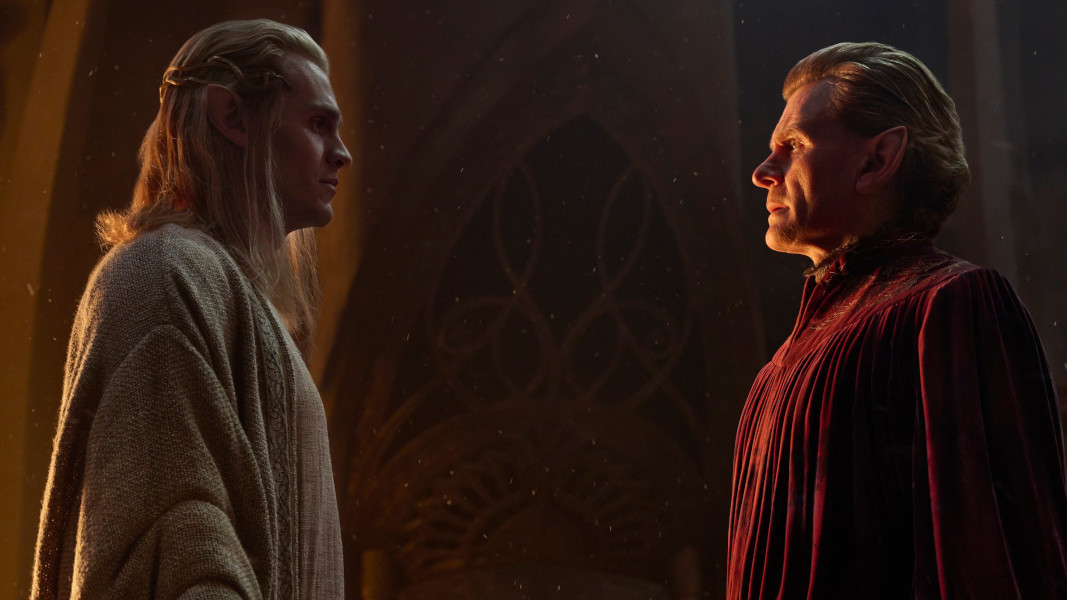
One of Rings of Power‘s best dynamics is the one between Celebrimbor (Charles Edwards) and Sauron (Charlie Vickers). Even when the latter was disguised as the Man Halbrand, the pair had a quick affinity for one another based in their mutual love of craft. But when his human guise led to doubt and suspicion, Sauron changed his fair hue to that of Annatar, the Lord of Gifts. Intimating he was sent by the Valar to aid Celebrimbor’s great works, their relationship was repaired … even if Celebrimbor still has a few doubts. And yet, even in that, Sauron has a way to talk him down: remind him that he lied to High King Gil-galad (Benjamin Walker) about shutting down the forge. As seen in last week’s episode, it’s a pretty powerful argument, but did Sauron know he would have that in his arsenal?
Going to the lore, it is difficult to asses. Moment-to-moment accounts of the Celebrimbor/Annatar relationship are non-existence. Instead, Tolkien related more of an overview of Annatar’s 300 year residence in Eregion. Nevertheless, we do know two things about that time: Celebrimbor had initial doubts about this Lord of Gifts, but set them aside as his fellow Elf craftsman grew to value Annatar’s knowledge of ringlore.
Nevertheless, it is easy to see how Celebrimbor would end up friendly with Sauron’s fair form. As the grandson of Fëanor, crafter of the Silmarils, Celebrimbor has a fascination (bordering on obsession) with smithing, designing, and other disciplines we’ll refer to collectively as “the art.” Indeed, Fëanor’s own obsessive tendencies toward his work led to much of strife in the First Age of Middle-earth as he and his sons all swore an oath to recover the Silmarils from Morgoth. The wording of their vow meant they would also mow through anyone who stood in the way of their goal. It led to the first kinslaying as Fëanor and his sons murdered Elves to obtain the boats needed to sail from Valinor back to Middle-earth. His sons would subsequently commit two additional kinslayings as they learned of the Silmaril Beren and Lúthien liberated from Morgoth’s Iron Crown. Both massacres failed to generate the desired result and the lone gem rides the night sky upon the brow of Elrond’s father, Eärendil (a story for another time).
And where was Celebrimbor during all of this? Increasing alienated from his family. He never swore to recapture the Silmarils and was not subject to its doom. Following the second kinslaying, he renounced the actions of his own father, Curufin, and remained in the Elf-realm of Nargothrond until it was invaded and laid waste. He also fought in the subsequent battles against the first Dark Lord. He re-emerged in the Second Age as one of the founders of Eregion and the leader of the Gwaith-i-Mírdain, the order of Elf-smiths who would craft the Rings of Power.
This part of his personal history is important because, at least as far as the Professor is concerned, Celebrimbor was not subject to the folly that led his father, uncles, and grandfather to ruin. His initial doubt of Annatar speaks to a more level-headed Noldor Elf, even if Sauron’s seductive abilities won out in the end. He had a folly of his own, to be sure, and it would lead to … well, something that we currently have to call a spoiler.
While we’ll never know how Tolkien may have approached scenes between Celebrimbor and Sauron, we’ll venture that part of the latter’s three-century stay in the Eregion included an appeal to the vanity passed down from Fëanor and Curufin. Although, it should be noted, Celebrimbor’s doubts about his guest never vanish completely and lead him to craft the Three Elven Rings by himself. In this scenario, Sauron would never truly rely on Celebrimbor’s ambitions because he already had the trust of the other smiths — an idea hinted at in last week’s episode Rings of Power.
The series, though, does not have the luxury to realize the Rings across a 300-year period (even if it could be argued the time is, indeed, there). To speed up the drama, its conception of Celebrimbor is one of an Elf more concerned with matching Fëanor’s great works than just a general love of the art. It’s a fair interpretation as, to borrow a Westerosi term, the blood tells in Tolkien’s world. No matter how often he rejects the actions of his family, he is still one of their number. His stated desire to craft something as memorable as the Silmarils leads, ultimately, to the Three Rings and it is Sauron’s appeal to that wish that keeps him safely in Eregion.
But it is here that we return to the question: did he expect Celebrimbor to write a letter declaring the work is done and the great forge will be extinguished?
I’m inclined to say no. While he always appealed to Celebrimbor’s vanity, he did not expect such a rebellious act. If we assume Sauron is aware of Celebrimbor’s actions in the First Age, he may have even believed he would need to be even more of a bad influence to keep the forge aflame. Nevertheless, Celebrimbor’s zeal to create the Seven superseded all other considerations — including Galadriel’s (Morfydd Clark) proclamation not to treat with Halbrand. If one goes back to the scene, Sauron even offers the slightest tell of surprise as Celebrimbor writes the memo.
That surprise, though, immediately gives way to Sauron incorporating it into a contingency plan he soon implements when Celebrimbor grows concerned that the Seven may be corrupted in some way. Annatar blames it on the Elf-smith’s initial deceit and suggests the only ways out are to either confess to Gil-galad or perfect the Rings of Power by crafting the Nine. Whether or not any of this respects the lore — and it doesn’t since Rings of Power choose to craft the Rings in the order of the Ring Poem — it is a deft reading of Sauron as an extremely adaptable manipulator. I’d also argue it’s very telling of the show’s take on Celebrimbor. Despite his loyalty to the High King, established centuries early when he rejected his father, he always sought to do more because he believed he could do more to stall the waning of Elvendom in Middle-earth. Sauron, as Annatar, merely offered the push.
In terms of a dramatic presentation of the material, it makes sense to align Celebrimbor far more with Fëanor than the Professor intended because, ultimately, he has to represent all of the Gwaith-i-Mírdain and their relationship with Sauron. If the show was just about the forging of the Rings, he could be more antagonistic toward Sauron as other smiths believe him implicitly. In this format, which also includes the tale of Numenór and others, he must be both himself and those namely smiths.
It remains true even if we saw Sauron sowing doubts about Celebrimbor’s competency among the others.
Whether or not it is a fair take on the character is something Tolkien scholars can debate until the Dagor Dagorath. As it happens, the two Shadow video games — Middle-earth: Shadow of Mordor and Middle-earth: Shadow of War — present a more overtly Fëanor-like Celebrimbor in both appearance and manner that should also be part of that larger discussion. For the moment, though, I’ll argue the well-meaning, but ambitious scion of Fëanor who ends up crafting another three millennia of strife is compelling. It will be interesting to see how his own inner conflict resolves as the Nine are made and he learns the truth about Annatar.