
Characterization In The Buffyverse — ‘Angel’ Season 1, Episode 21
by Benjamin Hall
This is part of a bi-weekly series concerning the characterization of Buffyverse characters. The first installment in this series can be found here. Arguably the best place to begin reading this series is at the beginning, but that is up to each reader. As a reminder this column will cover major and some minor characters from the shows Buffy The Vampire Slayer (1997-2003) and Angel (1999-2004). Other Buffyverse media, such as the graphic novel Spike: Into The Light (2014) are not pertinent to this series. Also there will be no referencing real world events that have direct relation to either show in this bi-weekly series.

This week: Angel Investigations seeks help to rescue some children. Aid comes in the form of Charles Gunn (J. August Richards) and an uncertain Lindsay McDonald (Christian Kane).
(Warning of spoilers from this point on!)
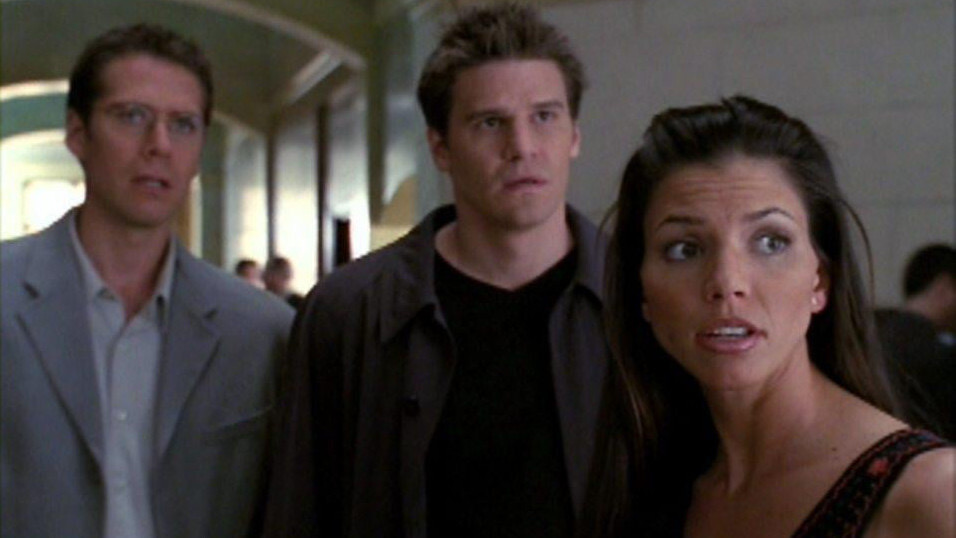
Angel (David Boreanaz) is all over the place in this episode. When it comes to his treatment of Lindsay, Angel is, at best, a jerk. He has very little reason to act this way other than their few encounters in the past and his frustration with the court system. In almost all other matters, though, he is the decisive action hero. That said, when the prophecy scroll enters his view he seems to be under mystical control. However, it is hard to discern how much actual choice he has when choosing to steal the scroll at that time.
Wesley Wyndham-Pryce (Alexis Denisof) counsels Angel a few times in this episode. Yet, like Cordelia Chase (Charisma Carpenter), he ends up following Angel’s lead regarding the situation and the treatment of Lindsay.
Cordelia is mainly in this episode to state the obvious and also ask certain questions. Like Angel and Wesley, she seems very uncaring about Lindsay’s welfare.
Gunn gets to play a stereotype while in Wolfram & Hart’s lobby. Other than this ability to exclaim to an audience while playing a role — and being more friendly to Angel — there is nothing new to him.
Lee Mercer (Thomas Burr) continues to have bad social skills as he acts as slimy as Shakespeare’s Iago from Othello when taunting Lindsay. He also appears to lack foresight and luck when it comes to his deceptions, which leads to his death.
The two mind readers (Keilana Smith and Dawn Suggs) give off a creepy girls from the movie The Shining (1980) vibe. They have no other characterization and just serve as plot devices.
Lilah Morgan (Stephanie Romanov) likes to do her own research which suggests trust issues. She also appears anxious during the meeting with the mind readers, but considering Lee’s fate, that seems reasonable.
Holland Manners (Sam Anderson) is half a no-nonsense boss and half counselor to Lindsay in this episode. Besides being these things, he is the devil when it comes to tempting Lindsay back to the firm, presumably with knowledge from the Mind Readers.
Lindsay’s backstory is severely cliché. Nevertheless, it offers an obvious reason as to why he decides to take his initial job at Wolfram & Hart. Plus: it adds to the reasons why he takes the promotion. The presumable other reasons are the manipulations of Holland Manners and the lack of care or respect Angel Investigations shows him. One can argue that Lindsay has potential to be a force for good, but the plot dictates he succumb to evil in a hurry.
Vanessa Brewer (Jennifer Badger Martin) is an evil analogue of Marvel’s Daredevil with similar abilities and lack of visual sight. While she has vast potential as a character, it is cut short by her death.
Howard (Charles Constant), Phil (unknown) the captive vampire (Joel Heyman), the vendor (Scott Berman), and the dying black man (Derek Anthony) are all stock characters. Most of them may serve the story in small ways, but none are truly essential.
The three blind children (Rishi Kumar, Karen Lu, Alex Buck) seem to be just props for the adults to save. Since they never appear again, their apparent importance to the prophecy involving Angel is mute.
This episode is mainly a diametrical character study of Angel and Lindsay. Yes, some other things happen that set-up Wolfram & Hart as a major villainous obstacle for Angel. However, the focus is strongly on Angel and Lindsay and whether they have choices in their respective destinies. Therefore, the other characters only get a sprinkling of characterization. Unfortunately, all the “choices” Angel and Lindsay make have a rush to them due to the runtime and the needs of the plot. Thus, they really have no “choices” that feel natural.