
Short On Character Development Or Explanation: Reviewing ‘Megalopolis’
by Koom Kankesan
Francis Ford Coppola‘s decades-in-the-making Megalopolis about rescuing the promise and destiny of New York City, transposed with the Catalinarian conspiracy of ancient Rome, is everything people tout it to be.

Much has been written and said about Coppola’s engagement with this project, all the mishaps that have befallen it along the way, so I won’t repeat them. I’ll try to focus on whether it’s a good film or not, and although that’s not easy to address, the main answer is ‘no.’ Conceived after the gruelling and arduous production of Apocalypse Now, Megalopolis is about visionary architect Cesar Catalina’s (Adam Driver) feud with corrupt mayor Franklyn Cicero (Giancarlo Esposito) in a near future/alternate New York City. Catalina wishes to build a utopia out of the decaying ruins of a New York/America in decline while Cicero wants to continue the old ways of concrete and steel. There are some other characters including Julia Cicero, Mayor Cicero’s daughter (Nathalie Emmanuel), Hamilton Crassus III, Cesar’s wealthy uncle and CEO of a bank (Jon Voigt), Clodio Pulcher, Crassus’ grandson and Cesar’s cousin (Shia LaBeouf), and Wow Platinum, Cesar’s mistress who leaves him to marry Crassus (Aubrey Plaza).

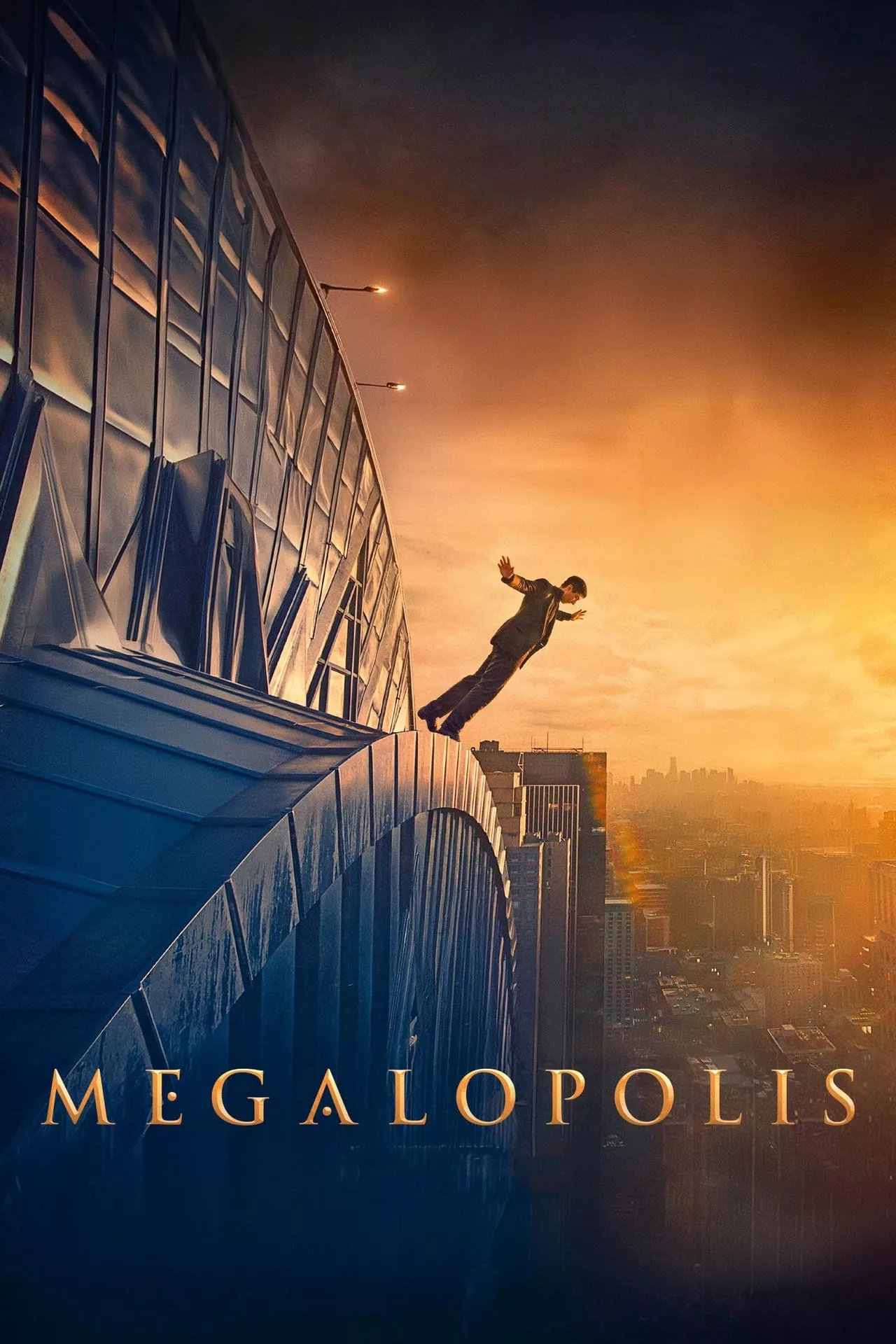
Short on character development or explanation, much of the epic’s twists and turns are hard to follow (or swallow). This isn’t helped by the poor sound design which makes it difficult to understand dialogue and nuance that is buried by the sounds of ambient spectacle, which drenches much of the film. To be fair, the spectacle is quite striking and often dazzlingly beautiful. From the lighting and colour choices which are emblazoned in scarlets, golds, and blacks to the visual flair and cornucopia of stimuli, this is not the work of an aging master. It brandishes the energy and visual sense of one of Coppola’s films from the early 1980s (One From the Heart, Rumblefish) but even more boosted, as only the digital age can furnish. I personally love those old films and despite his other failings, it’s nice to see Coppola serve up something as sumptuous as Dracula, full of blood and daring, while his heirs (including his own daughter) give us tamer fare.
That being said, the film suffers from excess, whimsical direction (if any), lack of shape, and meaningful writing. The same spirit of experimentation and enterprise that worked on Apocalypse Now now wrecks this epic. I was actually hooked during the initial chapter, the filmmaking and visual flair flowed, it turned out much better than anticipated. I thought I might love the whole thing. However, with the introduction of the Colosseum scene, the film went off the rails and never got back. This scene, with Adam Driver playing both his mental and physical selves and Shia LaBeouf, dressed as a woman, was near incomprehensible, to the point where my friend who attended the screening actually remembered it differently than I did. For example, there definitely were multiple versions of singer Vesta Sweetwater (Grace VanderWaal) hanging on metallic crescent moons at the Colosseum without explanation but were there also two different versions of Shia LaBeouf’s character embracing each other?

In terms of message and subject matter, at this point, discussions of whether the American empire is in decline are passé (Coppola himself tackled the subject in his ’70s films). While still highly influential, most people would agree that America is beset with problems that riddle its assurance. Coppola’s film, which bears strains of thinking over more than four decades, tackles such diverse subjects as the ascendancy of Fox News, youthful bacchanalia, Trump’s popularity, and the aftermath of 9/11. Some of the footage we see existed prior to the destruction of the World Trade Centre when Coppola originally filmed background footage for this film. Some of it was filmed after. The magic hour shots of the city from that time stand out against the contemporary use of CGI and green screen but blend into the burnished glow of the whole. It’s the writing and character work that don’t come together, not to mention the futuristic utopia that Driver’s visionary strives for. Even when we see this utopia at the end of the film, we have no idea what it does or what its purpose serves. Coppola repeatedly has Cesar tell us that the discussion of ideas is the most important thing, as if Coppola himself is still compiling and ruminating upon his own ideas without a solution, and this is the result.
I’m a big fan of Coppola’s films and I’m also a fan of the myth of Coppola: the legendary filmmaker who defied the studios and prevailed against small minded attitudes: the experimenter, the gambler, the artist who created such wonderful, original works as The Conversation and The Cotton Club. Remember, he was only about thirty years old when he made the first Godfather film! So, I’d rather see a bad Coppola movie most days than than a mediocre effort by a run of the mill director. However, I can’t in good conscience state that this particular film is ‘great’ or ‘ahead of its time’ or ‘misunderstood.’ It’s mostly ‘outside of time’ (not in a good way), ‘confused’ and ‘inexplicable.’ Talking of time, Cesar magically stops time periodically within the film — how he does this or how it connects to his architecture is completely befuddling. Given the archetypal idealism and the mixture of operatic, sensational sex and violence, it’s hard not to draw comparisons between Cesar’s ambitions and Coppola himself. It’s hard not to compare Cesar’s hazy project with Coppola’s cloudy film. If Adam Driver’s Cesar is a visionary, giving promise for a city and its people to continue living and thriving while his rivals do not, why is he named after a dictator? Your guess is as good as mine. In the end, this is not an incisive portrait of the American empire in decline so much as bread and circuses.
Megalopolis is in cinemas now.
