
Talking ‘Adrift On A Painted Sea’ With Tim Bird
by Rachel Bellwoar
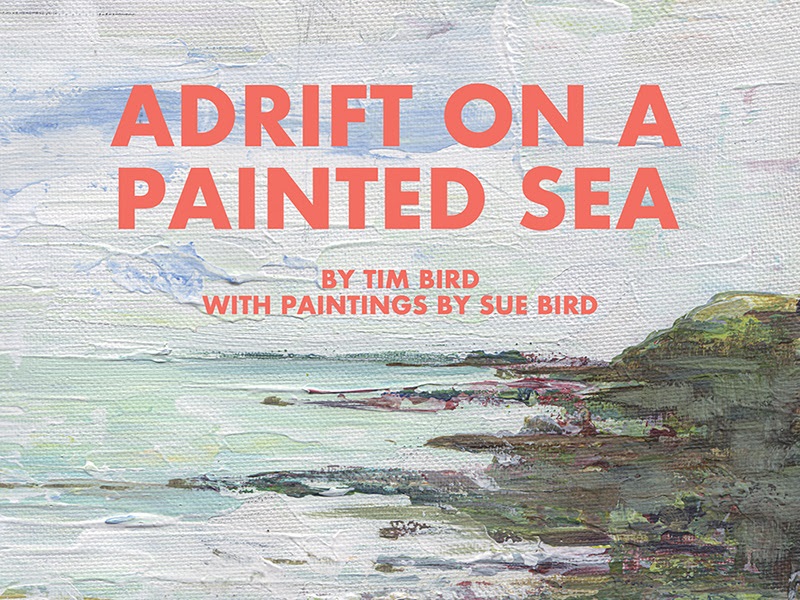
Grief can often feel like being adrift on a painted sea. In his latest graphic novel, Adrift on a Painted Sea, though, Tim Bird isn’t just paying tribute to his mother, Sue Bird, but showcasing her paintings for a new audience. To learn more about this project, check out this interview with Bird below:

Rachel Bellwoar: How has the experience of putting this graphic novel together been different from other graphic novels you’ve worked on?
Tim Bird: I see my creative practice as a process, so each project builds and develops from my previous work. The last graphic novel I worked on with Avery Hill Publishing, The Great North Wood, was about the history of a place, and how you can try to understand that place by exploring remnants of an ancient landscape and looking at place names that survive to the present day. In a way, my new graphic novel is also about a landscape – this time the sea. Over the past five years I have self-published several short autobiographical comics, so it felt natural to continue writing about my own experiences in the new book. In these short, self-published comics I started including photographs and ephemera, like tickets to football matches, which led to the idea of using my mum’s paintings as part of this graphic novel.
Bellwoar: In the book we learn more about why the sea was a favorite subject of your mom’s, but do you know why she chose painting as her medium of choice?
Bird: She actually experimented with lots of different creative media. She enjoyed crafts like knitting and sewing, as well as other artistic techniques like collage and printmaking. I remember her going to evening classes and learning to paint very neat botanical watercolours. It was only later in her life that she got into using oil paints and painting landscapes. I think she was drawn to painting specifically because she found the process relaxing and mindful.

Bellwoar: Was painting ever an activity you shared together, and how did you find your own path to becoming an artist?
Bird: I don’t remember ever painting together, but her enthusiasm for art definitely rubbed off on me when I was a child and we had lots of family trips to art galleries which were a big inspiration to me. She passed on a lot of knowledge about specific artistic techniques and accumulated a lot of books which I enjoy learning from.
I first started drawing comics when I was very young – inspired by Tintin. I drifted away from comics as a teenager but came back to them when I read Ghost World by Daniel Clowes. This led to me reading lots of American Alternative comics (by people like Adrian Tomine and Jeffrey Brown) which showed me I could write about my own experiences. My mum encouraged me to keep drawing and making comics which eventually led to me studying illustration. I’ve tried to find ways of making my work more commercial through selling my comics and doing freelance illustration work, but she was always happy keeping her art as a hobby.
Bellwoar: Where did the idea to use shipping forecasts to break up the book into sections come from?
Bird: About 10 years ago I made a short comic called From The City To The Sea which followed a journey along the river Thames in London, ending at the estuary. At the end of that comic, I listed the locations for the shipping forecast which I felt had a poetic rhythm that fitted the pace of the comic. I’ve always found the shipping forecast intriguing. The words and numbers don’t mean much, but the delivery and repetition are comforting. It reminds me of my parents listening to Radio 4. It conjures up imagery of fishermen out at sea in stormy weather. Some of the phrases feel like they could relate to emotions as well as the weather, and, like the sea, helps put our larger anxieties into perspective.
It always bothered me slightly that I hadn’t been geographically accurate with the list of locations in that first comic, so it felt like something I wanted to revisit and put right. In this comic I made more of an effort to get the details right – the shipping forecast I used was from the Tyne and Humber regions around the Yorkshire coast where my mum liked to paint from the night she passed away. I don’t think readers would know that, but I felt that it added an element of truthfulness or authenticity, which connects the reality of that night to the comic.

Bellwoar: Did you always know which memories you wanted to share and found paintings to match, or did your mom’s paintings really dictate the final form this book took?
Bird: I’d had a couple of false starts with the book, where it took on different formats and different narrative structures, so by the time I started work on the final version I was pretty clear what memories I wanted to share. The main goal of the book was to show my mum’s paintings, so they came first and dictated the stories I ended up including. Initially I had thought of just making a series of prints of the paintings, but what I felt was special about them was the context they took on in our family – the stories and memories behind them.
Bellwoar: In deciding which paintings to include, did you discover any you hadn’t seen before?
Bird: Yes lots! My mum had been painting as a hobby throughout her life and had never sold any of her work, so the house was (and is still) full of them. She painted lots of different subjects – I decided to focus on the ones of the sea because I felt it was a good metaphor for the grief I was experiencing. Sorting through them all was sad but brought back a lot of happy memories. There were lots of paintings I had never seen or forgotten, but I could always place where and when she’d made them. It was also interesting to look through her sketchbooks to see how the paintings had developed.

Bellwoar: My favorite pages are the ones involving your mother’s paintings where you include inserts of your own art on top. What was it like getting to create these collaborations?
Bird: I wanted to combine my drawings with my mum’s paintings so they became part of the same story. To show that the paintings were literally a backdrop to my childhood. I felt a little guilty about covering over some parts of my mum’s work but I made sure I didn’t cover any important details. My mum didn’t get to see the finished book, unfortunately, so I don’t know what her reaction would be, but I’m sure she’d understand the idea behind it. For me it feels nice to combine our work and present them as a complete narrative.
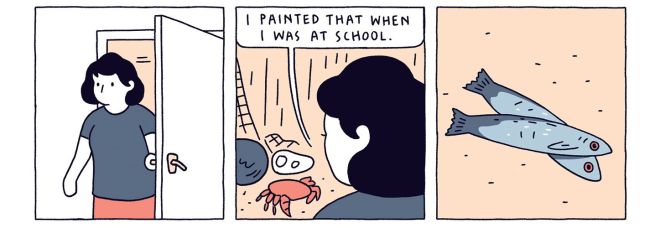
Bellwoar: I also love the page where you redraw her fish painting in your own style. What made you choose that painting in particular?
Bird: That was the first painting of hers that I remember seeing. She did it when she was in school, and it was on the walls in my grandparent’s house. I wanted to redraw it so I could show it in that context. It looks like the sort of thing you’d see in a museum – really technically accomplished, oil paints. She told us it had been exhibited in a big exhibition in Sheffield, but when I was looking through her sketchbooks and things I found the museum catalogue, and it had a different title (“View from the Classroom Window”). I couldn’t work out how the misunderstanding had happened, and by that point it was too late to ask her. I’m sure there’s a simple explanation. It made me realise there are always things we don’t know about someone, even those closest to us.
Bellwoar: Thanks for agreeing to this interview, Tim!
Adrift on a Painted Sea is on sale now from Avery Hill Publishing.
