
Suspicious Birds And The Grieving Process: ‘The Boy And The Heron’ Reviewed
by Rachel Bellwoar
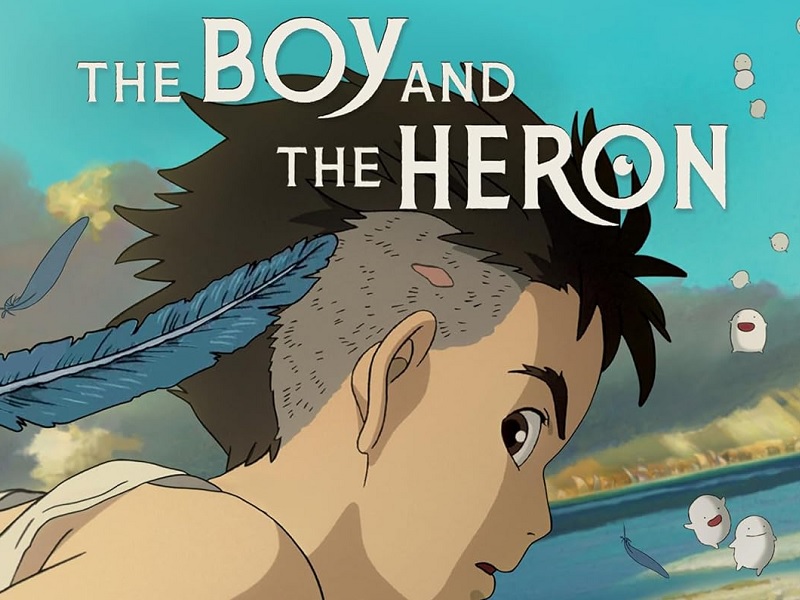
You’ve probably heard of the wolf in sheep’s clothing, but what about the guy in the heron suit? In Hayao Miyazaki‘s The Boy and the Heron, Mahito (Luca Padovan) is having trouble adjusting to a new home, and his aunt (Gemma Chan) as his new stepmom. He’s also just left a war zone and is dealing with the grief of losing his mom in a hospital fire, while blaming himself for failing to save her.

Somehow, though, despite all the trauma, Mahito is on to the Grey Heron (Robert Pattinson) from the start. He knows he’s not a real heron even before he begins making claims too good to be true, like that Mahito’s mom’s still alive and that he can take him to see her. When his aunt disappears, however, it’s the last straw. In order to find her again, Mahito agrees to let the heron act as his guide.
I don’t know whether it’s watching a Miyazaki film now as an adult versus as a child, and being more aware of the horror elements, or if The Boy and the Heron actually is darker than some of his previous movies. Spirited Away began with Chihiro’s parents being turned into pigs, so it’s not like darkness has been absent from his work. Maybe it’s that the tone of The Boy and the Heron leans more towards melancholy than fantasy than the director’s work has before, making the final impression sadness instead of joy (the use of silence and Joe Hisaishi’s score also add to this effect). One of the trailers describes the film as “semi-autobiographical,” but the bonus features on Shout! Factory’s Blu-ray don’t really get into specifics. Studio Ghibli co-founder Toshiro Suzuki does say he was the inspiration for the heron in his interview.
It’s definitely not a clear cut story. I mean, at it’s core, The Boy and the Heron is a film about one boy’s experience with grief and his literal search for his stepmom. But that journey is very abstract and unpredictable – a movie without bumpers, to use a bowling analogy. The rules of the quest aren’t defined. For a guide, Mahito never seems alarmed when the heron disappears and, while their relationship evolves, it’s not always easy to follow.
Parts of Mahito’s journey feel reminiscent of Orpheus’ trip to the Underworld, but I also feel confident that there are a number of cultural references I’m missing and would be interested in learning more about for context. The key is probably to give oneself over to the experience and not try to fight it or understand everything. In his interview, Hisashi brings up that he uses music to spark imagination, not to explain what’s going on, and that’s really the mindset to go into with The Boy and the Heron.
On an artistic level, the film is as beautiful as any film to come out of Studio Ghibli, with some of the same preoccupations. The warawara are very soot/Susuwatari-coded, for example. A lot of painterly backgrounds appear throughout. The design for the Grey Heron feels particularly original with all its reveals. All of the scenes where Mahito is being engulfed by animals (and this happens on a few occasions) are gob-smacking. There are a lot of birds; I’d be curious to know why Miyazaki decided to feature birds.
More than anything, the bonus features on Shout! Factory’s Blu-ray feel like a gift to artists and geared towards showing the next generation of animators how the process works. The feature-length storyboards, for example, are literally the entire film played out as storyboard drawings. There’s also an interview with supervising animator Takeshi Honda and a featurette where you get to watch him draw the main characters in real time. It’s clear that Miyazaki has put together a team that love what they do and that passion shines through.
The Boy and the Heron is available now on Blu-ray from Shout! Factory.
