
Lore Of The Rings: Is The Stranger Who He Claims To Be In ‘The Rings Of Power’?
by Erik Amaya
The history of Middle-earth is vast but also incomplete. Where other fantasy realms have fully charted histories, author J.R.R. Tolkien never finished working out the finer details of his lore. In that gap lives a lot of choices in terms of transmedia adaptation. These are often in display on Prime Video’s The Lord of the Rings: The Rings of Power television series. In Lore of the Rings, we’ll take a look at some of the choices made in the series and how they line up (or diverge) from the Professor’s intentions, notes, and ideas.

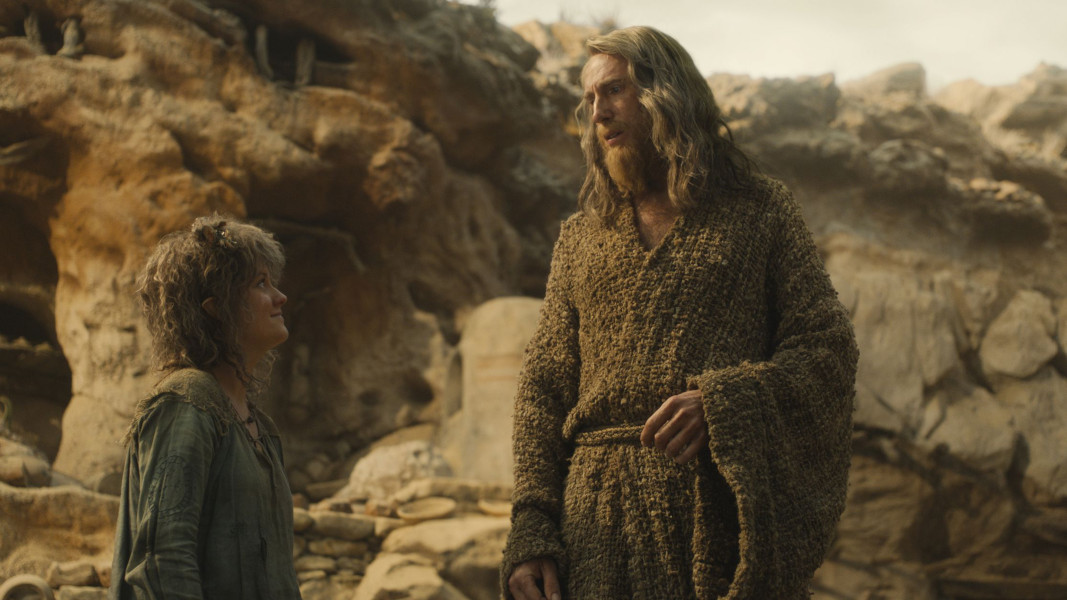
This week’s question is, perhaps, the most controversial in the whole of Rings of Power as it concerns the identity of Daniel Weyman‘s The Stranger. Since the beginning of the series, his true nature and name has fueled the program’s attempt at the modern genre convention of the mystery box. At first, audiences were to meant to wonder if he was Sauron or some aspect of him. At the end of Season 1, Halbrand (Charlie Vickers) turned out to be the eventual Dark Lord with The Stranger only identified as an Istar (more on that later). Season 2 saw the character in Rhûn, the east of Middle-earth, chasing the constellation burned into his mind from the moment he touched down near the Harfoot caravan along the River Anduin. To be honest, The Stranger in the East was the weakest thread of the year as it took a backseat to more interesting ideas like the forging of the Seven and the Nine and the political turmoil in Númenor. A case could also be made that the Dwarf story was also weak, but bolstered by the fine cast of actors playing Durin’s Folk.
The one time The Stranger’s wandering in Rhûn becomes compelling is when he meets Tom Bombadil (Rory Kinnear), a character we’ve already discussed in this column as one who could be a manifestation of the creator deity Eru Ilúvatar. His conversation with The Stranger heavily implies the wandering wizard will know his identity when he finds his staff … and that he will realize he was Gandalf all along. The Stranger comes to that seeming realization in the Season 2 finale, having found his staff among the rubble of the Stoor village. He returns to Tom’s eastern dwelling to confirm that “they will call me Gandalf” with the merry old fellow. Tom appears to agree with what The Stranger believes, but is this truly the case?
From a lore perspective, Gandalf wandering Middle-earth in the Second Age is the biggest departure from lore the show has committed to thus far. As unambiguously detailed in The Lord of the Rings appendices, Gandalf arrives in the Grey Havens, the great Elvish port depicted in the early episode of Rings second season, in the year 1000 of the Third Age. The Grey Wizard will receive his name sometime later. But it seems the visit was not Gandalf’s true first trip to Middle-earth’s shores. In The Nature of the Middle-earth, a collection of Tolkien’s writings collated by is the suggestion that Gandalf — known as Olorín in his true Maia form — was one of six Maiar who served as protectors to the newly awakened Elves in the earliest days of the world. While not necessarily a canon notion — indeed, canon is hard to pin down beyond the text of The Hobbit and The Lord of the Rings — the implication here is the five of the six Maiar would, millennia later, become the Five Istari, the wizards sent by the Valar to inspire the Free Peoples of Middle-earth to hold fast against the designs of Sauron. The six Maia was Melian, who would go on to be one of Elrond’s antecedents.
There is also one other thin thread indicating Olorín may have been in Middle-earth during the events depicted in Rings of Power.
In one story idea published in Unfinished Tales, Christopher Tolkien‘s second volume of his father’s writings, the Professor outlined a meeting between the Maia and Galadriel. He is specifically sent by the Maia Yavanna to deliver the Elessar, with which Galadriel can protect the great forest of Middle-earth. He also tells her a time will come when she will give the Elf-stone to someone named Elessar. The concept features several inconsistencies from The Lord of the Rings and other thoughts the Professor had about the Elf-stone — including the implication that the Elessar would serve to preserve the forest before Galadriel’s Ring was made — but they offer some cover for those who wish to include Gandalf in a Second Age tale.
Indeed, The Lord of the Rings Online went one step further by creating a storyline in which Glorfindel reveals Olorín took part in the Last Alliance while cloaked as an Elf. Sadly, he was captured and slowly tortured by Sauron, who recognized his true nature. When the Dark Lord finally dispatched him, his spirit returned to Valinor, where the Valar removed his memories of that traumatic journey. Although, as the LOTRO story draws to a close, Gandalf the White begins to remember his experiences in Mordor.
But for Rings of Power, what does it mean for Gandalf to be on the continent in the Second Age? Right now, I personally have a hard time finding a great reason to do so beyond the most obvious: casual viewers love the character. In fact, I still want The Stranger to end up as one of the Blue Wizards, a pair of Istari who immediately set out to the East after arriving in Middle-earth and of which seldom is known. Tolkien himself was unsure if they succeeded in their mission or failed. He would, in fact, change his mind on the subject during different periods of his life. He also changed his mind on when they arrived, sometimes landing in the Grey Havens alongside Glorfindel in the Second Age. For the show, employing these characters would be a chance to feature wizards without breaking lore. Gandalf, meanwhile, breaks an aspect of lore the series definitely has access to and since the showrunners previously said they would not be pulling anything from the Third Age timeline, he must serve some other purpose than just being a wandering wizard.
One possibility — his eventual confrontation with the Dark Wizard (Ciarán Hinds) could allow him the chance to become a viewpoint character for a story set in Rhûn. Despite early marketing messages suggesting the region would be important this year, we saw precious little of it. In the larger context of Rings of Power, the lands of the East are important as, at the very least, they will produce the only Nazgûl we know by name. Khamûl is second only to the Witch-King of Angmar and is also known as “The Shadow of the East.” Outlining that character before Sauron gifts him a Ring could offer Gandalf a tragic friendship with a Ringbearer.
Beyond that, Gandalf is a familiar presence in an unknown land. Rhûn isn’t even an organized nation, just the Westron word for “East.” And as Tolkien only ever lightly sketched the region out, there is room for Rings of Power to tell a compelling tale of Men who both submit to the Dark Lord and chafe against his cruelty. Additionally, there is an opportunity to reveal the politics of the land, various Men of renown or ill repute, and, eventually, the identity of the Dark Wizard. The Grey Pilgrim could be our guide there.
Or, perhaps, it is all a ruse and The Stranger will be one of the Blue Wizards. In that case, the tale becomes one of the first attempt to inspire the hearts of Sauron’s foes and how it goes disastrously bad. But I suppose Gandalf could be part of the tale even if, like his Second Age appearance in LOTRO, it is something he loses all knowledge of and only distantly recalls when trying to convince the Free Peoples to once again march to war in the Third Age.
One other thing to consider: although Gandalf is described as the Grey Wizard and wears robes of that color until his fall at Moria, Tolkien first depicts him in The Hobbit as wearing a blue hat…
In the meantime, Ring of Power signs off for another long hiatus. But for me, the lore remains. It is there on my shelf and within my e-reader. The language of Tolkien stands even when the excitement of an adaptation falls away for the season, and for that I am eternally grateful.