
Something Spooky: ‘Tomb of Dracula’ #7 Assembles Two Important Teams
by Austin Gorton
In the wake of the political and cultural upheaval of the 1960s, horror rose to prominence once again in the pop culture of the 1970s. Marvel Comics, never shy about chasing a potential money-making fad, responded in kind. Stepping through the door opened by the loosening of restrictions by the Comics Code Authority which prevented more traditional characters and themes of the horror genre from appearing in comics, the 1970s saw a massive wave of horror comics published by Marvel.
From more traditionally sci-fi spins on the tropes like Morbius the Living Vampire or Man-Wolf (a space werewolf), to more occult characters like Ghost Rider (a stunt cyclist — another ’70s fad — who makes a deal with a devil) or Damion Hellstrom, Son of Satan, to Marvelized riffs on classic movie monsters, like Werewolf by Night or the Monster of Frankenstein, the 1970s were a boom time for horror comics at Marvel. Chief amongst them was Tomb of Dracula.
Somewhat unique (though not unheard of), Tomb of Dracula is a series centered around, essentially, its villain. Unlike, say, the science-derived and Dracula-adjacent vampirism of Morbius, the title character is the Dracula, the character of the Bram Stoker novel, appearing in a form consistent with the (then and now) publicly-recognized interpretation of the character in films by the likes of Bela Lugosi and Christopher Lee, films familiar to comics readers at the time thanks to syndicated reruns of the old Universal and Hammer films on late-night TV.
Throughout the series, Dracula does battle with a team of vampire hunters including Frank Drake (a descendant of Dracula responsible for reviving him in the modern day, more or less the series’ main non-Dracula character), Rachel Van Helsing (daughter of Abraham Van Helsing, the vampire hunter of the Stoker novel), Taj (a mute Southeast Asian “body man” for Rachel with some cultural tropes that haven’t aged well), Quincy Harker (the son of Jonathan and Mina Harker from the novel) and, occasionally, a certain human/vampire hybrid by the name of Blade.
Tomb of Dracula #7 is notable for being the first issue of the series to bring together the full creative team that would become most synonymous with the series: writer Marv Wolfman, penciler Gene Colan, and inker Tom Palmer. While previous series writers like Gerry Conway and Archie Goodwin had already introduced key members of the cast in Frank Drake and Rachel Van Helsing, Wolfman uses the introduction of Quincy Harker to bring together the core vampire hunter trio he will feature in the series for the first time. Though it continues directly from the previous issues, in many ways, the issue reads like a soft relaunch of the series, as the team forms and quickly engages in its first battle with Dracula.

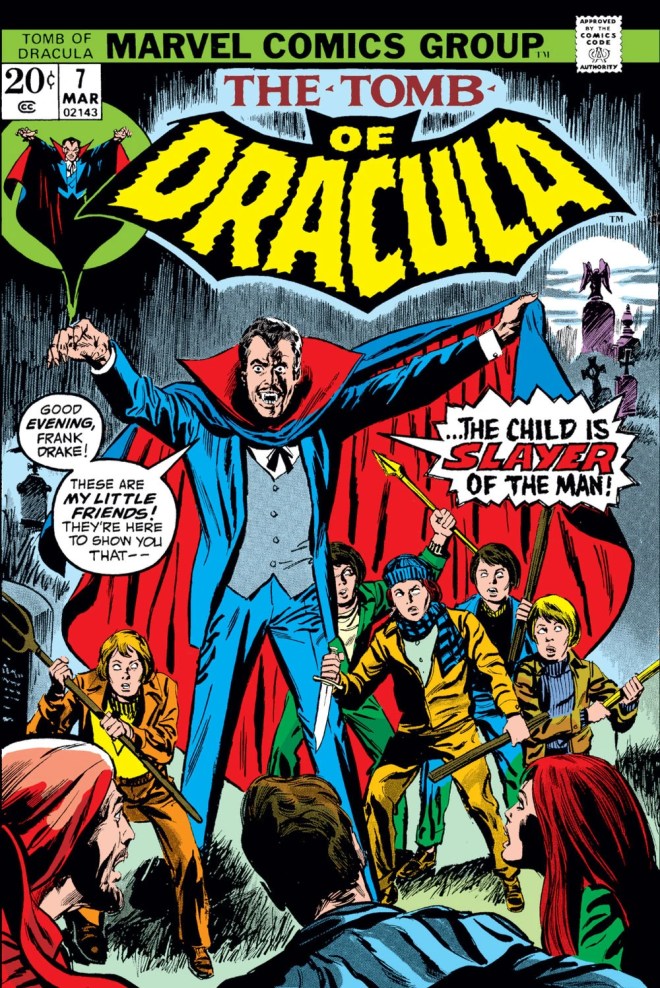
Wolfman relies on some of the more outdated storytelling techniques of the time, necessary when there was more of an emphasis on making each issue a self-contained story: the hunters are drawn into battle with Dracula because he just happens to attack someone within earshot of Quincy’s home, and Dracula already has a plan in place involving a body double by the time the hunters follow him (from their car, while he’s flying in bat-form, through a snowstorm) to his London abode. But Wolfman also illustrates a fast knack for horror writing. The cover of the issue is inspired by the climax, in which Dracula besets a group of hypnotized small children on his foes.
There’s something equally creepy and absurd about Dracula closing the issue by crying out about his “legion of doom!” over the image of a bunch of dead-eyed children. Wolfman also manages to generate fast pathos for Dracula’s victim, a young man celebrating the night before his wedding. As the victim runs from Dracula, thinking about how he doesn’t want to die before he marries his fiancé, Wolfman is able to make readers invest in his plight in just a scant few panels, making the ensuing fight between Dracula and the hunters more impactful.
The real star here, however, is Gene Colan. There is perhaps no title more suited to Colan’s sweeping, impressionistic style than Tomb of Dracula. A master of atmosphere, he drapes Tomb of Dracula #7 in a sense of dread, a swirling cool-blue London punctuated by bursts of warmth, around any corner of which Dracula may be lurking. It is an atmosphere that makes some of the grander leaps of logic in Wolfman’s plot more believable — or at least, feel like less of a leap.
Meanwhile, Tom Palmer is the perfect partner for Colan. His heavy, detailed lines bring much needed definition to Colan’s often-sweeping pencils. Both are artists whose styles tends to dominate: Colan overpowering the constraints of his his inkers, Palmer all too often subsuming the style of his penciler under his own. Together, they find just the right balance in that tension, both too strong to completely overshadow the other. Palmer helps keep the action clear, the figures distinct, while Colan is able to maintain his distinctive sense of atmosphere and form.

All in all, Tomb of Dracula #7 stands as an effective snapshot of what the series will become for its long run across the decade at the vanguard of Marvel’s horror books. Effectively a second #1 issue, it brings together, in full for the first time, two significant casts, its core in-universe team of vampire hunters, and the creative team of Wolfman, Colan and Palmer.
Both groups will ultimately define the series, as the “antagonists” of the title character necessary to craft the sort of stories familiar to readers of the ’70s and the chroniclers of those stories, whose strengths and weaknesses as storytellers will be balanced by each other. There is perhaps no better snapshot than this issue of horror at Marvel in the ’70s, a time when the tropes of comic book storytelling met the baddies of yesteryear, a time unlike any other.

