
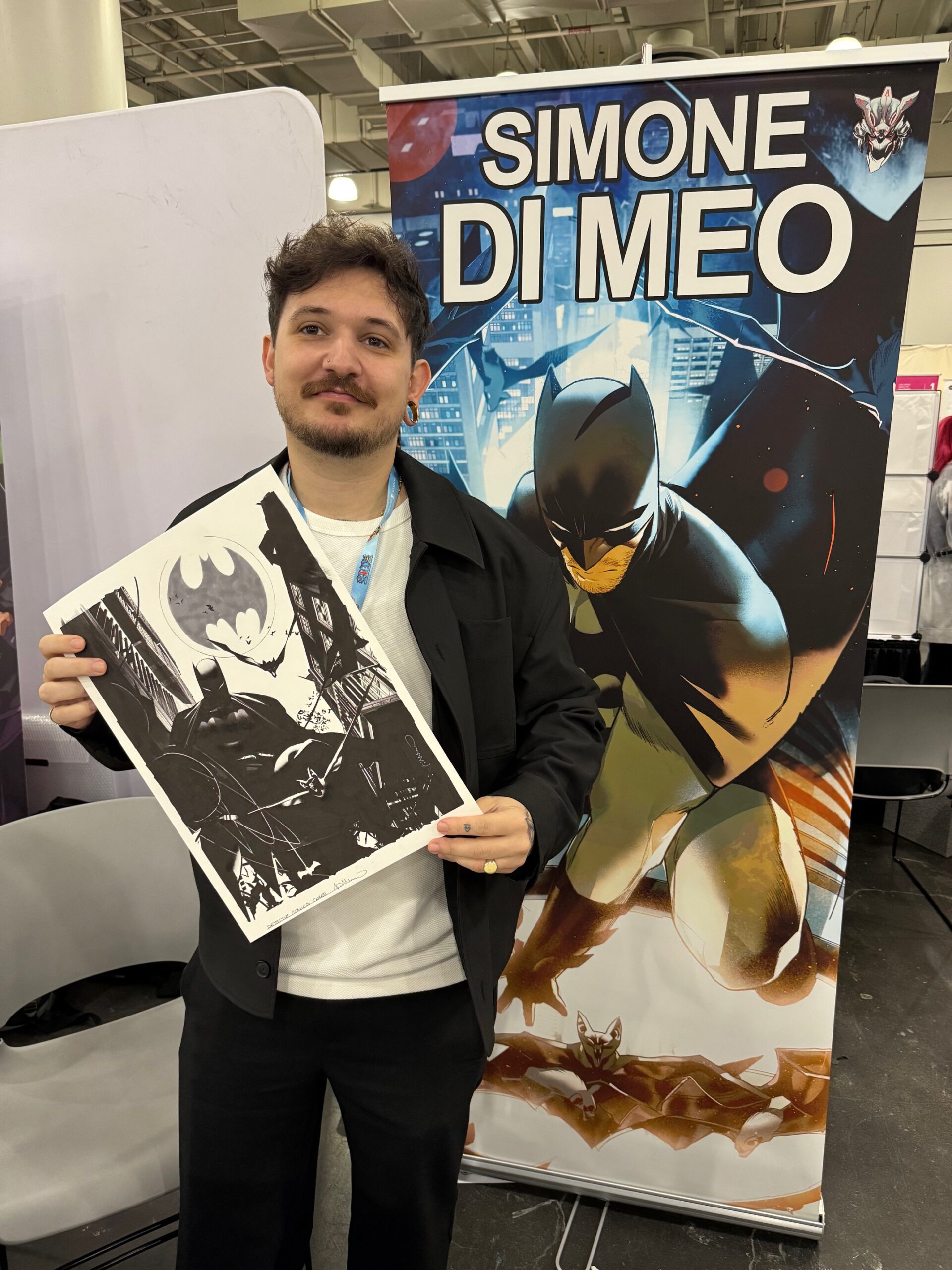
NYCC 2024: Simone Di Meo Gives Back To The Artist Community
by Tom Smithyman
Best known for his work on Batman and Robin and his covers for Batman: The Brave and the Bold, artist Simone Di Meo is taking on a new role: author. In his book Quello Che Ho Capito Fin Qui (What I’ve Understood So Far), the Ringo Award-winner shares advice he’s gleaned from his time in the comics industry. In an exclusive interview with Comicon.com from New York Comic Con’s Artist Alley, Di Meo shares some of the advice he’s giving younger artists, including the things that surprised even him.

Tom Smithyman: You’re known primarily as an artist. Why did you want to write this book?
Simone Di Meo: For many years, I’ve been a teacher at a school for aspiring comic book artists. After 10 years, I though maybe I could write something for young artists. I thought: “If I am a student right now. What do I need?”
Ten to 15-years ago, I was looking for different books to try to improve my skills. But not just my drawing skills. The skills about the job. The skills that you need to be a professional.
It was a lot of fun to write 50 tips for the students. I’m doing a tour in Italy – from north to south – in different schools just to talk about what I’ve learned to the students and the teachers.
It’s something I really care about. I studied in a comics school, and it changed my life. Now I’m just trying to do the same for others.
Smithyman: What are some of the top pieces of advice that you reveal in the book?
Di Meo: Sometimes people think that artists just study drawings – anatomy and perspective. But one of the most important things for me to do in this job is to study the market. You need to understand the market that you work in.
You need to know who the publishers are. Who are the big ones? Who are the smaller ones? You need to understand what each of those publishers is looking for and how to break into their businesses. There are geographical differences as well. In the US, you have a lot of variant covers. What is their point of view.
It’s really important because a lot of people are really great at drawing but know nothing about the market. It’s hard to start working in this industry.

Smithyman: It’s difficult to teach many artists about the business side.
Di Meo: Absolutely! Absolutely! Our work is a balance of artistical vision and business vision. Sometimes it’s hard for artists because some just like drawing. But you need more. You need to know more.
Smithyman: As you were writing about all the different pieces of advice, were you surprised by any of them?
Di Meo: A lot! When I wrote the points, I remembered that I don’t follow some of them right now. I need to re-read my book sometimes!
Smithyman: Give me an example.
Di Meo: For several years, I never went to the gym. For an artist, it’s so important to work out. We have a lot of back problems when we’re sitting down for 15 hours a day. And for 10 years, I never worked out. When I started, it changed my life. So any time I don’t want to go to the gym because I’m tired, I need to open the book!
Smithyman: The book is only in Italian right now. Do you have any plans to translate it into other languages?
Di Meo: For sure. So we have some ideas to sell the rights here in the US and maybe in France and other countries. I hope that it’s possible.
I’m proud of this book because it’s part of my life. So I just tried to write about some of the things I tried so hard to improve.
Smithyman: If you had read this book 15-20 years ago, what would you have done differently in your career?
Di Meo: Oh a lot! A lot of things! One of the most important things that I would change would be to carefully read all of my contracts. Sometimes artists don’t pay enough attention to the contracts because you need to draw. And you like to draw for work. But it’s important to understand that contracts are part of the business.
The other thing I would do is spend more time with family and friends. You work hard, but understand that family and friends are an important part of this work. Sometimes you need support for all the crazy work you have to do. Family and friends are really important.
Smithyman: We’re here at New York Comic Con where you have an exclusive variant cover of Detective Comics #27, which is the first appearance of Batman. What was your inspiration for that cover?
Di Meo: I was thinking that, for the first time, I need to do something simple with Batman. Something different from my typical work. Sometimes I change things up. So I came up with just a silhouette – just black with good shapes and good composition. You can feel the Batman without really seeing Batman.
There are just a few colors. No special effects. And I’m satisfied. I’m proud of it because it’s different from my usual work. But it’s good to see.
Smithyman: You’ve drawn a lot of Batman. Are you surprised that you keep coming up with new ways to depict him?
Di Meo: I’m not surprised, but I try to change him every time. Just to have fun. So I don’t do the same thing every day of my life. And maybe I’ll find another solution some time. I just try to change him and have fun.
Smithyman: Well, it’s been a lot of fun looking at your depictions of the Dark Knight. Best of luck with the new book.


