
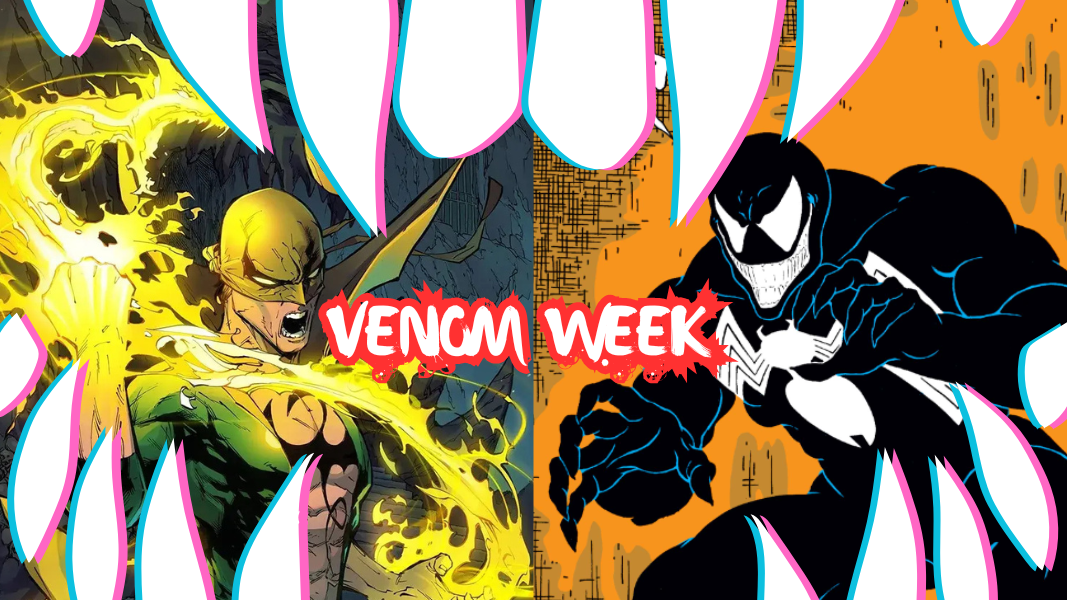
Venom Week: How Iron Fist Helped Create Venom
by Austin Gorton

The question of comic book character creation is often a tricky one. Even in the simplest, most straight-forward origins, the collaborative nature of the medium means it’s often difficult to attribute specific elements of a character to a sole creator. When the shared universe aspects of the modern superhero narratives come into play, things can get even more complicated: a character can be retroactively linked to another, causing creator credits to come crashing together (are Chris Claremont and Rick Leonardi co-creators of Cable because they introduced Cyclops’ son who was retroactively established as Cable?).
Additionally, the real-world “universe” of creators crafting these stories and sharing ideas with one another along the way can sometimes create long strings of credit, as ideas travel from creator to creator and character to character before being executed in print. In this way, a character like Iron Fist can contribute, at least in part, to the creation of Venom, a character with little direct connection to the martial arts master, who debuted at a time when Iron Fist wasn’t even appearing regularly in a comic book.

It all started back in the late 1970s. Before they began their well-regarded collaboration on Uncanny X-Men, Claremont and fellow contemporary John Byrne worked together on Iron Fist, chronicling the adventures of one of Marvel’s more overt efforts to chase the kung-fu fad of the 1970s. In the course of those adventures, Iron Fist’s costume would often get torn or otherwise damaged. As Byrne tells it on his Byrne Robotics site, he had a hard time imagining Danny Rand sitting down between issues to sew up his costume by hand. With Claremont taking the series in a more sci-fi direction around the same time, Byrne set upon the idea of establishing that Iron Fist’s costume was actually a living alien which would “heal” itself, repairing those tears without the need for (imagined) thread and Iron Fist needlework.

This idea never made it out of Byrne’s head and onto the page. Before Claremont delved too deeply into the sci-fi realm with the character (and before Byrne could introduce an alien costume into the mix), Iron Fist merged with Power Man to become Power Man and Iron Fist, a becoming a series which mashed up two of Marvel’s more fad-driven characters in one book. Shortly thereafter, both Claremont and Byrne left the series — in part to focus on their work in X-Men. However, Byrne was good friends with writer Roger Stern (who also edited a good chunk of the Claremont/Byrne X-Men), and mentioned the whole “alien costume” idea to him in passing.

Flashforward a few years. Stern is now the writer of Amazing Spider-Man, and needs to give Spider-Man a new costume as part of a tie-in to the Marvel Super-Heroes Secret Wars event. He remembers Byrne’s ideas, and asks his old friend if he can use it as the source of Spider-Man’s new costume. Byrne agrees, and Spider-Man’s alien costume is born. Yet in further testament to the complicated nature of comic book creation, the issue in which Stern introduces Spider-Man’s alien costume is his last on the book.
It would fall to incoming writer Tom DeFalco to flesh out the details (including the costume’s symbiotic nature). And of course, subsequent creators played further roles in shepherding the concept of a living, alien costume into Venom, including writer David Michelinie (who paired the costume up with a new host in Eddie Brock) and artist Todd MacFarlane (who amongst other things gave Venom his signature wicked grin).
Clearly, Venom is more than simply an alien costume. Byrne is clear that any suggestion he is owed creator credit for the character is to be taken with tongue firmly in cheek. Nevertheless, there’s a clear line of inception from a fad ’70s character (and Byrne’s odd fascination with explaining the upkeep of superhero attire) to one of the most significant Spider-Man villains-turned-anti-hero.
It stands as a prime example of the often complex and convoluted development that goes into the final execution of a character.
