
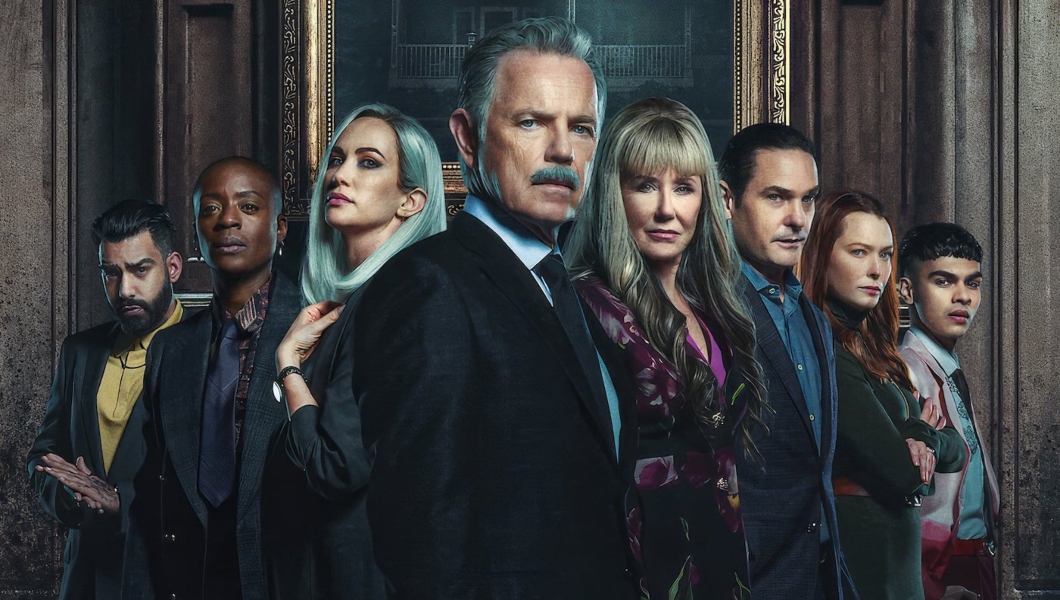
Commentary: ‘The Fall Of The House Of Usher’ Is An Impressive Feat
by Frank Martin

Sometimes stories can be judged simply on their scope rather than on their quality. Ideas can often be so ambitious that the mere undertaking of trying to pull them off is monumental. The creators may succeed or fail in their attempt to make it, but props should also be given to the concept. The Fall Of The House Of Usher is one such show. It attempted to create a connected universe of Edgar Allan Poe short stories, using one in particular as an overarching narrative framework for all the others. Whether or not the show is a good source of entertainment is one thing, but it should be given credit for even creating such an impressive feat.
The story open with Roderick Usher (Bruce Greenwood) and his sister, Madeline (Mary McDonnell), making a deal with a mysterious entity named Verna (Carla Gugino) early in their lives. The deal allows them to achieve incredible success and everything they ever dreamed. Roderick builds an immense fortune he shares with his children, some of whom he fathered out of wedlock. Unfortunately, the deal causes his children to die when his life is at an end. One by one, all of his family expire, including sister Madeline, before Roderick himself meets his end, thus fulfilling the fall of the House of Usher.
The short story, “The Fall Of The House Of Usher”, is obviously the larger narrative framework of the show. Then, each individual member of the family is killed while drawing inspiration from different Poe stories such as “The Masque of the Red Death,” “The Telltale Heart,” and “The Pit And The Pendulum.” Even the boss Roderick and Madeline kill to take over his company meets an end inspired by “The Cask Of Amontillado.” All throughout the series, Poe Easter eggs and homages are littered in every episode for fans to spot. Even if viewers feel the show falls short creating a cohesive story, the attempt deserves immense credit.
The Fall Of The House Of Usher is now streaming on Netflix.

