
Talking ‘The Worst Journey In The World’ And Polar Exploration With Sarah Airriess
by Rachel Bellwoar
To get a title like The Worst Journey in the World you have to really earn it, and it sounds like the crew of the Terra Nova did in Sarah Airriess‘ graphic novel adaption of Apsley Cherry-Garrard‘s memoir. Meticulously researched and based on Cherry-Garrard’s real account of what happened, find out what caused Airriess to latch onto his story and more in the following interview:

Rachel Bellwoar: In the introduction you talk about the radio production of The Worst Journey in the World that changed the course of your life. What has been the most rewarding part about taking a story you first heard orally and adapting it for a visual medium?
Sarah Airriess: Getting the pictures out of my head that have been there for so long … and they turned out to be pretty nice! Volume 1 doesn’t cover any of the material in the radio play, so in a way it’s not even the same thing, but it’s all the same people I fell in love with in the drama, and they’re what tie everything together. It was really fun to do part of the story that practically no one else has told dramatically (it has some of the best bits!).
Bellwoar: How early did you know you wanted to include an Appendix and do you feel you could have told this story as effectively without one?
Airriess: The annotations were really part of it from the start. I’ve been friends with Sydney Padua for practically my whole adult life, and when she first started posting Lovelace and Babbage comics on her blog, there’d be a few pages of rough comic and then reams of notes from all the research she’d been doing. When I got into Scott shortly after, I very quickly came to realise how wrong most narrative adaptations were about the facts, and even how wrong a lot of the nonfiction books were. A big part of deciding to do the graphic novel at all was to tell the story properly and set the record straight for a new generation, and to do this transparently I had to cite all my sources and flag any time I made a deviation from the historical record. Following Sydney’s example was just obvious. Then, since I was doing annotations anyway, I also had somewhere to stick the fun stuff I had to leave out, and explain things in a depth that the narrative flow of the comic wouldn’t allow. One of the fun things about this project is learning so much about the science, and so many other tangents off the main story; the annotations allow me to pass along that joy.

Bellwoar: Adapting a book is one thing but it sounds like a lot of travel and research went into creating this graphic novel. Can you talk a little about your experience visiting Antarctica and how different it is to visit today, versus when explorers were sailing there?
Airriess: Well, for one thing, you just hop on a heated plane for a few hours, instead of battling a sailing ship through the Southern Ocean! I do feel like I cheated, there. In some ways, Antarctica is a completely different place now – noisy, motor vehicles everywhere, food that doesn’t come from a tin – but in other ways it still has a lot in common with the historical Antarctica, if you can see modern and historical Antarctica through their respective contemporary lenses. Antarcticans still live in prefab huts, get one big food delivery a year, have to deal with the same weather, do the same science, have the same sort of ambivalent relationship with the rest of the world . . . none of that has changed. If you’re at one of the big bases, you might get your own bedroom, or share with one roommate, rather than all cram into one hut, but field camps haven’t changed very much, beyond having a radio. Maybe the biggest difference is plumbing, and the Antarctic Treaty insisting you have to pack out what you pack in, so no dumping your rubbish (or poo) in the tide crack. The same sort of personalities are attracted to Antarctica, and the prefab spaces and standard-issue gear get personalised in the same idiosyncratic way. There’s just a different aesthetic now.
Bellwoar: With a title like The Worst Journey in the World you know what you’re signing up for but, as this graphic novel is only part one, the worst is seemingly yet to come. Do you know how many graphic novels this series will be altogether and did you ever consider changing the title?
Airriess: I have the whole series plotted out already, and the rest of it falls into nine discrete “episodes” with self-contained story arcs. These are vastly differing lengths, though, so the plan is to release them in three omnibi of three episodes each, which will also have a beginning-middle-end structure. So, four volumes total, including Volume 1.
I always wanted to do an adaptation specifically of Cherry’s book. For a little while, I considered making it a more general adaptation of the history, but Cherry is such a good writer and such an interesting character, and he structures his book so beautifully, that it seemed a shame to leave it by the wayside. Thankfully, the Scott Polar Research Institute, which holds the copyright, has been enthusiastic about my adaptation, so I didn’t have to be coy about it! Not only is the title catchy, but it’s also meaningful: on one hand, there were some pretty terrible journeys*, but the journey Cherry makes from innocence to experience is arguably the worst of all.
* The title actually refers to the midwinter to Cape Crozier for penguin eggs, rather than the polar journey, but it fits both

Bellwoar: Apsley Cherry-Garrard wasn’t the only member of the Terra Nova expedition to write about his experience. What makes his account stand apart from the others?
Airriess: Compared to the other accounts, Cherry’s book is the most intimate and personal, and the most evocative of the lived experience of Antarctica. You really feel like you’re there with him, and the people around him really come alive. He’s also the perfect sort of character to be the audience’s stand-in: he’s going into the adventure as much of a rookie as any reader, and we experience it all for the first time with him. He was at the centre of most of the expedition, and can write about things first-hand, whereas many of the other authors missed a large chunk. When he can’t write from his own experience, he quotes someone who can, so it’s an oddly collaborative book as well. Scott’s journal is an amazing document of the expedition, but incomplete; very much a first draft, and very much just him. Cherry wasn’t a specialist, but was curious and intelligent and loved learning, so he’s a good viewpoint from which to explain nearly everything. Plus, I think most of us can identify at least a little with his youthful innocence and idealism … and his disillusionment.
Bellwoar: Cherry-Garrard didn’t have to go on this expedition. In fact, early on in your graphic novel we see that Cherry-Gerrard is writing his memoir from inside a mansion. Why do you think he was so determined to go?
Airriess: I think he was looking up the barrel of a life completely devoid of meaning and purpose, and wanted to be a part of something that mattered, that was worth putting effort into – and something where he could prove his own worth, rather than the worth ascribed to him by his rank in society. He was born into privilege and put straight on the conveyor belt to a dull life of managing his estate and hobnobbing with posh bores, none of which interested him at all. I think it’s a little harder to understand the claustrophobia of the Edwardian class system from an American perspective: the big house wasn’t just a little palace of comfort for a rich person to bask in; being upper class came with a lot of responsibilities and obligations. He ended up selling his house and all his land and moving to an apartment in London to be free of the weight of it all.

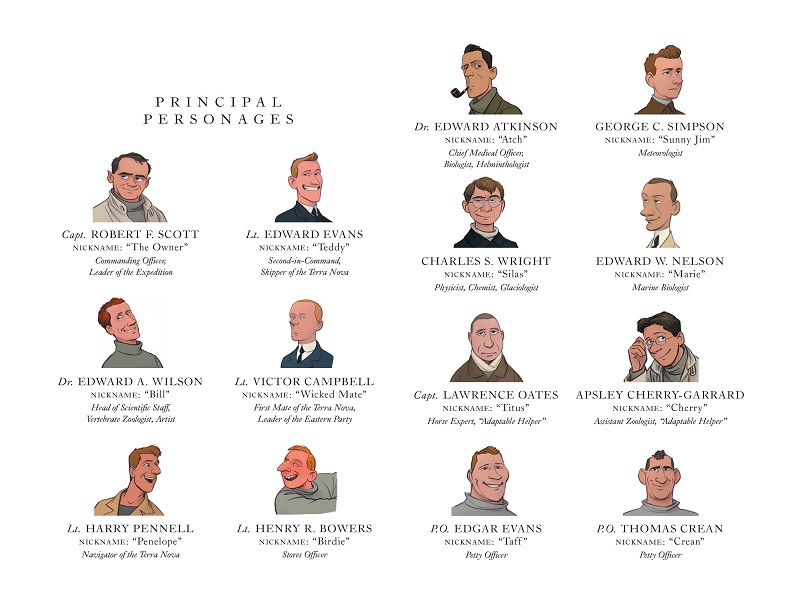
Bellwoar: One of the sections I find most impressive is when you introduce the characters. What was it like trying to capture each person’s personality in a facial expression?
Airriess: To be perfectly honest, it’s just a lot of fun. That’s the best part of the job. I’ve been living with these guys for so long that I don’t really have to think about what is an appropriate facial expression for them, they just do it and I sketch it down. It’s something I’ve always been able to do without thinking about it too much; that’s why I became an animator. I would have been an actor if I were any good at it; instead I just see the acting in my head!
Bellwoar: Songs are featured a lot in part one. Is it strange, trying to portray a song visually?
Airriess: I mean, I come from animation, we portray songs visually all the time … it took about ten seconds to decide to put the lyrics in ribbons, and then I just had to make people look like they were singing. I haven’t attempted any choreography!

Bellwoar: I never would’ve realized how much time and energy had to be devoted to bailing water. Was there anything you learned while doing researching for this project that surprised you?
Airriess: I was very surprised how bright turquoise the water is in New Zealand! I have not exaggerated that at all!
Bellwoar: Coming into this book as a fan of TV shows like The Terror and The North Water, are there any other books or media you’d recommend to readers interested in stories about Polar exploration?
Airriess: Oh boy, my friend Jess has the best guide for Sad Boat Books: https://www.tumblr.com/jesslovesboats/724047146616225792/new-to-sad-boat-start-here-to-see-if-its-for?source=share
That’s the nonfiction list; here’s the fiction* one: https://www.tumblr.com/jesslovesboats/757642956834586624/hello-friends-i-am-back-with-more-reading?source=share
My no.1 recc for Terra Nova reading is Diana Preston‘s A First Rate Tragedy – she does an amazing job of giving you the essentials of the expedition in a pacey, readable way; she foregrounds the personalities, gives exactly the right amount of background for you to understand Scott and the decisions he made, and is faithful to the historical record. (She cites everything! I love her!) I recommend Preston over the original Worst Journey to first-timers because WJ is massively long and it’s a huge commitment if you’re not into it already. However, it will reward the reading. Please feel free to skip the introductory chapter about the history of Antarctic exploration – a lot of people give up there because it’s very dry and they think they have 600 more pages of that ahead of them. Just start at Cardiff, you’ll be fine. If you want something lighter, even if you don’t like rocks as much as Griff does, T. Griffith Taylor‘s With Scott: The Silver Lining is a good time. Richard Farr‘s Emperors of the Ice is a very fine narrative retelling of the Winter Journey and Cherry’s POV of the expedition. For non-Terra Nova books, I have really enjoyed David Grann‘s The Wager, a mind-blowing true story of shipwreck and skullduggery. I have to admit I haven’t read Madhouse at the End of the Earth yet, but it sounds like exactly the sort of thing that would chime with Terror fans, and it’s quite popular. This is hardly polar exploration, but Netflix’s Society of the Snow is beautifully made, and hits many of the same emotional points. I didn’t actually enjoy The North Water at all, so I don’t know what will appeal to those folks, sorry!
*For a given value of fiction; perhaps ‘dramatised’ is better
Bellwoar: Thanks for agreeing to this interview, Sarah, and all of the recommendations!
The Worst Journey in the World Volume 1: Making Our Easting Down is on sale now from Iron Circus Comics.