
Something Spooky: The X-Men Are The Monsters In ‘Uncanny X-Men’ #232
by Austin Gorton
In Uncanny X-Men #232’s “Earthfall,” writer Chris Claremont and artists Marc Silvestri & Dan Green kick off the second “Brood Saga.” A follow-up to the Claremont-penned, Dave Cocrkrum and Paul Smith-drawn “Brood Saga” from a few years earlier, this second go round takes place on Earth (instead of outer space) and features an almost-entirely new lineup of X-Men, the “Outback Era” team which operated out of a base in the Australian outback for the last few years of the 80s. This second “Brood Saga” is one of the signature stories of that era. It is notable for the way it leans heavily into the horror aspects of the Brood — parasitic aliens which implant eggs in people, that, when they hatch, turn the host into a Brood. Leaning into the sexier, edgier art style of Silvestri and Green to tell a grittier, darker story, Uncanny X-Men #232 is notable for the way it starts the second “Brood Saga” by upending the dynamic between the X-Men and the Brood, casting the X-Men as the monsters of the tale.
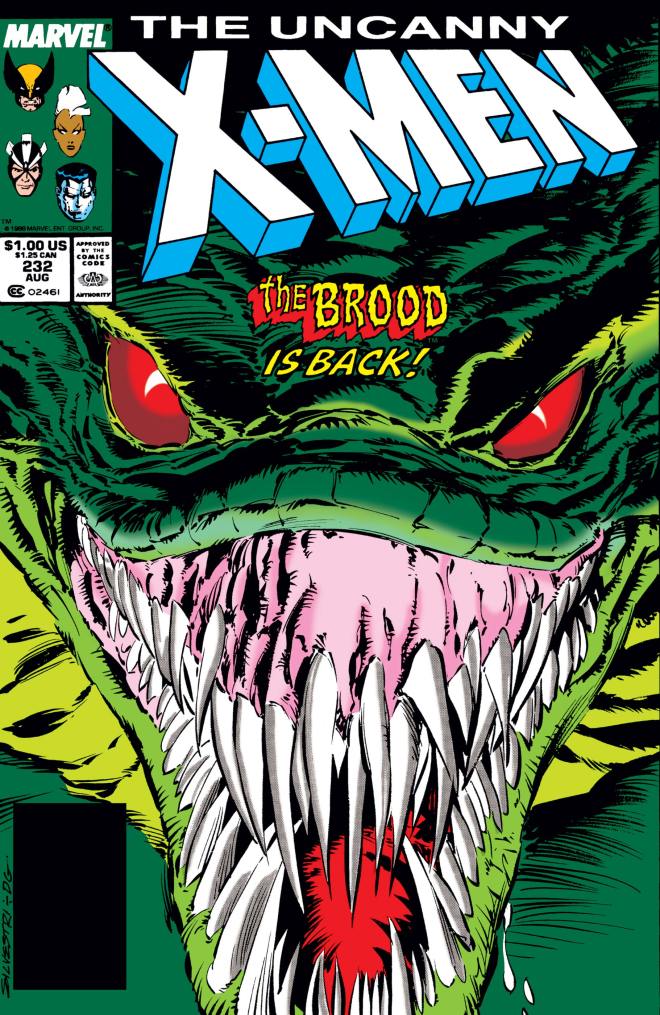
It begins by revisiting a plotline begun — and seemingly forgotten — back in Uncanny X-Men #218, in which an alien ship (technically, a Star Shark) crash landed in New Mexico. Discovered by a man named Harry Palmer and his friends, the theme of being hunted by some inhuman Other is established immediately as the Brood emerge from the ship and hunt down the humans one by one. The attack is staged like a horror film, the Brood striking from the shadows, visually indistinct, save for one panel which briefly shows a Brood in their full glory. The “camera” stays tight on Harry and his reactions as he scrambles to safety, the horror unfolding on his friends occurring off-panel, left to the reader’s imagination as Harry desperately and, seemingly, successfully manages to survive the attack and escape.
The story then cuts to the present, as Harry goes about his day working as a paramedic in Denver. Yet it quickly becomes clear that Harry was changed by his encounter with the Brood as, after responding to a call involving a fire-generating mutant suffering a heart attack, Harry’s demeanor subtly changes and he implants the mutant with a Brood egg. After a brief transition to check-in with another ongoing plot line, the narrative returns to Harry arriving home late at night.
In a scene straight out of horror movie, he walks through pockets of light generated by street lamps, along a mist-shrouded street to his apartment. He passes two seemingly innocuous lovers, canoodling in the shadows. Stepping into his apartment, he finds a strange hooded-and-cloaked figure waiting for him. She knows his name. Behind him, a metallic behemoth closes the door, trapping him inside. Harry fights back, best he can, escaping into the night. From above, a waiting figure in black hits him with a blast of energy. Just then, the two lovers emerge from the shadows, and attack Harry as well.

Readers know the figures attacking Harry to be Psylocke, Colossus, Havok, Longshot and Dazzler of the X-Men, and readers know (thanks to the earlier medical emergency scene) that Harry’s sudden burst of strength and ability to almost instinctively shrug off the X-Men’s attacks are a result of the growing Brood gestating inside him. But this first encounter between Harry and the X-Men is staged entirely from Harry’s perspective. It’s clear he neither knows the X-Men, nor what is happening to him. In this monster movie, the monster is the hero, and the heroes are the monsters.
After Harry escapes into the night, the X-Men regroup. On the surface, this seems like a standard superhero comic book scene, the heroes discussing how best to defeat their foe. Yet pointedly — especially when taken in comparison with the earlier Brood story — there is little debate over whether or not the X-Men should kill Harry (and the Brood inside him). Whereas earlier Storm agonized over the notion of killing a Brood — even going so far as to sacrifice her own life to avoid doing so — she makes it clear in Uncanny X-Men #232 that she wants Harry alive only long enough to learn who else he may have implanted. And so Wolverine — from some perspectives, the most monstrous of all the X-Men — slinks off into the mists, body hunched over, his prey’s scent in his nose, on the hunt.

“Earthfall” then returns to Harry’s POV. He frantically boards a city bus, only to discover one of the passengers is Rogue, lying in wait. He attacks her, just as Wolverine catches up, pulling Harry from the bus. Harry runs down a dead-end alley. Wolverine — rendered in black, his shadow stretching the length of the alley — cuts off his access to freedom. Wolverine is soon joined by Rogue. All seems lost for Harry, until a police car suddenly pulls up behind the X-Men. Wolverine pivots, and attacks.
Just when it seems like the X-Men have crossed a line, attacking innocent bystanders in their hunt for a monster, Claremont & Silvestri reveal the twist: the police are infected with Brood, too, and so are the rest of a small group of people who emerge as Harry’s Brood side takes dominance. Suddenly, the X-Men are surrounded by Brood, the hunted having become the hunter as Harry, the “final girl” of the story up to this point, transforms into the true monster of the tale.
From there, this second Brood Saga becomes more of a traditional — albeit still horror-tinged — superhero story, as well as a deeper examination of the moral complexity that comes with the best Brood stories. But for the length of Uncanny X-Men #232, at least, Claremont, Silvestri and Green go full horror, tapping into the tropes, tricks and techniques of the genre to tell a moody, atmospheric story involving a seemingly nice young man’s desperate efforts to evade the monsters hunting him down — monsters who just happen to be the X-Men.
