
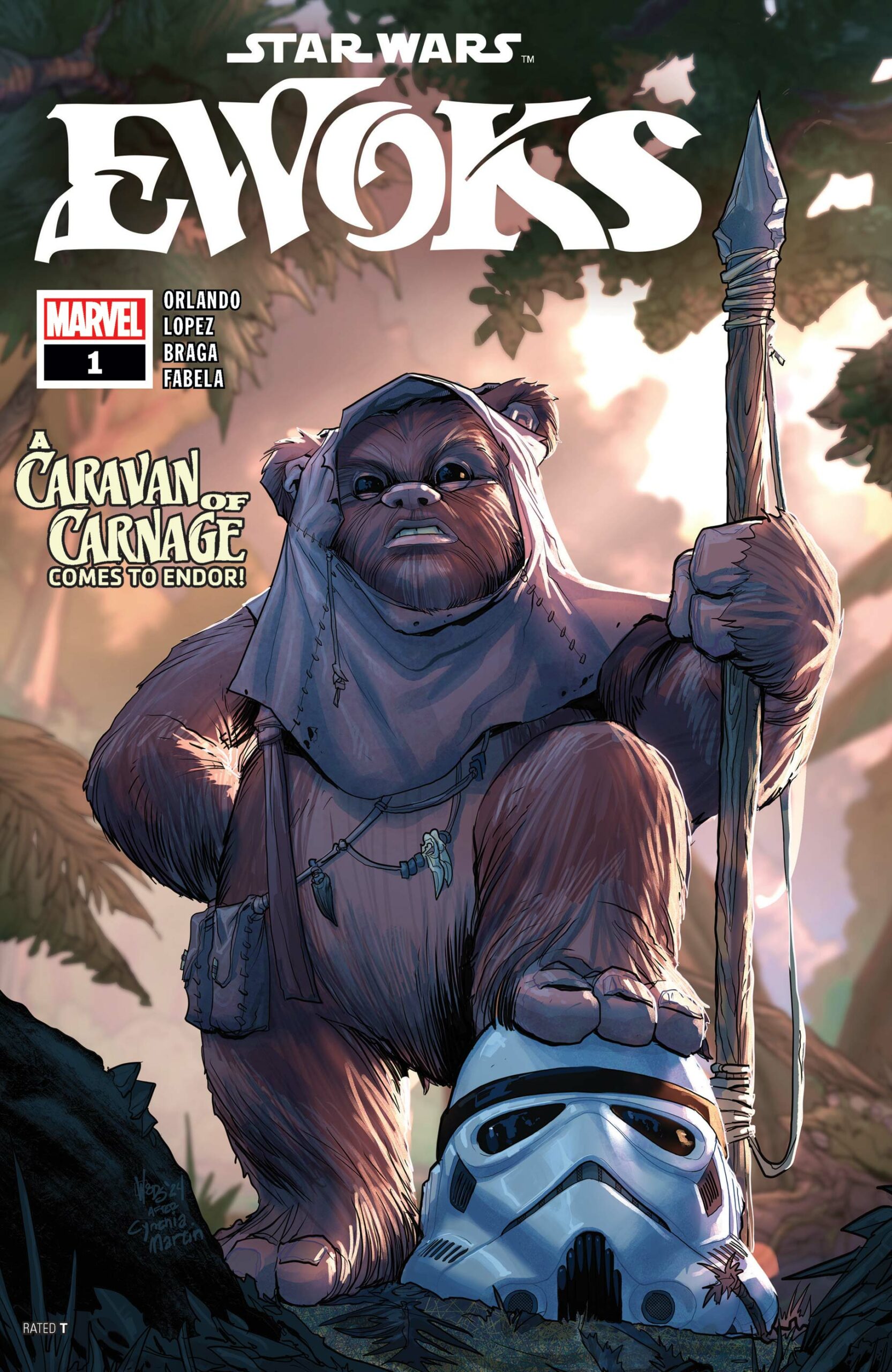
‘Ewoks’ #1 Review — Star Wars’ Murder Bears Take Center Stage
by Austin Gorton
Overall
6/10Who doesn’t love the Ewoks? A lot of people, actually — especially in the pre-Jar Jar Binks days of Star Wars. But love ’em or hate ’em, there’s also potential for interesting stories involving the divisive yet adorable little murder-bears. Writer Steve Orlando, along with artists Àlvaro López and Laura Braga, are attempting to do just that with Star Wars: Ewoks #1. How successful are they? Well, the answer is … complicated.

The debut issue picks up in the relative aftermath of the events of Return of the Jedi. The Rebellion has partied, Leia and Han have gotten married, and the “outsiders,” good and bad, have left the forest moon. The members of the Ewok Bright Tree village, including Wicket, Chief Chirpa, and the Wolverine-esque Meedro (he’s a tough-talking loner from the outskirts of the village), are deciding how best to deal with the newfound knowledge that they are just “one tree in a much larger forest,” and how to deal with the inevitable arrival of more outsiders. Meanwhile, the Imperial remnant is in need of equipment, so Moff Adelhard dispatches General Koyatta to access a hidden armory he left behind on Endor.
Right off the bat, Orlando makes some choices that directly impact the success of the story. It would be nigh-impossible to write this series without providing the Ewoks with dialogue readers can understand. The original Marvel Star Wars comic book, which used the Ewoks a fair amount in its post-Return of the Jedi issues, rarely did that (incidentally, the cover of this issue is an homage to one such issue, Star Wars #94). But that series still had Han, Leia, and the other human characters to drive the action, relegating the Ewoks to a supporting role. Here, Orlando is using the Ewoks as the main characters, and thus, establishes the whole “what you’re reading is translated from their native language” routine right at the top.

Yet as necessary as it may be, the dialogue still sounds off in places. Sometimes, the “translation” uses words like “outsiders” for aliens or “cruel ones” to refer to the Imperials. Yet at other times, it suggests the Ewoks are familiar with words like “skull” or “predator”. The mishmash in approach — between translating directly (an Ewok word to an English/Basic word) and translating metaphorically (presenting the Ewok term for something in English/Basic) — is occasionally jarring, making it difficult to stay fully immersed in the story.
More successful is the use of Adelhard and the Imperial remnant. Not only is Ewoks #1 set after Return of the Jedi, it is set in the current post-Jedi era of Marvel Star Wars storytelling. Adelhard — one of the main antagonists in the concurrent Battle of Jakku series — underscores this, confirming the book as part of the larger narrative. In execution, the use of Koyatta and his ragtag team (composed of an Imperial Scout trooper, a Sequel Trilogy-era Dowutin tracker, and the bounty hunters Zuckuss and 4-LOM) strike the right balance between being threatening and beatable. They also speak to the state of the Empire at this time, still capable of causing trouble but forced to hire out for help just to retrieve a weapons stash.

Ewoks #1 probably isn’t good enough to change the minds of any diehard Ewoks-haters. But there’s plenty to enjoy here for the pro-Ewok or Ewok-ambivalent types. The translation effect of their dialogue can occasionally be off-putting, but when it’s not, it allows the Ewoks to more fully come into focus as characters in their own right — particularly Wicket and Meedro, who get teamed up in a sort of mismatched buddy cop dynamic by the end of the issue. The use of the Empire, and the way that connects the series to the larger ongoing Star Wars narrative, also helps. Unlike previous Ewok-centric tales, it helps make this story feel less like an attempt to simply cash in on the toyetic adorableness of the characters and more like an actual story that has something to say, and is simply saying it in a specific pocket of the Star Wars galaxy.