
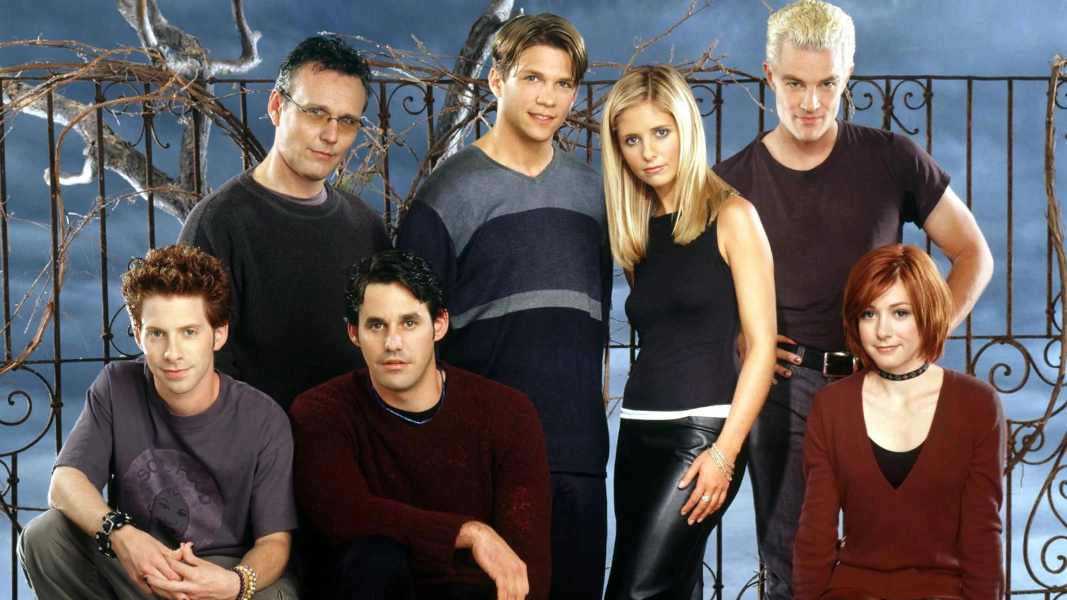
Characterization In The Buffyverse — ‘Buffy The Vampire Slayer’ Season 4 Wrap-Up
by Benjamin Hall
This is part of a bi-weekly series concerning the characterization of Buffyverse characters. The first installment in this series can be found here. Arguably the best place to begin reading this series is at the beginning, but that is up to each reader. As a reminder this column will cover major and some minor characters from the shows Buffy The Vampire Slayer (1997-2003) and Angel (1999-2004). Other Buffyverse media, such as the graphic novel Spike: Into The Light (2014) are not pertinent to this series. Also there will be no referencing real world events that have a direct relation to either show in this bi-weekly series.
This week wraps-up the examination of Buffy The Vampire Slayer Season 4. The following seasons will still be put under a figurative microscope, but I think it is important to examine where select characters are after each season. And as each concludes, we will also see who holds the titles of “most negative characterization” and “most positive characterization.” Also, in these wrap-ups, we will see who gets the most and least focus, respectively. Lastly, later wrap-ups will refer back to previous ones where appropriate.

(Warning of spoilers from this point on!)
(Trigger warning for mentions of abuse, suicidal depression, and non-consensual acts)
Buffy Summers (Sarah Michelle Gellar) has her love of cheese become a firm character trait this season (Season 4, Episode 7, “The Initiative”). While a spell starts off the potential of the eventual romance between Buffy and Spike (James Marsters) that will evolve in future episodes (Season 4, Episode 9, “Something Blue”), when it comes to romance in this season she is just trying to be what Angel/Angelus (David Boreanaz) wants despite experiences with Owen Thurman (Christopher Wiehl) and Scott Hope (Fab Filippo) in Season 1, Episode 5, “Never Kill a Boy on the First Date” and Season 3, Episode 4, “Beauty and the Beasts” respectively. While Parker Abrams (Adam Kaufman) is not like either of those two, he does result in her having even more trust issues after her time with Angel/Angelus (Season 4, Episode 3, “The Harsh Light Of Day”). Her current significant other, Riley Finn (Marc Blucas), is a little bit of a mixture of Scott, Owen, and Angel. As for balancing college life with slaying, she does not appear to take many classes which causes an apparent lack of balance. Finally, she and her friends continue to have poor communication with each other.
Willow Rosenberg (Alyson Hannigan) has a major romantic change with her break-up with Oz (Seth Green) and starting a relationship with Tara Maclay (Amber Benson). This coincides with the start of her moving away from technology and towards magic. This change symbolizes the romance one. She also displays a lack of respect for others via magic misuse starting this season, especially with the “something blue” spell. On the plus side she displays way more confidence in herself this season.
Xander Harris (Nicholas Brendon) still shows toxic behavior — mainly in the way he treats Anya. Nevertheless, he is (for the most part) less toxic than in previous seasons. Also, he shows some maturity by trying to get and maintain a job. His construction work this season will greatly add to his character development going forward. Meanwhile, his soldier knowledge from a prior spell (Season 2, Episode 6, “Halloween”) comes into play this season to help infiltrate and deal with The Initiative (Season 4, Episode 19, “New Moon Rising”).
Tara enters the picture as a mysterious magic user with a stutter that Willow eventually falls in love with. Other than this summary there isn’t too much to her development this season that will stick around in subsequent ones.
Oz ends his time as a character here. Unfortunately, it personally feels like there isn’t really a seasonal character arc for him until this season, and then only a minor one involving his affair. Although he has arcs in prior seasons they are only episodic ones. Although, it could be argued the whole werewolf control problem amounts to a longer arc. However, I again personally feel this is not a season-long storyline since this detail goes through all the television seasons he appears in. Also, this issue of controlling his wolf instincts and form does not see resolution in the show. The only thing that does is his romance with Willow, which is mainly due to his cheating.
Anya (Emma Caulfield Ford) sees some change to her personality from her comeback at the beginning of the season to the end of it. Her personality seems to revolve around her primary interests which this season are sex, Xander, and talking about her past. These interests will fluctuate in future episodes of the next three seasons depending on two things. The first will be whether her upcoming interest in money can be mentioned. The second: how much screen time she gets per episode. As far as this season goes, her interest in Xander seems to override the others. Lastly, she still considers herself more demon than human, and this creates some inconsistent character beats for her throughout this season.
Ethan Rayne (Robin Sachs) makes his final appearance in the show this year. Unfortunately, he has little-to-no development as well as little impact on the other characters and the over-arching plot.
Rupert Giles (Anthony Stewart Head) has a non-starter romance with Olivia Williams (Phina Oruche). He spends the majority of this season providing exposition while dealing with a lack of direction in an empty nest syndrome kind of way.
Spike has a good deal of development this year. Due to the control chip, Spike displays depression that culminates in a failure at suicide (Season 4, Episode 11, “Doomed”). It is resolved after he learns he can still fight demons. He has a toxic rebound relationship with Harmony Kendall (Mercedes McNab) that is mostly just about sex on his part (Season 4, Episode 3, “The Harsh Light Of Day”). Arguably, he shows some admiration of Buffy while talking her up to Adam (Season 4, Episode 20, “The Yoko Factor”). Also, it is worth mentioning his perceptiveness and trouble with lying continue to display themselves throughout the episodes.
Riley Finn displays a few relationship red flags. First: He is in a position of authority as a teacher’s assistant and yet wants to date a student Another red flag it is the fact that he insults Buffy before they date in response to her not wanting to (Season 4, Episode 11, “Doomed”). A third flag is his involvement with a secret government program that is okay with vivisection. This form of torture is something he never seems to feel bad about until Oz (Season 4, Episode 19, “New Moon Rising”) and then never again. He is otherwise very bland in terms of personality despite being a man of action. Unfortunately, he will become even more toxic throughout the next two seasons.
Professor Maggie Walsh (Lindsay Crouse) and Adam (George Hertzberg) are just a modernizing of the Dr. Victor Frankenstein and his creation (Frankenstein; or, The Modern Prometheus by author Mary Shelley [1818]), and this is despite both failing to have any real development of their own . Yes, Maggie has some weird complex about being a mother to a new group of beings, but it is unclear if that is just her being a Nazi or something else.
Joyce Summers (Kristine Sutherland) is mostly a non-character this season despite her prior characterization in the past as an important part of Buffy’s life. While this isn’t fully negative characterization, it is disappointing for the above reasoning and in light of what will happen soon.
Harmony Kendall, essentially, has the same characterization as a vampire as when she was human in the first three seasons. The only new aspects revolve around how she acts and reacts in her toxic relationship with Spike, which suggest she is both a manipulator and an abuse survivor (Season 4, Episode 3, “The Harsh Light Of Day”).
Forrest Gates (Leonard Roberts) starts out as a seemingly okay guy, but by the end he becomes both a literal and figurative monster. Additionally, his character arc sees a lot of rushing and, therefore, there are few reasons viewers get to see for his change.
Graham Miller (Bailey Chase) begins both as an equal to Forest when it comes to their friendship with Riley and also as a decent supporting character. Yet, he quickly becomes totally stock and irrelevant.
Faith (Eliza Dushku) and Angel do appear in this season, though at different times (Season 4, Episode 16, “Who Are You” and Season 4, Episode 8, “Pangs”). Although, as their stories continue more in Angel than this show, the analysis of them will be in the next installment of this column.
Jonathan Levinson (Danny Strong) still has low-self-esteem issues and this does not go away by the end, but at least he is not suicidal (Season 3, Episode 18, “Earshot”). Thus, the only developments for him include becoming a magic user, a rapist, and a murderer through the use of his popularity spell (Season 4, Episode 17, “Superstar”).
D’Hoffryn (Andy Umberger) is more of a character this season than last (Season 4, Episode 9, “Something Blue” versus Season 3, Episode 16, ”Doppelgängland”). He is less of a a generic demon and more like an overly dramatic boss and recruiter.
While this season collectively has a lot of changes and good character moments on a per-episode basis, this is hard to see. A lot of details established here will grow in future seasons. As for who is most negative in characterization, it would be a tie-in between Jonathan, Walsh and Adam. They are the characters who individually commit the worst acts in this season in a way that most can agree are horrific. The best characterization is arguably Spike or Joyce. Both have moments of positive growth (Spike) or good communication skills (Joyce) — an important thing on Buffy — leaving the award a toss-up between the two.

