
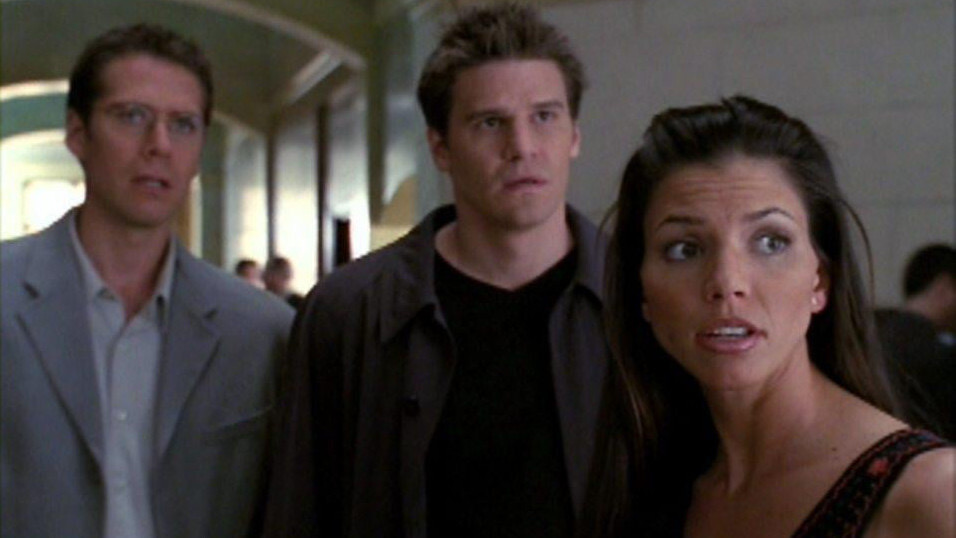
Characterization In The Buffyverse — ‘Angel’ Season 1 Wrap-Up
by Benjamin Hall
This is part of a bi-weekly series concerning the characterization of Buffyverse characters. The first installment in this series can be found here. Arguably the best place to begin reading this series is at the beginning, but that is up to each reader. As a reminder this column will cover major and some minor characters from the shows Buffy The Vampire Slayer (1997-2003) and Angel (1999-2004). Other Buffyverse media, such as the graphic novel Spike: Into The Light (2014) are not pertinent to this series. Also there will be no referencing real world events that have a direct relation to either show in this bi-weekly series.
This week wraps-up the examination of Angel Season 1. The following seasons will still be put under a figurative microscope, but I think it is important to examine where select characters are after each season. And as each concludes, we will also see who holds the titles of “most negative characterization” and “most positive characterization.” Also, in these wrap-ups, we will see who gets the most and least focus, respectively. Lastly, later wrap-ups will refer back to previous ones where appropriate.

(Warning of spoilers from this point on!)
(Trigger warning for mentions of abuse, torture, suicidal actions, and non-consensual acts)
Angel/Liam/Angelus (David Boreanaz) gets a bit of a reset at the start of the series when it comes to his social skills (Season 1, Episode 1, “City Of”). They are, to an extent, similar to his original presentation in Buffy Season 1 (Buffy The Vampire Slayer Season 1, Episode 7, “Angel”). While those skills will never be the best throughout the series, they do improve in consistency as this season, and the show itself, goes on. As for the flashbacks, they fill in details of his past, and demonstrate that he is not that different no matter the persona or name (Season 1, Episode 15 ,“The Prodigal”). His ability to create mechanisms that assist in killing vampires, one can assume, comes from his time thinking — and implementing — tortures in the past. Well, that and the needs of the plot. Finally, his unilateral and selfish ways of thinking are visible throughout and often lead to bad moments of characterization or plot, especially when it comes to Buffy Summers (Sarah Michelle Gellar) (Season 1, Episode 8, “I Will Remember You”).
Allen Francis Doyle (Glenn Quinn) sees possibly the most development out of all the characters original to Angel thus far. He goes from a seedy coward to a true hero. Unfortunately, the majority of this development occurs via just two episodes and concludes with his death (Season 1, Episode 7, “The Bachelor Party” and Season 1, Episode 9, “Hero”).
Cordelia Chase (Charisma Carpenter) is pretty much the same character throughout much of this season as at the end of Buffy Season 3. Yes, she has small moments of growth, but it is only at the very end of this season she displays a true change.
Wesley Wyndham Pryce (Alexis Denisof) goes from being a gag character on Buffy to more of an action hero version of Rupert Giles (Anthony Stewart Head). There is also the reveal of a traumatic past (Season 1, Episode 14, “I’ve Got You Under My Skin”) that creates a reason for his overly-proper manner on Buffy.
Spike (James Marsters) has one of his most negative character moments in his guest appearance (Season 1, Episode 3, “In The Dark”). While his teaming up with the pedophile vampire Marcus (Kevin West) does not personally impact Spike too much due to his own past evil deeds, it does affect how some viewers see him.
Buffy Summers is a victim of Angel’s selfish way of doing things during her guest appearances. This is especially true with the time reversal that wipes her memory of him being human for a day.
Faith (Eliza Dushku) goes from raping Riley Finn (Marc Blucas) using Buffy’s body (Buffy The Vampire Slayer Season 4, Episode 16, “Who Are You?”) — which also causes Buffy mental trauma — to torturing Wesley and then seeking suicide via Angel (Season 1, Episode 18, “Five By Five”). These are arguably her darkest actions on the two shows. While they are horrible, her attempt to redeem herself through going to prison is absurd since she has no assurance that the Watcher’s Council or Wolfram & Hart won’t kill her there. See also: she acts like a junkie before turning herself in, and there is no reason viewers learn for this behavior. Thus, while Faith gets to start a redemption arc that is mostly off-screen, she does not get a logical beginning to it.
Kate Lockley (Elisabeth Röhm) starts out as a substitute Buffy thanks to her potential as a love interest and her assistance on some of Angel’s cases. But by the end of the season, her purpose as a character changes to the point that she is an antagonist with no believable purpose.
Darla (Julie Benz) has no real new developments until she comes back to life in the finale (Season 1, Episode 22, “To Shanshu in L.A.”). Yet, some of her personal history becomes fuller with the flashbacks.
Charles Gunn (J. August Richards) has a stereotypical “young black guy from the streets” TV personality. While he gets a little development in his appearances, it isn’t enough to escape the stereotype.
Holland Manners (Sam Anderson) is a mysterious antagonist this season. His position at Wolfram & Hart is unclear, as are his interactions with Lindsay McDonald (Christian Kane) (Season 1, Episode 21, “Blind Date”).
Lindsay starts out as a mysterious but generic evil lawyer. By the end of the season, he is starting to become an actual character as viewers learn his motivations and his gains an actual grievance aganst Angel.
Lilah Morgan (Stephanie Romanov) comes across as a potential on-the-rise lawyer, as well as a rival to Lindsay. Her only other characteristic: she is willing to gamble (Season 1, Episode 16, “The Ring”).
David Nabbit (David Herman) is a stereotype of a wealthy nerd who knows about the supernatural. Other than this stock stereotyping, there is nothing to him this season.
Oz (Seth Green) has a brief guest appearance with some generic cool moments, such as crashing a vehicle through a building. Yet, his time on Angel is almost as weak in purpose as David Nabbit’s existence.
When it comes to having the most negative traits this season, Angel just edges out Spike on this front. Yes, Spike teams up with a pedophile and uses slurs, but Angel wipes out a day for the whole world just to become a vampire again. Plus, his lack of thought in certain moments causes unnecessary problems for others, such as Kate’s father, Trevor (John Mahon). On the positive side of things, the best trait is Cordelia’s blunt perspective. It does a few things, with the most important being the way it grounds Angel to humanity. Unfortunately, this season’s various episodic plots hurt the amount of development any of the characters could have.

