
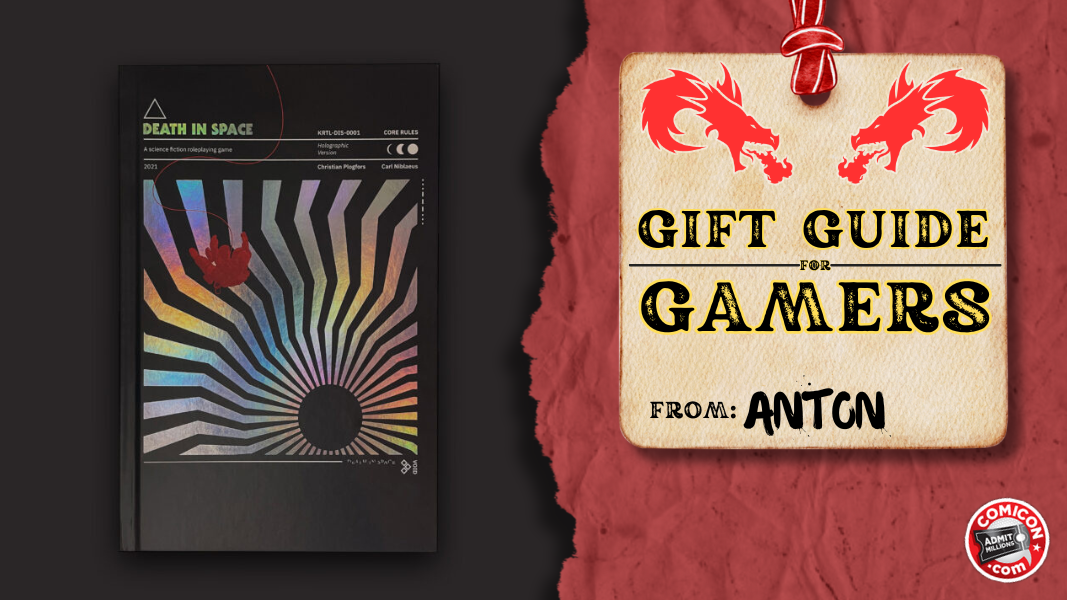
Gift Guide For Gamers 2024: Free League’s ‘Death In Space’
by Anton Kromoff
Welcome to the table,
While I love sword & sorcery stories and the game settings that allow to explore those themes of strange spell casters, ancient artifacts, dazzling storytelling set pieces, there is always a place at my table for non dragon adjacent gaming. One of the coolest offerings in the “not a wizard” landscape from my pals at Free League has earned a spot on my coveted Gift Guide for Gamers. The game in question is called Death in Space.

Death In Space is an extraordinary TTRPG that blends haunting visual design and accessible gameplay with innovated mechanics and a fresh and immersive experience for players and storytellers alike.
As with all Free League publications, the art and style of Death in Space is stunning. Every page feels deliberate, from the typography that skitters across the page like retro-future computer displays, to the art that evoke a post-cosmic-apocalyptic junk-punk aesthetic. The book does not so much present rules, as provide an immerses experience that allows those venturing into this odd setting to really feel the chill of the void as they float from page to page.

For those looking for a new setting to play in, character creation in Death in Space is quick, intuitive, and flexible. Players roll dice and consult charts to craft unique backstories and affiliations, with plenty of room for creative interpretation.
The group dynamic in this game is also in full effect as the creation of the Hub, a kind of shared spacecraft or space station that serves as the party’s home, is made through group storytelling and decision making. As the story unfolds, not only do your characters evolve, but so does the Hub, reflecting the group’s survival efforts and progress in a way that can feel really fulfilling regardless of how cohesive your table is. If the table is troubled, the Hub is chaotic, if the table works together, the Hub works.

I also really love the Void Point system present in Death in Space. It introduces an ever-present cosmic force that watches and influences the players. Fail an ability check? Gain a Void Point. Use Void Points to succeed in critical moments or activate bizarre and disorienting mutations—like growing an extra set of teeth or developing a detached twin.
This mechanic reinforces the game’s tone of instability and the creeping horror of the unknown, creating a very present unsettling vibe that can make for some truly cool storytelling moments at the table.

There are a lot of video games out there that require you scavenge to survive. Honestly, those frustrate me a bit. If I’m off on an adventure and I have to keep stopping to eat or finding new weapons because they break I lose interest quickly.
However, in Death in Space there is this focus on the fragility of life and resources in a desolate and unforgiving universe, and it just sort of works. Players must scavenge and repair their gear and spacecraft, adding weight to every decision they make, and who gets what when dividing up the limited loot. The system fosters teamwork and encourages group strategy, making it a fantastic choice for players who love collaborative storytelling and great for storytellers who have a table they know is going to fight or try and cut each other out of things.

Death in Space works on so many levels. If you are into innovative game design, you will dig this. If you like cosmic horror, you will dig this. If you want to look at some really solid beautifully haunting design work, you will dig this. Death in Space is such a perfect unforgettable addition to any TTRPG collection that it makes a great gift for players, storytellers, or just people who like rad books on their shelves.
You can score a copy in cool game shops that carry rad books or over at this link.
Until next time, I adore this game and it really does make a fantastic addition to the non-high fantasy/Sword & Sorcery space and will forever be a recommendation for great gifts for gamers.
