
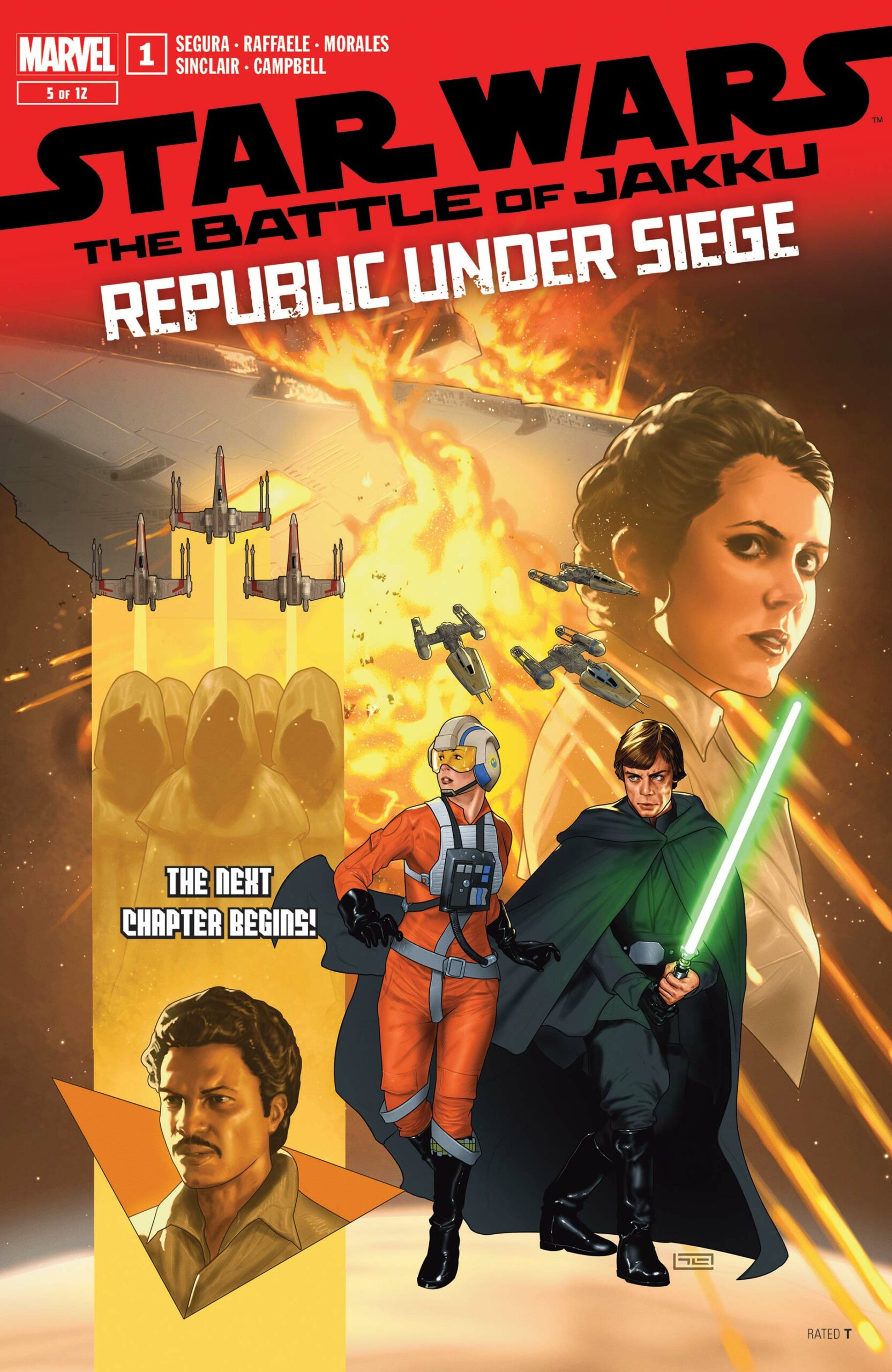
Review — ‘Star Wars The Battle of Jakku: Republic Under Siege’ #1 Is More Of the Same
by Austin Gorton
Overview
Star Wars The Battle of Jakku: Republic Under Siege #1 is ostensibly the beginning of a new chapter in this post-Return of the Jedi story but it’s less a new start and more a continuation of what’s come before. Including, unfortunately, the series’ ongoing flaws.
Overall
4/10This issue of Star Wars: The Battle of Jakku comes with two numbers on its cover. However, it quickly becomes clear that the “5 of 12” is more indicative of the story it’s telling than the #1 and new subtitle (“Republic Under Siege“). Which is to say, rather than representing a significant new direction for the book or a clean jumping on point, it is very much a continuation of everything the series has been doing for its previous four issues, in ways both good and, unfortunately, bad.

The post-Return of the Jedi Star Wars narrative is a fractured one. With no dedicated film or trilogy to chronicle its happenings (the Sequel Trilogy being set a generation after these events, which have fallen into legend), it is a scattershot cornucopia of tales across different media. The comic miniseries Shattered Empire, Chuck Wendig‘s Aftermath trilogy, and TV shows like The Mandalorian all contribute pieces to the narrative, but nothing has pulled all those threads together quite yet.
Star Wars The Battle of Jakku, to some extent, is trying, but the end result is a scattered narrative with no clear throughline. Something like Leia having a conversation with a Wookiee general in this issue seems like an effort to wed this narrative to one of the major plot points in one of the Wendig novels (as well as explain Han and Chewbacca’s absence from the series). But it’s done here so obliquely, with nary a footnote or any additional context for anyone not deeply versed in Star Wars lore, that the effect is lost.

Similarly, while most of the post-Jedi material at this point has largely backgrounded the “big three” of Star Wars (Luke, Leia and Han) as well as Lando, this series seemed poised to finally make them the drivers of the action in this era, thanks in part to a lack of limitations (no need to worry about recasting actors) and the fact that previous iterations of the Marvel Comic have always kept the saga’s biggest characters centered in the action. Yet all throughout the series and continuing here in Republic Under Siege #1, it is the non-movie characters who are getting the most page-time and development.
The mains are there — Luke is fighting Sith acolytes, Leia is working on the new government — but it is characters like Moff Adelhard, in both the main story and the dedicated backup, that are demanding the most attention. And despite the focus given Adlehard, the series has yet to sell him as anything more than a generic Imperial warlord straight out of the old Expanded Universe. This adds to the feeling that this book is less a primary driver of the story and more of a supplemental one, where the big Star Wars characters are once again taking a backseat to others.
Befitting for its function as the beginning of the next “act” of the “Battle of Jakku” story, Republic Under Siege #1 also brings in a new artist, Stefano Raffaele, whose work unfortunately adds to the feeling of this being a “second tier” book. Certainly, Raffaele’s art is perfectly serviceable: the action storytelling supports the plot, figures look distinctive and, in the case of movie-originating ones, recognizable to their cinematic selves. But the art also lacks any sense of visual panache.
Facial expressions are either generic and dead-eyed or, as in the case of Sith Acolyte of the Beyond Howzell, comically over-the-top. Layouts are effective, but workmanlike. Given this is meant to be the centerpiece title of the Star Wars line at this time, it’s a shame Marvel won’t assign a more dynamic artist to the book.

Star Wars: The Battle of Jakku is meant to be a big book, the defining series of both the current comic book line and the post-Return of the Jedi Star Wars narrative. Yet its scattershot plot — bouncing from plot point to plot point while largely backgrounding the main Star Wars characters — rendered in serviceable but unexciting art, belies all that. Republic Under Siege #1 concludes with the introduction to the series of a character with the potential to shake things up and add a much needed shot of irreverent energy to the book. It remains to be seen if that will be enough to energize the series on the whole.


