
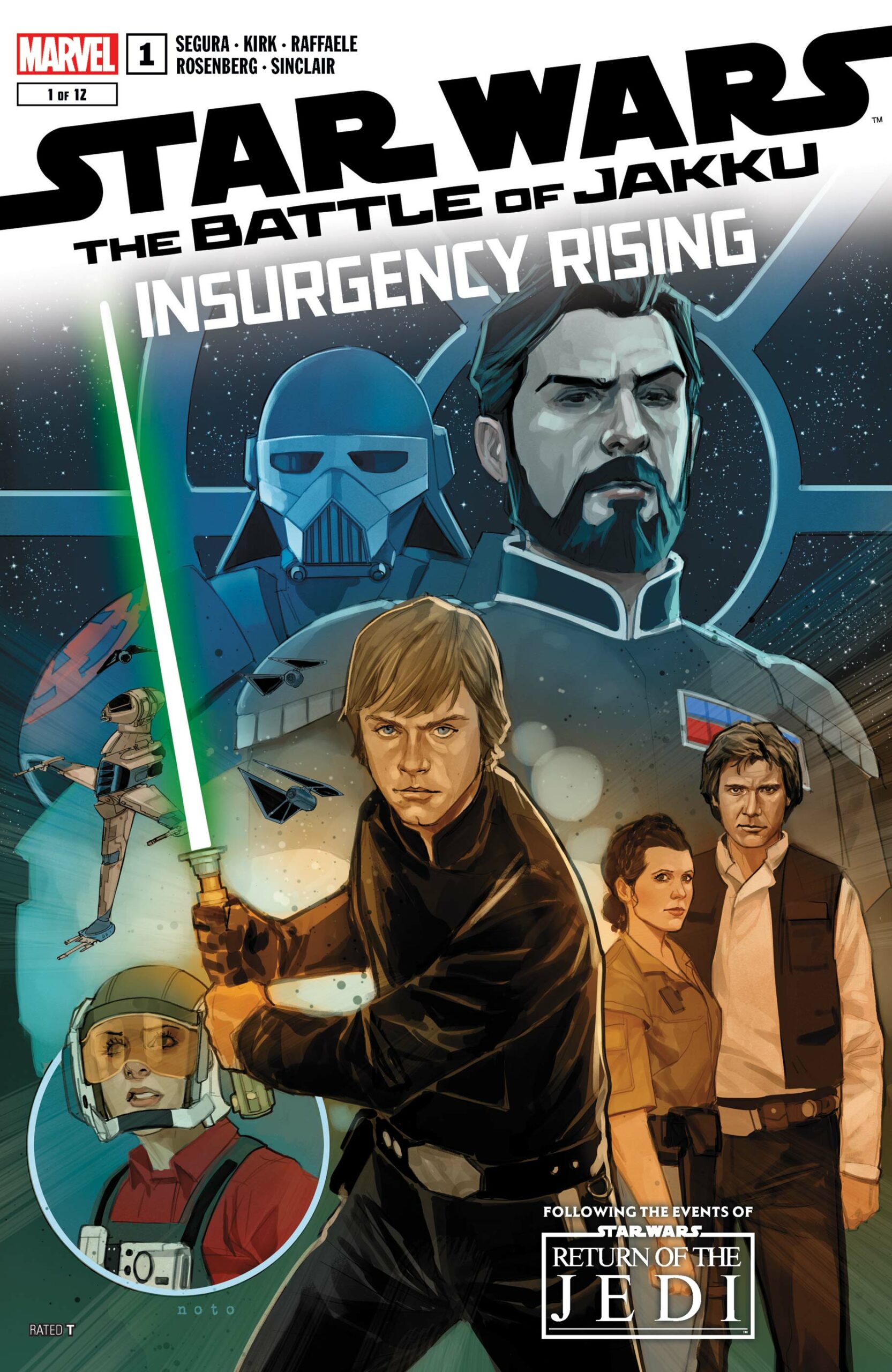
It’s The Villains Show For Now– Reviewing ‘Star Wars: The Battle Of Jakku – Insurgency Rising #1’
by Austin Gorton
Overview
Star Wars: The Battle of Jakku – Insurgency Rising #1 isn’t a bad comic, but its focus on establishing the villains within the confines of its titular plot hold it back from being a satisfying kickoff to a new era of Star Wars comics.
Overall
5/10Since reacquiring the license for Star Wars comic books back in 2015, Marvel has mostly shied away from telling stories set in the era of the Sequel Trilogy. Stuff like a Force Awakens tie-in miniseries (2015’s Shattered Empire), the Poe Dameron-focused series, and The Rise of Kylo Ren aside, Marvel has mostly stuck to the Original and Prequel Eras (as well as the originating-in-print High Republic Era). That changes with Star Wars: The Battle of Jakku – Insurgency Rising #1 (try saying that ten times fast), the first issue of a multi-series initiative to chronicle the last battle of the Galactic Civil War between the Empire and the Rebel Alliance.
Having wrapped up the latest iteration of its ongoing Star Wars series, the line is moving firmly into the post-Return of the Jedi era for the first time. But as the title suggests, this first issue of this new “micro era” of Marvel Star Wars comics is, for now, focused specifically on setting up the events of a specific point in that history, for good and for bad.

While this is the first concerted effort to dive into this time period via comics, the post-Jedi setting isn’t a complete narrative wasteland. The Aftermath trilogy of novels by Chuck Wendig have already provided a rough outline of events leading up to and including the Battle of Jakku. The Mandalorian television series, while set after the battle, has offered up narrative details both directly and obliquely. And the Star Wars Uprising mobile game introduced two characters whom writer Alex Segura and artist Luke Ross have plucked from phones to seemingly serve as the main villains of this story: Moff Adelhard and the Vader-esque Commander Bragh.
On the one hand, this limits the risk that this chunk of narrative history will spiral out of control with dozens and dozens of “minor” villains (a problem that came to afflict the old post-Jedi Expanded Universe), and both Adlehard and Bragh are relatively deep cuts (Yupe Tashu, arguably the closest thing to an arch villain of the Aftermath trilogy, also appears briefly in Insurgency Rising #1, so Segura & Ross have clearly done their homework). On the other hand, it risks preventing this series from standing on its own and reading more like a dramatized Wiki than a proper story.
That’s not the case yet — plenty of time is spent here introducing Adlehard and Bragh to readers via a new POV Imperial character, Lieutenant Alaytia, rather than assuming familiarity. But it does result in the issue feeling particularly Imperial-heavy; helped by a backup story that fleshes out Adelhard’s backstory (by Segura with art from Stefano Raffaele). More pages are spent on Adelhard and his associates than with Luke, Leia, Han, Lando and the like.

Which is a shame, because the best material in the issue involves the Rebels. Leia visiting the site of Vader’s funeral pyre the morning after the Rebel’s OT-ending party with the Ewoks is the kind of moment you want in a series like this. Watching her begin to grapple with the legacy of her newly-discovered biological family and acknowledging that forgiveness naturally comes easier to Luke than to her is something that would have been great to see on film, but for which there simply wasn’t room.
So, in steps, the continuing adventures of the Star Warriors in comic book form picks up the slack! Combined with the visual of Vader’s twisted, melted helmet that Leia’s son will later lionize, thereby visually connecting the two eras, it’s the kind of thing that makes the issue feel the most like the continuation of Marvel’s Star Wars narrative it’s ostensibly meant to be.

Unfortunately, the Leia/Luke material in Insurgency Rising #1 is limited. As the title suggests, the vast majority of the issue is devoted to set-up, either in terms of plot (establishing the notion of the Imperial Remnant and the continuation of the war despite the death of the Emperor in Jedi) or its technically-not-new-but-mostly-unknown antagonists. That’s necessary work, but it’s not exactly the most engaging of work. Especially when it seems to be more in service of a specific plotline rather than setting up a whole new era of comic book storytelling.
